
Jaipur gives a food brand something most cities cannot: metro-scale footfall on a tier-2 cost base. The state economy behind it is projected to grow 16.7% in nominal terms this year. Rajasthan also draws 17.9 crore domestic visitors a year, and Jaipur sits at the head of that circuit.
What decides whether that works for you is which side of the equation you are buying. Rent, staff and licence costs sit at tier-2 levels. Demand does not.
This post sets out the numbers behind the Jaipur case. It also covers where the gaps still are, and how to judge the opportunity before you sign anything.
Key Takeaways
- Almost half of Rajasthan’s economy is services. That is the share which predicts eating out, not the population count.
- Metro prime rent crosses ₹1,800 per sq ft. Tier-2 runs at a tenth. On 1,200 sq ft that gap beats most wage bills.
- 94% of operators want tier-2, but only 24% run full systems. Your competition is not measuring itself.
What Makes Jaipur a Food Business Opportunity in 2026?
Food business and F&B mean the same thing here. Three things decide any entry into it: the size of the economy, the demand walking past the door, and what it costs to open. Jaipur is unusual because all three point the same way at once. That is what makes it an opportunity rather than just a cheaper city.
Most tier-2 markets ask you to trade demand for cost. You get cheaper rent. You also get a smaller catchment and a quieter Tuesday.
Jaipur is one of the few places where that trade does not apply. The tourist economy keeps the catchment large even when the local one is slow.
The next three sections are the evidence for that shape.
How Big Is the Market Behind Jaipur?
Large enough to matter, and growing in double digits. This section sets out the size, the growth and the shape, because a city’s F&B market is funded by the economy around it.
The state GSDP for 2025-26 is projected at ₹19,89,000 crore at current prices, a rise of 16.7% over the previous year. Per capita GSDP reached ₹1,87,454 in 2023-24, up 11.4% in a single year.
The shape matters as much as the size. Agriculture and manufacturing each account for 27% of the economy, and services account for 46%. A services-led state is one where people eat out, because eating out is a services habit before it is a food habit.
| What it measures | Rajasthan’s figure | Year |
|---|---|---|
| Gross State Domestic Product | ₹19,89,000 crore, up 16.7% | 2025-26, projected |
| Per capita GSDP | ₹1,87,454, up 11.4% | 2023-24 |
| Services share of the economy | 46% | 2024-25 |
| Agriculture share | 27% | 2024-25 |
| Manufacturing share | 27% | 2024-25 |
Numbers at current prices, from the PRS India analysis of the state budget.
What Do Rajasthan’s 17.9 Crore Visitors Do to Jaipur F&B Demand?
Tourism is the part of the Jaipur case no spreadsheet model captures properly. It is worth setting out plainly. The state government’s own figures put tourism at 12% of Rajasthan’s GDP. The state drew 179 million domestic and 1.7 million international visitors in FY 2023.
For a food business that changes three things.
- The catchment is not the population. A 5 km radius in most tier-2 cities tells you who your customers are. In a tourist city it tells you only the part that lives there.
- The weekly pattern flattens. Grant Thornton Bharat found that operators outside the metros can see up to 60% of revenue land on weekends. A visitor economy does not keep office hours, so a Jaipur outlet in the right location fills midweek too.
- The seasons are visible and plannable. Tourist arrivals move with a calendar you can read a year ahead. Local demand does not give you that.
The catch is that tourist footfall is location-specific in a way local demand is not. A site two streets off the route is a different business from one on it.
Why Does the Cost Side Favour Jaipur Over a Metro?
Here is where the case becomes concrete. The single biggest fixed cost in a food business is rent. The gap between a metro and a tier-2 market is not small.
Grant Thornton Bharat puts commercial leases in metro prime zones at often crossing ₹1,800 per sq ft. Tier-2 markets typically run at about a tenth of that rate.
Put a real floor plate against those rates. A 1,200 sq ft café in a metro prime zone at ₹1,800 per sq ft pays ₹21,60,000 a month in rent.
The same 1,200 sq ft in a tier-2 market at a tenth of the rate pays ₹2,16,000. That is ₹19,44,000 a month, every month, before a single dish is sold (an example).
That difference is not a discount, it is a different business model. It is the gap between needing a metro price point to survive and being able to price for a local one. Most brands that fail in tier-2 fail because they carried the metro price point with them.
Petpooja is India’s biggest and most price effective restaurant POS, behind the success of 1,00,000+ outlets. Sixty lakh bills run through it every day at 0% processing errors, across 14+ years in the Indian market.
Where Does the Jaipur F&B Market Still Have Gaps?
A market with no gaps is a market you are too late for. So this section is the good news, not the bad. Three gaps show up in the published data.
The Systems Gap is the Widest
Grant Thornton Bharat surveyed more than 160 operators across 50-plus cities. Only 24% had implemented full operational systems, meaning POS, ERP, CRM and kitchen automation together.
Three out of four are running on partial setups. So a brand that arrives with its billing, stock and reporting already joined up in one restaurant POS starts ahead. Most of the floor it competes with does not have that.
The Staffing Gap is Not About Wages
In the same survey, 61% reported shortages in both kitchen and service staff. A brand arriving with training built into the format has an advantage over one that expects to hire experience locally.
Whole Categories are Still Thin
At the F&B franchise event running in Jaipur this October, the brands confirmed so far sit in four categories: QSR, ice cream, desserts, and café and tea. Bakery, cloud kitchen and fine dine have not filled up. That is a live signal about which formats are under-served in the region.
My read on the 24% figure. It is the most useful number in that whole survey, and not for the reason it looks like. It says the competition you will face in a tier-2 market is mostly not measuring itself. A brand that reads its food cost ratio every week is not competing on equal terms. The one that finds out at the end of the quarter is already behind.
Three Ways Into the Jaipur F&B Market
Search for a food business opportunity in Jaipur and most of what comes back is listings. Outlets for sale, stakes on offer, franchise adverts. That tells you something useful, which is that the real question is not whether to enter but which way in.
| Route in | What you are buying | What it asks of you |
|---|---|---|
| Start your own outlet | Full control of the format, the menu and the margin | You build the brand, the supply chain and the training from nothing |
| Buy a running outlet | A trading business with staff, licences and a customer base already in place | You inherit its lease, its reputation and whatever its books do not show |
| Take a franchise | A proven format, a supply chain and a training plan | You follow someone else’s system and pay for it |
None of the three is the right answer on its own. Two things decide it. How much of the format you want to own, and how much of the first year you can afford to spend learning.
How to Judge the Jaipur Food Business Opportunity
Reading a market case is not the same as testing it against your own numbers. This section is the practical half. Four checks, in the order they matter.
- Price the site, not the city. Tier-2 average rent is useless to you. Get the quote for the specific address, then work out what daily cover count it needs at your average bill value.
- Decide whether you are buying footfall or a catchment. A tourist-route site and a residential-catchment site in the same city are two different businesses with two different menus. Pick one deliberately.
- Work out your own franchise entry cost. Our restaurant franchise cost calculator runs the fee, the fit-out and the working capital together, which is where most first-time investors under-budget.
- Ask what the brand hands over. A format that transfers is a manual, a supply chain and a training plan. Our franchise operations manual template is the shape that document should take. If a brand cannot produce one, you are buying a recipe, not a system.
The decision runs differently from the other side. If you are thinking of taking your own brand into the region, the calculation is not the same one. That case is set out in our guide on exhibiting at a franchise expo.
Attend One Weekend to Learn How to Grow a Food Business in Jaipur
The fastest way to learn how a restaurant grows in Jaipur is to spend a weekend with the people doing it. Everything above is a market case built from published figures. What those figures cannot tell you is what the brands themselves are offering.
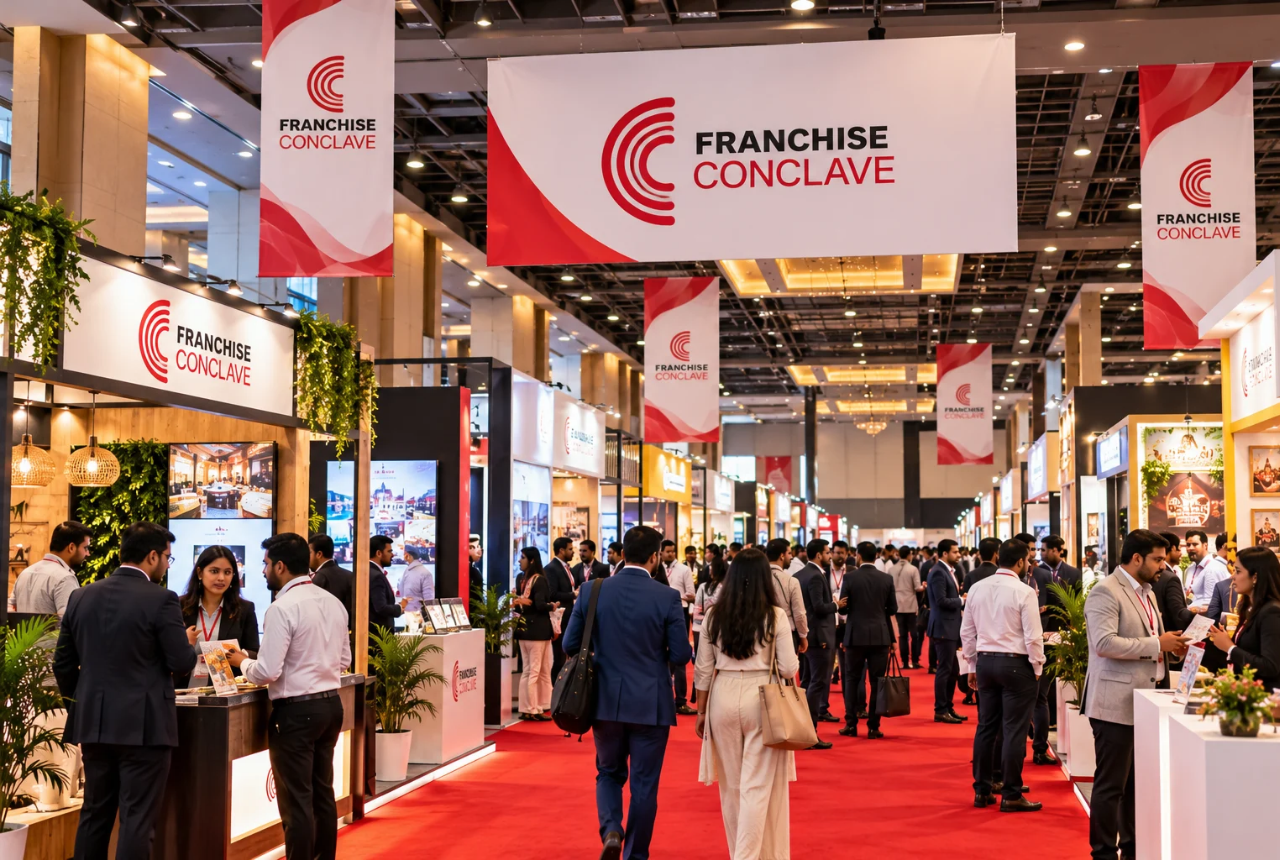
Franchise Conclave Jaipur runs on 3 and 4 October 2026 at the Rajasthan International Centre on JLN Marg, Jhalana Doongri. It is Rajasthan’s first dedicated F&B franchise forum. 40+ curated stalls, eight categories, and 4,000+ expected visitors who registered as franchise seekers rather than walking in off the street.
The format is worth knowing before you go. There is no stage, no MC and no panel programme, so the floor is the whole event. B2B matchmaking runs on both afternoons, and Sunday carries live demos from midday.
What to do with the two days, and what to ask at each type of stall, is covered in our franchise investor guide.
Conclusion
Jaipur’s case comes down to one thing. You get the demand of a much larger city on the cost base of a smaller one, inside a state economy that is growing quickly.
The first thing to do is price a specific site rather than the city, and work out the cover count it needs. That single calculation settles more than any market report will.
If the opportunity looks right, the next step is meeting the brands in person. That is what the first weekend of October in Jaipur is for.
And if you do take a site in Jaipur, the cost advantage has to survive the first season. It only does if you can see your numbers weekly. That is the job a restaurant POS does.
Frequently Asked Questions
It depends on what your format needs. Jaipur gives you a lower rent line and a visitor economy that fills midweek. A metro gives you a higher average bill value and a denser delivery radius. If your model needs volume at a modest price point, tier-2 is the easier cost base to survive in.
It softens, it does not vanish, and the calendar is predictable enough to plan staffing around. The bigger risk is not seasonality but siting: a location that depends entirely on visitor routes has no floor under it when arrivals dip.
There is no fixed number, and anyone quoting one is guessing. The real test is whether the format transfers. That means documented recipes, a supply chain that reaches the city, and unit economics that hold without the founder in the kitchen.
The same national set as anywhere in India, starting with an FSSAI registration or licence depending on turnover, plus state and municipal approvals. Our food safety checklist covers what an inspection actually looks for.
It is, and the cost base is what makes it realistic. What changes at outlet two is that you stop managing by presence and start managing by report. Most owners describe that as the hardest part. Multi-outlet management covers what changes.








