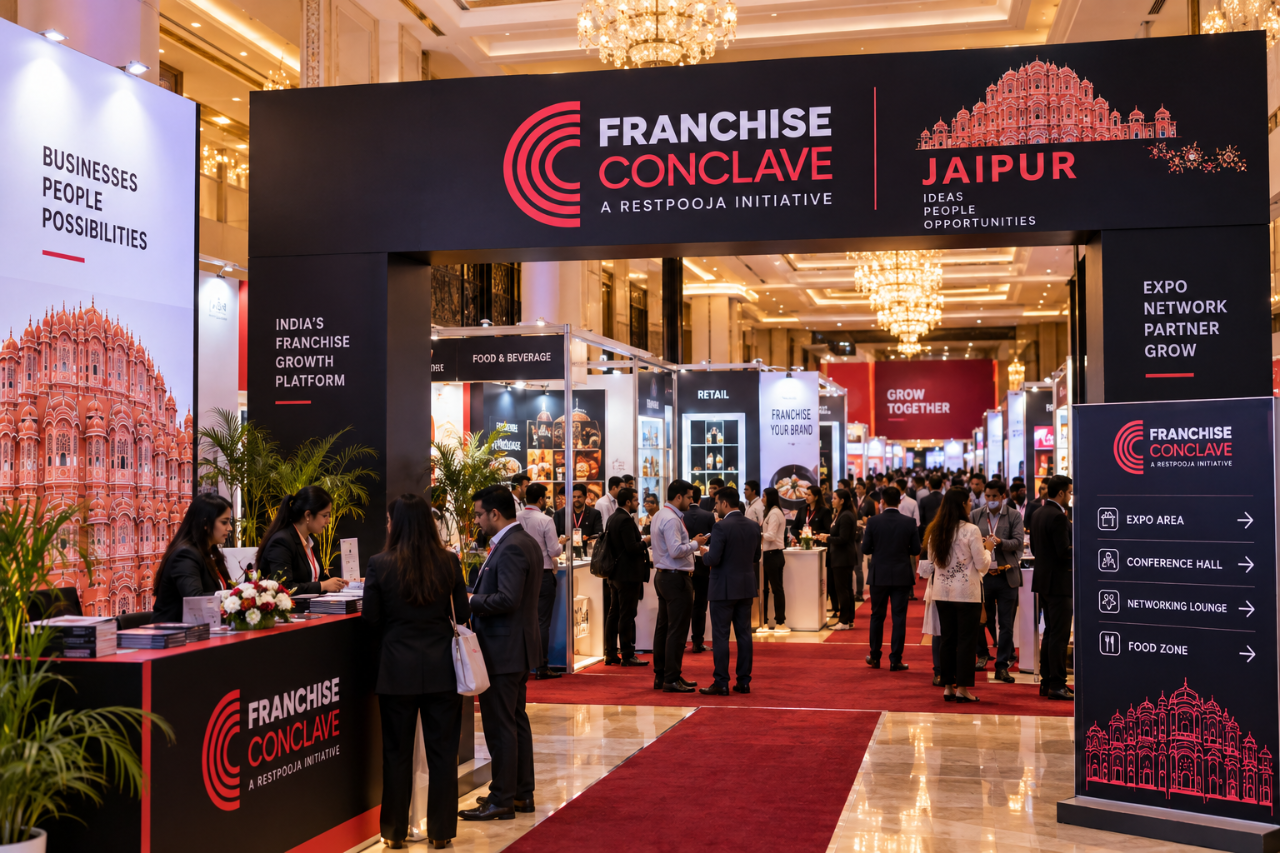
A stall at Franchise Conclave Jaipur is worth it when your brand is ready to sign partners and the floor is filled with people who came to buy one. It is not worth it when either half of that is missing.
Most brands get the first half right and never check the second. They book a stall at a large expo and spend two days explaining what a cloud kitchen is to people who came for a solar panel. The weekend then gets counted as a marketing spend rather than a failure.
This post covers what a stall actually gets you, how to read a floor before you commit, and what to have ready on the day.
Key Takeaways
- A stall earns its cost only if the floor is filled with your buyer
- Ask the organiser for the visitor filter, not the visitor count
- An all-F&B floor with pre-registered visitors, so you explain less and sell more
- Have your unit economics on one page before you book
- Setup and teardown days are your cost too, so plan for them
What Does a Franchise Conclave Jaipur Stall Get You?
A stall buys you two days of face time with people who are already looking to buy a franchise. This section covers what that converts into, and what it does not.
The realistic outputs are signed MOUs on the spot, a qualified pipeline for the following quarter, and brand visibility across a region you have not entered yet. A tasting counter does work a brochure cannot, because an F&B franchise decision usually runs through the food.
Our investor guide sets out what the people at your stall will be asking.
What a stall does not buy is demand that was never there. If nobody in that city is looking to invest in your category, the floor cannot manufacture it.
The honest test is whether you could name the buyer before you booked. A brand entering Rajasthan with 10 outlets in Gujarat can name them. A brand with two outlets and no operations manual cannot, and should spend the money on the manual first.
When Is Franchise Conclave Jaipur Worth a Stall?
Four conditions make a stall pay, and they are all about readiness rather than budget. This section covers each one, with the failure it prevents.
You Can Hand Over a Working System, Not Just a Recipe
A franchisee is buying a repeatable operation. If your second outlet still depends on you being in it, you are selling a job rather than a franchise. The Wow! Momo scaling story is a useful read on what that system has to cover.
Your Unit Economics Fit on One Page
Investors at a franchise floor want three numbers inside the first two minutes. What it costs to open, how long it takes to pay back, and what it costs to run each month. A brand that has to go and check loses the conversation.
Have the food cost ratio on the same page. It is the number an experienced operator reaches for first, because it tells them whether the model survives a slow month.
You are Entering a Region, Not a Single City
One expo in a state capital can open a market that takes eight separate city visits otherwise. That maths only works if you intend to sign in more than one city, which is the case our Gujarat franchise post makes for a neighbouring state.
You Have Someone Who Can Close
Sending the marketing executive alone is the most common mistake. The person on the stall needs authority to talk terms, or every good conversation turns into a follow-up that never happens.
When Is a Stall Not Worth Booking?
Three situations turn a stall into a marketing expense with nothing behind it. This section covers them plainly, because the money is better spent elsewhere in each.
The first is a brand still fixing its own operations. Franchise partners magnify whatever your system already does, including the parts that break. A restaurant expansion checklist is the cheaper thing to work through first.
The second is a multi-sector expo where F&B is one hall of nine. Your stall competes with sectors that have nothing to do with you, and the visitor walking past came for something else entirely.
The third is an expo where the organiser cannot tell you who is coming. If the answer to “who are your visitors” is a headline footfall number, the number is the product and you are the customer.
How Do You Read an Expo Floor Plan Before You Book?
Six checks separate a floor worth paying for from one that is merely large. This section runs through them in the order they matter.
| What to check | Why it decides the outcome |
|---|---|
| Visitor filter | Pre-registered and verified beats a walk-in gate every time |
| Sector mix | A single-sector floor puts every visitor in your category |
| Stall count | A smaller curated floor gives each brand more of the room |
| Your stall position | Corner and aisle-end stalls see more of the traffic |
| Programme | A stage running sessions pulls people off the floor |
| Selling rules | Know where sampling ends and selling begins |
The programme line is the one brands under-weigh. At an expo with a full panel agenda, your stall is empty for the hours the room is in a session, and you paid for those hours too.
Ask the organiser for the visitor registration criteria in writing. A floor that verifies its investors is doing the filtering you would otherwise do at your own stall.
Shell Space or Bare Space?
Most organisers offer two ways to take a stall, and the right one depends on how often you exhibit. The difference is what is standing on your 9 sqm when you walk in.
Here is what each one gives you.
Shell space arrives built. You get the stall structure, a name fascia, spot lights, a table and chairs, so you turn up with your branding and your samples and nothing else.
Bare space is raw floor. You construct your own stall, which gives full control of the design and suits a brand that already owns a reusable build.
A brand exhibiting once or twice a year is usually better off with shell space. The build cost of a custom stall only amortises if you take it somewhere else afterwards.
What Should You Have Ready on the Day?
A stall converts on preparation rather than on decoration, and most of it fits in a folder. Here is the list worth packing.
- A one-page unit economics sheet: setup cost, payback period, monthly running cost
- Your franchise agreement outline, so terms can be discussed rather than promised
- Photographs of a real outlet, not renders
- Something to taste, prepared for two days of service
- A way to capture leads that is not a paper notebook, because multi-outlet reporting starts with clean data
- Someone on the stall with authority to talk numbers
Restaurant owners using Petpooja tell us the question that stops a conversation at the stall is rarely about the food. It is the one about what the franchisee sees in their reports, and how the brand sees it too.
What Happens at Franchise Conclave Jaipur?
Franchise Conclave Jaipur is a worked example of the single-sector floor described above, and it runs on 3 and 4 October 2026. This section covers how it is set up for exhibitors, and the Jaipur event page carries the visitor side.
The floor is laid out as 53 stalls, all 3 by 3 metres, split into 12 premium corner positions and 41 inline stalls. The organiser expects 35 to 40 brands to take them, so some will hold more than one stall.
Every brand on the floor is food and beverage, across eight categories from QSR and cafés to cloud kitchens, bakery and ice cream.
There is no stage, no MC and no panel programme. Every hour of the two days is exhibition time, so your stall is never competing with a session for the room.
Visitors are pre-registered franchise seekers rather than general admission, with 4,000+ expected. The first edition in Ahmedabad in June 2026 drew 9,000+ investors and generated 10,000+ leads.
The one selling zone is the food court at the far end of the hall. Everywhere else, a tasting is a tasting and the conversation is about a franchise.
Stall enquiries and the current rate card go through Hardik Gandhi at hardik.gandhi@petpooja.com or on +91 63588 70736. The visitor side and the venue details sit on franchiseconclave.com.
Petpooja is the restaurant POS behind 1,00,000+ restaurant outlets in India. Multi-outlet reporting rolls every franchise outlet into one view, which is the answer to the question investors ask at the stall.
Conclusion
Exhibiting is worth it when your brand can hand over a working system and the floor is filled with people who came to buy one. Both halves have to be true.
Check the visitor filter before the visitor count, the sector mix before the hall size, and the programme before the stall price. A smaller single-sector floor with verified investors beats a larger one where your category is a corridor.
If you are ready, the preparation matters more than the stall design. Get the unit economics on one page and put someone on the stall who can close. Make sure the operating system behind the brand is something you can show rather than describe.
Frequently Asked Questions
Early enough to pick your position on the floor plan, because corner and aisle-end stalls go first and they see the most traffic. At Franchise Conclave Jaipur, priority stall location closes once public registrations open.
They do different jobs. Digital generates volume you then have to qualify, while a curated expo floor hands you qualified conversations but only for two days. Most brands signing partners run both.
Shell space comes built, with a stall structure, name fascia, lights, a table and chairs. Bare space is raw floor that you construct on. Shell suits brands exhibiting once or twice a year.
At Franchise Conclave Jaipur, selling is permitted only in the food court at the far end of the hall. Tastings and demos run at the stalls, but the transaction happens in one zone.
Rates depend on the stall tier and whether you take shell or bare space. Contact Hardik Gandhi at hardik.gandhi@petpooja.com for the current rate card, as pricing can change before the floor closes.