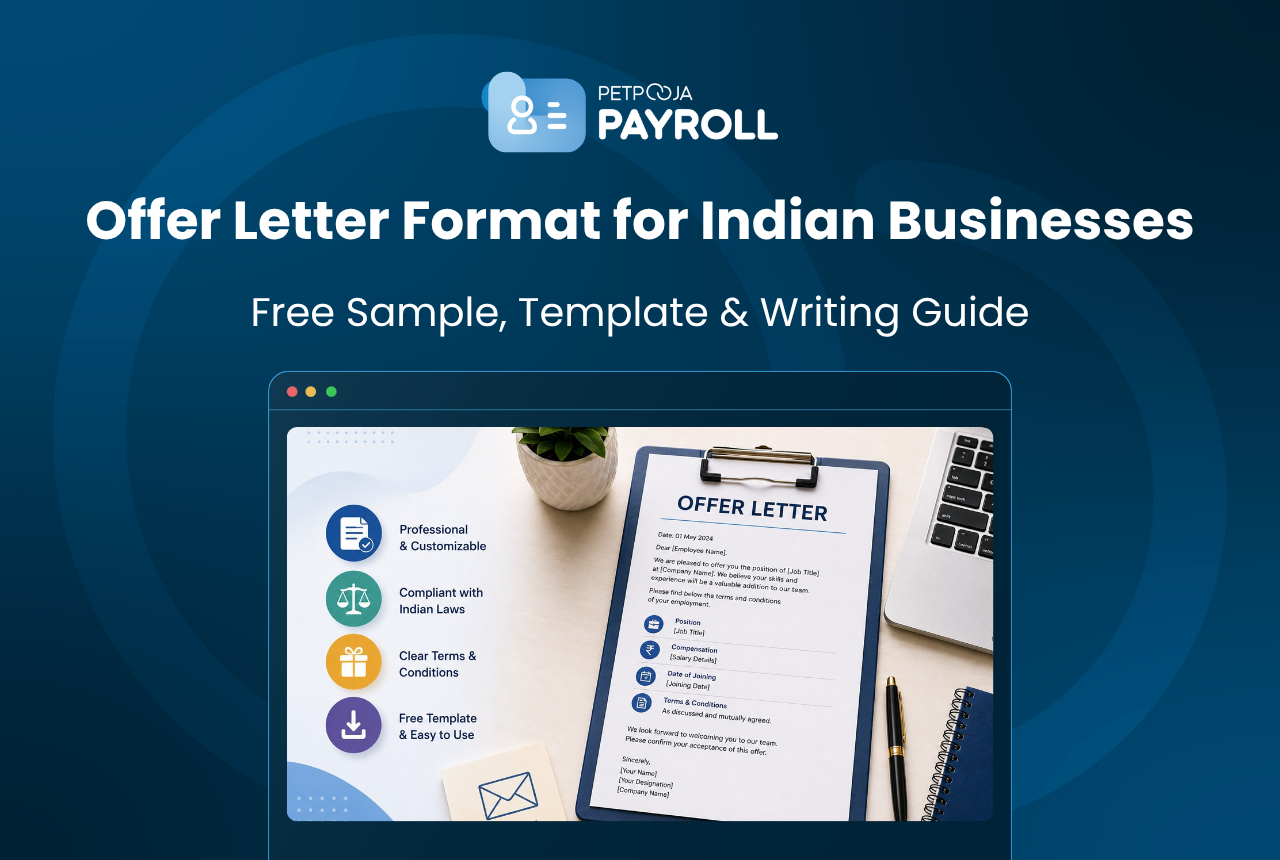
Seven things belong in every offer letter: The candidate’s name, job title, reporting manager, CTC with a component-wise breakup, joining date, work location, and notice period. Leave out any one of these and you are handing a new hire a document that will either confuse them on the first morning or fall apart the day a labour dispute reaches a district court.
Written appointment letters became mandatory for every worker in India on 21 November 2025, the date the Industrial Relations Code, 2020 came into force. An EY analysis of the new labour codes confirmed that this applies across all sectors and establishment sizes. The offer letter is a separate, earlier document, but it is the first thing a candidate signs. What it says shapes every expectation that follows.
Key Takeaways
- Every offer letter needs seven fields: job title, CTC breakup, joining date, work location, reporting manager, notice period, and PF/ESI applicability.
- The Industrial Relations Code, 2020 (effective 21 November 2025) requires written appointment letters for all workers in all sectors.
- A signed offer letter is a binding contract under the Indian Contract Act, 1872.
- “At-will” clauses lifted from American templates hold zero legal weight in Indian employment law.
What Goes into a Proper Offer Letter?
Keep it to one or two pages. The appointment letter handles the rest. Each field below pulls its weight for a different reason, and skipping even one opens a gap that shows up weeks or months after the hire.
Job title and department. A 40-person pharma distributor in Vashi issued an offer letter that read “Executive” with no department name. Two months in, the employee was asked to shift from warehouse ops to field sales and pushed back, pointing at the letter. Write “Warehouse Operations Executive, Logistics” and the problem disappears before it starts. The job title also feeds into PF filings and Form 16, so whatever you write here will follow the employee through tax season.
Reporting manager. Name and designation, both. We have had clients where a joinee walked in on Day 1 and spent half the morning figuring out who they report to because the offer letter said nothing.
CTC and salary breakup. This is where most arguments begin. The candidate hears “six lakhs” and assumes that is what lands in the bank. It is not. Break the number down: basic salary, HRA, special allowance, employer PF at 12 percent, variable pay. Run it through the free CTC calculator before printing the letter. If PF and ESI apply to your establishment, state it on the letter. A missing PF line leaves it unclear whether the employer’s 12 percent sits inside CTC or on top of it, and that ambiguity is the fastest route to a salary dispute in the first pay cycle.
Joining date and work location. Pin both down to the specific branch. “Our Ahmedabad office” is not enough when the company runs outlets in both Vastrapur and Maninagar. Write the full address.
Notice period. Cover both stages. For example, a typical clause reads: “During probation: 15 days. Post-confirmation: 60 days. Either party may terminate by serving the applicable notice or paying salary in lieu.” Without this line, every resignation turns into a negotiation.
Probation duration. Three months? Six? Does confirmation happen on its own or need a written letter from the manager? Spell it out. If the letter stays silent, the employee has grounds to claim they were confirmed from Day 1, which changes termination protections entirely.
Conditions. Background verification, medical fitness, original document submission, NDA signing. One line per condition is enough.
How Is It Different from an Appointment Letter?
HR teams at smaller firms treat the two as interchangeable. They are not, and collapsing them into one document causes trouble during exits.
| Offer letter | Appointment letter | |
|---|---|---|
| When issued | After selection, before joining | On or after the joining date |
| Length | 1-2 pages | 4-10 pages |
| Legal weight | Binding once both parties sign | Full employment contract |
| What it covers | CTC, title, location, notice period | IP rights, leave policy, confidentiality, termination grounds, code of conduct |
| Withdrawal | Possible before candidate signs; risky after | Only through termination process |
The offer letter is the handshake. The appointment letter is the legal marriage. Under the Indian Contract Act, 1872, a signed offer letter counts as a valid contract. But it rarely has enough detail to resolve a dispute about leave entitlement or intellectual property.
Across 30,000-plus Attendo clients, we see businesses with fewer than 50 employees skip the appointment letter entirely. The offer letter carries all the weight until a dispute surfaces and it turns out the document is too thin to settle anything.
Does a Signed Offer Letter Hold Up in Court?
Yes. The Indian Contract Act, 1872 treats a signed offer letter as an enforceable agreement. More than one High Court ruling has awarded damages where employers pulled back signed offers without valid grounds.
Unsigned letters are a different matter. If only the employer has signed, the document is an invitation to treat. Intent without obligation. The binding force kicks in the moment the candidate signs and returns the letter.
“At-will” clauses do not work here. A diagnostic lab chain in Thane copied an American template that read “employment is at-will and either party may terminate at any time without cause.” Indian labour law does not recognise at-will employment. Termination after confirmation requires a notice period or salary in lieu. That clause was dead on arrival, and it told the three candidates who actually read the letter that the company had not bothered adapting its paperwork to Indian law.
Non-compete clauses after exit are unenforceable. Section 27 of the Indian Contract Act voids post-employment non-compete restrictions, and courts strike them down with near-perfect consistency. A non-solicitation clause (preventing the departing employee from approaching specific clients or poaching team members for six to twelve months) has a marginally better chance. A blanket “cannot join any competitor” clause will not survive a legal challenge.
What Does a Sample Offer Letter Look Like?
Below is an example template. This is a simplified starting point, not a substitute for legal review. Adapt the fields to your business.
[Company Name] | [Company Address]
Date: [DD/MM/YYYY]
To: [Candidate Full Name] Subject: Offer of Employment
Dear [First Name],
We are pleased to offer you the position of [Job Title] in the [Department] at [Work Location]. You will report to [Manager Name], [Manager Designation].
Compensation:
| Component | Monthly (Rs) | Annual (Rs) |
|---|---|---|
| Basic Salary | [amount] | [amount] |
| HRA | [amount] | [amount] |
| Special Allowance | [amount] | [amount] |
| Employer PF (12%) | [amount] | [amount] |
| Total CTC | [amount] | [amount] |
For a detailed breakup of how gross salary, deductions, and take-home connect to CTC, refer to our salary structure guide.
Joining Date: [DD/MM/YYYY] Probation: [X] months. Confirmation subject to performance review. Notice Period: 15 days during probation. 60 days post-confirmation.
Conditions:
- Completion of background verification
- Submission of original documents for verification on the joining date
- Medical fitness (if applicable)
This offer is valid until [expiry date]. Please sign and return a copy to confirm acceptance.
Yours sincerely, [Authorised Signatory Name] [Designation] | [Company Name]
Candidate Acceptance: I accept this offer and agree to the terms stated above.
Signature: _____________ Date: _____________
Which Mistakes Cost Indian Employers the Most?
We have reviewed offer letters from a 12-person CA firm in Andheri to a 90-person packaging unit in Pimpri-Chinchwad. Six errors repeat across nearly all of them.
- CTC with no breakup. A garment showroom in Bopal offered a floor manager “Rs 3,60,000 per annum.” The manager assumed Rs 30,000 would land in his account every month. After EPF, ESI, and professional tax deductions, the first payslip showed Rs 24,800. He resigned within six weeks. Had the offer letter included a component table, there would have been no surprise.
- Silent on PF and ESI. Any business with 20-plus employees falls under the EPF Act. Ten-plus employees in notified states triggers ESI. Our guide to 2026 payroll tax changes covers the latest thresholds in detail. If the offer letter does not mention either, the employee has no way of knowing that Rs 1,800 will vanish from each payslip. This silence is the most common trigger for salary complaints in the first month.
- American templates used as-is. At-will employment, two-year non-competes, references to “COBRA benefits” and “401(k)” plans. These phrases show up in Indian offer letters far more than they should. They carry zero legal weight and signal to any careful reader that the company did not bother localising its documents.
- No probation clause. Without written probation terms, the employee can argue they hold full confirmation rights from their start date. That argument has won in labour court more than once.
- Missing expiry date. A fintech startup in Whitefield issued an offer in January 2026 with no acceptance deadline. The candidate sat on it until April, negotiated a counter-offer elsewhere, and came back holding the original letter as a fallback. An expiry date of seven to ten working days would have closed that window.
- Vague work location. Naming the city without the branch is trouble waiting to happen. A candidate offered “Pune office” showed up at Hinjewadi; the company assigned them to Kothrud, fourteen kilometres away. The commute difference was forty minutes each way.
Conclusion
An offer letter is the first binding document between a business and a new employee. Under the new labour codes effective since November 2025, written employment paperwork is a legal requirement for every worker in India, regardless of company size or sector. The format matters: job title, CTC breakup, joining date, work location, notice period, PF/ESI applicability, and probation terms all belong in the letter.
If your HR team still builds offer letters from a blank document for every hire, Attendo (formerly Petpooja Payroll) keeps salary structures, employee records, and compliance filing on one dashboard. The numbers in your offer letter match your payroll register from Day 1.
Frequently Asked Questions
No specific statute mandates the offer letter by name. But the Industrial Relations Code, 2020 (effective November 2025) requires a written appointment letter for every worker. Most businesses issue an offer letter first, then follow up with the full appointment letter on or before the joining date.
Pulling back a signed offer exposes the employer to a damages claim under the Indian Contract Act, 1872. High Court judgments have ruled in favour of candidates whose accepted offers were withdrawn without valid cause. Once signed by both parties, treat it as done.
CTC bundles employer PF, ESI, gratuity, and other costs that never reach the employee’s bank account. In-hand salary is what lands after every deduction. The gap ranges from 15 to 30 percent depending on the salary bracket. Use the CTC salary structure calculator template to map the exact difference at any salary level.
Always. Cover both probation and post-confirmation periods. Without it, every resignation becomes a back-and-forth. A common structure: 15 days during probation, 30 to 60 days after confirmation, with salary in lieu as the alternative.
You can write it in. Indian courts will take it out. Section 27 of the Indian Contract Act voids post-employment non-compete restrictions, and judges strike them down almost without exception. A narrower non-solicitation clause, where the departing employee agrees not to approach named clients or recruit former colleagues for six to twelve months, has a slightly better shot at holding up.