


- KRA defines responsibility zones; KPI attaches a measurable number to each zone
- Only 36% of Indian employees found their appraisal process effective (The Federal, 2025)
- A KRA-KPI sheet reviewed monthly works better than annual reviews for teams under 200
- OKRs serve a different purpose; most SMBs need KPIs first
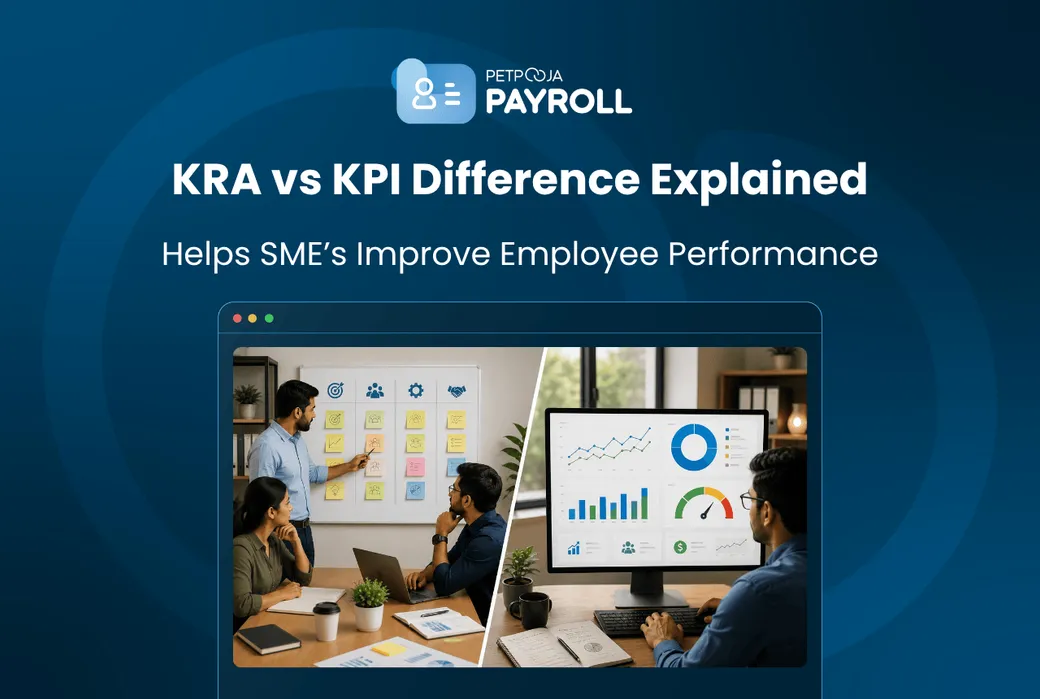
KRA (Key Result Area) defines the broad outcome zone a role exists to serve. KPI (Key Performance Indicator) is the measurable metric that tracks performance within that KRA. A KRA tells an employee which part of their job carries the most weight, and a KPI puts a number on whether they’re doing that part well or badly.
A garment showroom in Surat with 14 staff doesn’t fail because people are lazy. It fails because nobody wrote down what “doing your job well” looks like beyond week one. The store manager thinks her KRA is sales. The owner thinks it’s inventory control. Because nobody agreed upfront, the appraisal conversation in March turns into an argument about expectations that were never set.
What does KRA actually mean?
A Key Result Area (KRA) marks the broad outcome zone a role exists to serve. It is not a daily task but the result the company depends on from that position. Most roles need three to five KRAs, defined at hiring and reviewed during appraisals. KRA as a concept has stayed relevant since Peter Drucker built management by objectives around it in the 1950s.
Here’s a question that cuts through the jargon: ask any employee, “If you disappeared for two weeks and nobody covered for you, what three things would fall apart?” Whatever they name, those are likely their KRAs. For example, a production supervisor at an auto parts factory in Chakan, Pune might say output volume would drop, rejection rates would spike, and the maintenance schedule would slip. Three answers map directly to three KRAs.
You can’t measure someone if you haven’t first agreed on what their job is supposed to produce. Across 30,000+ Attendo clients at Petpooja, we’ve noticed that businesses writing KRAs into the appointment letter see fewer “but I didn’t know that was my job” arguments during appraisal month, because both sides agreed on expectations before the first salary was credited. Fifteen minutes per hire buys you twelve months of clarity.
What is a KPI and how does it connect to a KRA?
A Key Performance Indicator (KPI) is a measurable metric bolted onto a specific KRA. Without KPIs, a KRA remains a vague sentence on a job description that nobody revisits after the offer letter gets signed. Each KRA should have two to three KPIs with numeric targets that the employee and manager agree on together.
For example, take a delivery fleet supervisor at a logistics firm in Hyderabad. “On-time delivery” is a KPI. But what counts as on-time? The KPI pins it down:
| KRA | KPI | Target |
|---|---|---|
| On-time delivery | % orders delivered within SLA | 95% |
| Fleet utilisation | Avg trips per vehicle per day | 6 |
| Cost control | Fuel cost per delivery | Below ₹38 |
| Driver retention | Monthly attrition rate | Below 5% |
The mistake we see most in Indian SMBs is using “KRA” and “KPI” as interchangeable words on appraisal forms. Even companies that invest in a proper attendance and payroll setup often skip this step. A manager who tells someone “your KRA is customer satisfaction” without attaching a number like “CSAT above 4.2” has given them no way to know if they’re winning or losing.
How do KRA and KPI compare side by side?
KRA is qualitative and broad, defining the responsibility zone. KPI is quantitative and specific, measuring performance within that zone. KRAs rarely change for a role, while KPI targets are adjusted quarterly or monthly based on business conditions and team capacity. The table below puts the full comparison in one place.
| Parameter | KRA | KPI |
|---|---|---|
| Full form | Key Result Area | Key Performance Indicator |
| Nature | Qualitative, broad | Quantitative, specific |
| Changes how often | Rarely; tied to the role | Quarterly or monthly |
| Who sets it | HR + reporting manager | Manager + employee together |
| Example | “Revenue growth” | “15% QoQ revenue increase” |
| Count per role | 3 to 5 | 2-3 per KRA |
A QSR in Vastrapur, Ahmedabad and another outlet of the same chain in Madhapur, Hyderabad share identical KRAs for the outlet manager role. But KPI targets differ because Vastrapur gets evening footfall while Madhapur peaks at lunch. Same job, different numbers. This is why separating the two matters: KRAs stay constant across locations while KPIs adapt to local conditions.
How do KRAs and KPIs fix broken appraisals?
A 2025 survey of 5,000 Indian employees found only 36% considered their appraisal process effective, and 52% wanted more transparency (The Federal, 2025). KRA-KPI pairing replaces subjective gut-feeling appraisals with measurable criteria, where managers review actual numbers against agreed targets rather than relying on impressions.
Instead of “I think you did okay”, a branch head at a diagnostic lab in Pune pulls up numbers: “Report accuracy was 99.2% against 99.5% target, and patient wait time dropped from 14 to 11 minutes.” That conversation takes 20 minutes per person.
Here’s a four-step setup that works for 15-to-150 person teams:
- Write 3-5 KRAs per role into the appointment letter. “Inventory accuracy” beats “maintenance of optimal stock-level equilibrium”.
- Agree on 2 KPIs per KRA with the employee. SHRM’s performance management research confirms that employees involved in goal-setting are 3.6 times more engaged. Budget 15 minutes per person.
- Pull KPI numbers monthly, because annual reviews are autopsies while monthly check-ins are health check-ups. A shared Google Sheet or a task management tool that lets you track daily completions and assign tasks with proof works well for this.
- Score each KPI 1-5 during formal appraisal. Average across KRAs for a composite rating. The maths takes five minutes; the conversation stays anchored in data.
What do KRA-KPI examples look like across industries?
KRA-KPI frameworks apply across all industries, not just corporate offices. A retail store manager’s KRA might be daily sales with a revenue-per-day KPI, while a hospital front desk lead’s KRA is patient experience measured by average OPD wait time. Targets differ by industry, city, and team size. The tables below are examples meant as starting templates.
Retail (garment showroom, Jaipur)
| Role | KRA | KPI | Target |
|---|---|---|---|
| Store Manager | Daily sales | Revenue per day | ₹1,80,000 |
| Store Manager | Shrinkage | Inventory loss % | Below 1.2% |
| Sales Executive | Conversion | Walk-in to purchase ratio | 35% |
Manufacturing (auto parts, Chakan)
| Role | KRA | KPI | Target |
|---|---|---|---|
| Production Head | Output | Units per shift | 1,200 |
| Production Head | Quality | Rejection rate | Below 2% |
| Maintenance Lead | Uptime | Unplanned downtime hrs/month | Below 8 |
Hospital (multi-speciality clinic, Chennai)
| Role | KRA | KPI | Target |
|---|---|---|---|
| Front Desk Lead | Patient experience | Avg OPD wait time | Below 12 min |
| Nursing Supervisor | Care quality | Medication errors | Zero |
| Nursing Supervisor | Staffing | Shift coverage % | 98% |
Restaurant (QSR, Lucknow)
| Role | KRA | KPI | Target |
|---|---|---|---|
| Outlet Manager | Revenue | Monthly sales vs target | 100%+ |
| Outlet Manager | Food cost | FCR | Below 32% |
| Kitchen Lead | Speed | Avg order prep time | Below 8 min |
The pattern across all four industries is the same: define the zone (KRA), attach a number (KPI), and set a target the employee agrees to before the review period starts.
How is an OKR different from a KPI?
KPIs are standing metrics tracked month after month to answer “Are we running well right now?” OKRs (Objectives and Key Results) are quarterly stretch goals with deadlines that answer “What big thing are we changing this quarter?” Most Indian SMBs should establish KPI tracking before adopting OKRs.
Google popularised OKRs, and Indian startups adopted them after 2015. But they solve a different problem than KPIs do. For example:
- KPI: Monthly customer retention at 82%. Tracked every month, target is to stay above 80%.
- OKR: Objective: cut churn by half before September. Key Result 1: push retention to 91%. Key Result 2: launch loyalty programme by July.
For a 30-person textile wholesaler in Tirupur, KPIs on dispatch volume and return rates are enough. OKRs become useful when the owner decides to launch an online channel and needs milestones hit in 90 days. Until then, KRAs and KPIs cover the ground.
We’ve seen this at Petpooja: businesses that skip to OKRs before their team is comfortable with basic KPI tracking end up with quarterly objectives nobody references after the kick-off meeting.
What mistakes break the KRA-KPI system?
The most common KRA-KPI mistakes in Indian SMBs are assigning too many KRAs per role, measuring activity instead of outcomes, using generic internet templates without local adaptation, reviewing only annually instead of monthly, and giving flat salary hikes that ignore KPI scores. Here’s what each looks like in practice:
Too many KRAs. A receptionist with eight KRAs has zero, because none get attention. Three is enough for junior roles.
Measuring activity instead of outcome. “Attend daily standup” is attendance tracking, whereas “Resolve 90% of tickets within SLA” is an actual result that moves the business forward.
Using internet templates without adapting them. A KRA sheet designed for a 500-person IT firm won’t fit a 20-person bakery chain in Indore, because the KPIs and targets need local adaptation every single time.
Reviewing once a year. That same Federal survey found 85% were planning to switch jobs despite receiving hikes. The reason is that monthly reviews feel like coaching, while annual reviews feel like judgement day.
Flat hikes ignoring KPI scores. When someone hitting 110% gets the same 8% raise as someone at 70%, the system loses credibility overnight. Even a small variable component of ₹2,000-5,000 monthly tied to KPI scores changes behaviour across the board.
Globally, just 20% of employees were engaged at work in 2025, with South Asia seeing an eight-point drop in employee engagement among managers (Gallup, 2026). KRAs and KPIs won’t fix everything, but they remove the biggest friction point: nobody knowing what “good performance” means at their company.
Conclusion
Three KRAs per role, two KPIs per KRA, monthly reviews, and a link between scores and pay. That’s the whole system. You don’t need an HRMS worth lakhs. A spreadsheet and a Friday review habit get the job done for teams under 200.
Frequently Asked Questions
What is KRA full form and KPI full form?
KRA is Key Result Area and KPI is Key Performance Indicator. KRA defines what part of a job matters most, while KPI measures how well that part is being done. A typical role has 3-5 KRAs with 2-3 KPIs each, and the combination gives both the employee and manager a shared scorecard to work from.
Can a 10-15 person business use KRAs and KPIs?
Yes, and it’s actually easier at that size because there’s less room for underperformance to hide. A 12-person electronics store in Nehru Place can track everything on one Google Sheet reviewed fortnightly. No salary management system or expensive HRMS needed to get started.
How often should KPIs be reviewed?
Monthly at minimum, though retail and restaurant teams with daily sales targets often go weekly. The 2025 appraisal survey found 52% of Indian employees want more transparency, and frequent KPI reviews deliver exactly that. If you run multiple outlets, a daily task tracker that collects proof of completion makes monthly aggregation much easier.
How is an OKR different from a KPI?
A KPI is a standing metric tracked month after month, like “monthly retention rate at 82%”. An OKR (Objectives and Key Results) is a quarterly stretch goal with a deadline, like “push retention to 91% by September”. Most SMBs should get KPIs running first and layer in OKRs later when they need to drive a specific strategic change like entering a new market or launching a product line.
How many KRAs should one person have?
Between three and five. Junior roles like billing executives or delivery riders do well with three. Mid-level roles like branch heads or operations managers need four or five to cover their scope. Going beyond five dilutes focus, and in practice, diluted focus produces the same result as having no KRAs at all.
Thanks. This helps us make the next article better.

Avani Joshi is a Content Writer at Petpooja, where she writes about payroll, billing, and the everyday software that keeps Indian SMEs running. She has a knack for taking complicated topics and explaining them in plain language for business owners who don't have time to decode jargon.