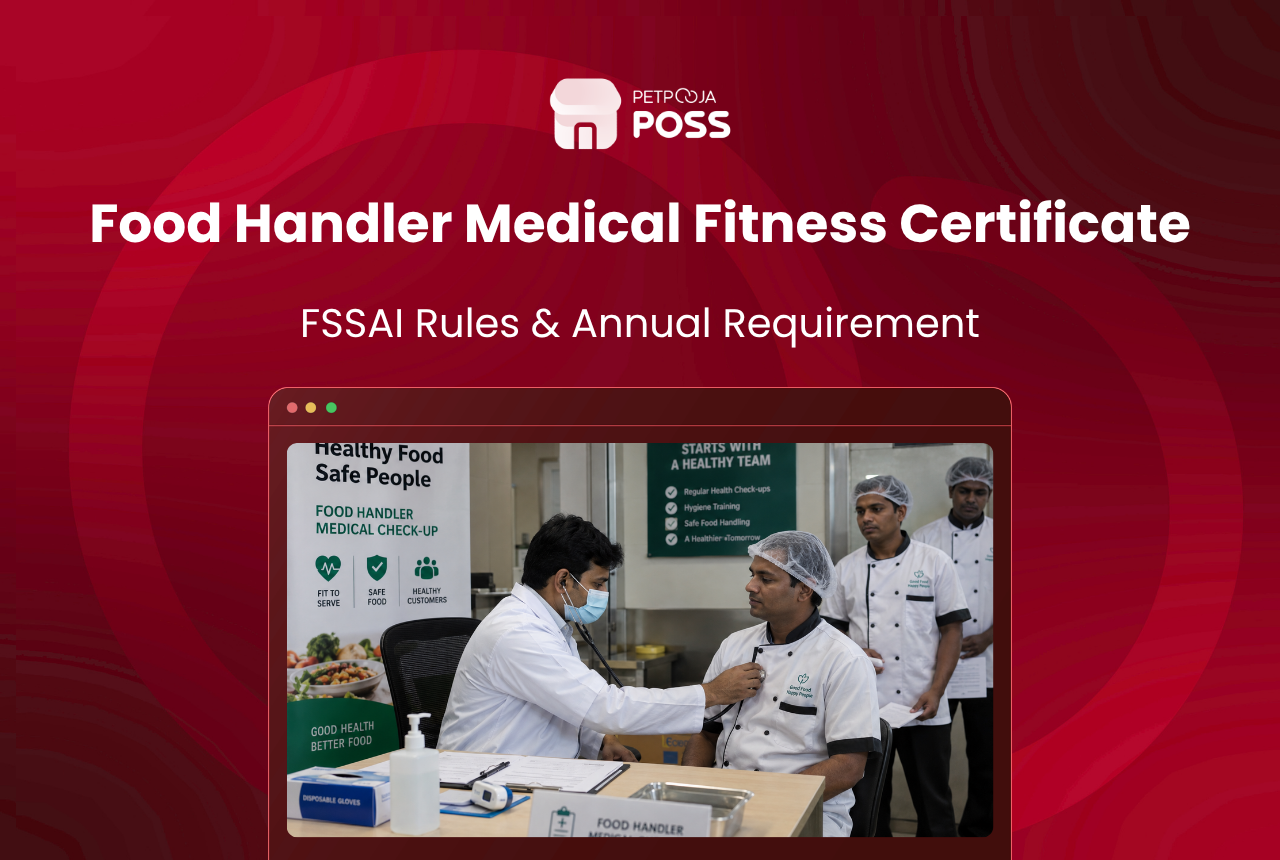
A food handler medical fitness certificate is proof that a member of your kitchen staff has been checked and found free of illness that could pass into food. FSSAI wants that check once a year, for every food handler in a licensed food business.
The rule itself takes up four short clauses. Most of the confusion comes from things it does not say. It sets no fixed list of tests for restaurants, and the long test list you may have seen online belongs to a different kind of business.
This post covers who needs the check, what the rule asks for and what the record must show. It also covers vaccination, sick staff, how this differs from ESIC, and what happens if you cannot show the paperwork.
Key Takeaways
- Every food handler needs a medical check once a year (clause 10.1.2)
- A registered medical practitioner signs the record; keep it for inspection
- Staff are vaccinated against the enteric group (clause 10.1.3)
- Schedule 4 lists no tests for restaurants, so your doctor chooses them
- Anyone carrying a food-borne illness stays out of food areas
What Is a Food Handler Medical Fitness Certificate?
A food handler medical fitness certificate is the signed record that someone has been checked and found free of illness that could reach food. The core of the rule sits in Schedule 4 of the 2011 licensing regulations, at Part II, clause 10.1.2.
The clause asks you to get food handlers “medically examined once in a year”. It also says why. The check is to make sure they are free from any infectious, contagious and other communicable diseases.
Two more things sit in the same clause. The record must be signed by a registered medical practitioner, and you keep it on the premises for inspection. The clause stops there: it does not say what else the record should contain.
This is not a one-off at hiring. It is a yearly cycle, and it covers a cook who joined last week as much as the ones who were there on opening day.
Who Counts as a Food Handler in Your Restaurant?
A food handler is anyone whose work brings them into contact with food, or with the surfaces and utensils food touches. The rule turns on contact rather than job title, so it reaches wider than the kitchen line.
That means cooks, prep staff, tandoor and grill staff and dishwashers. It also covers servers who plate or carry uncovered food, the storekeeper who opens sacks, and whoever packs delivery orders. Our guide to restaurant staff structure sets out how those roles usually sit together.
A simple test helps. Ask whether the person could pass something to a plate. If the answer is yes on a normal shift, treat them as a food handler.
Office staff who never enter the food areas sit outside the rule. If someone crosses into the kitchen even now and then, include them. It is easier than arguing the point during an inspection.
What Does the FSSAI Medical Check Include?
Schedule 4 sets no test list for restaurants. It fixes the purpose and the timing, then leaves the tests to the doctor doing the check. This section covers the list that gets quoted at owners anyway, and what to ask your doctor for instead.
That is the most misread part of the rule, so it is worth being plain.
The Test List That Does Not Apply to You
You will find pages listing sputum tests, a chest X-ray for TB, and stool tests for parasites and bugs such as Salmonella. That list is real, and it is in Schedule 4.
It sits in Part IV, which covers meat: slaughter houses, meat processing and meat shops. That test list is the meat shop rule. Part IV does not reach a restaurant kitchen, though it would apply to a retail meat counter if you also run one.
A restaurant follows Part II and Part V. Part II is headed as the general requirements “to be followed by all Food Business Operators applying for License”, so it covers you whatever you cook. Part V is the catering layer on top.
Part V has its own personal hygiene section, section III, and it deals with handwashing, footwear and handling. It sets no medical examination rule. So clause 10.1 in Part II is the one that governs this.
Some owners run the meat shop tests anyway, which is their call to make with their doctor. Just know that you are going past the rule rather than meeting it, and budget for it on that basis.
What to Ask Your Practitioner For
The rule names an outcome, not a method. So the simplest brief to your doctor is the wording of the clause. Ask them to check the handler and certify that they are free from infectious, contagious and other communicable diseases.
Let the doctor decide what that takes for the person in front of them. The yearly round is not the only trigger either, as the section on sick staff below explains.
Which Vaccinations Does FSSAI Require for Food Handlers?
Clause 10.1.3 makes vaccination compulsory and asks you to keep the record. What it names is a group of diseases rather than a branded vaccine, so this section sets out what that group covers.
The enteric group means illnesses passed on through food and water carrying faecal matter. These are the ones it turns on:
- Typhoid fever. A vaccine exists for it, and this is what a food handler jab normally covers.
- Paratyphoid fever. The CDC calls it “clinically indistinguishable” from typhoid, and says “no vaccines are available for paratyphoid fever”. Food and water hygiene is the only guard against it.
- Cholera. Spread the same way, by food or water carrying faecal matter.
That middle line is worth knowing before a clinic quotes you for a package that claims to cover all three.
The timing follows the vaccine, not your calendar. Staff are vaccinated “as per recommended schedule of the vaccine”. So the gap is whatever the vaccine calls for, not automatically twelve months.
Clause 10.1.4 adds a rule for an epidemic. All workers are vaccinated then, wherever they sit in the normal schedule.
What Must the Food Handler Medical Record Show?
Only the signature and the keeping are fixed by the clause. The rest is what makes a record usable when an officer asks, and this section covers all four things plus the vaccination record that sits with them.
Keep the vaccination record in the same folder. That one has to be available for inspection too, and an officer can ask for either. Hunting for one while they wait is a bad start to a visit.
What Happens When a Food Handler Is Sick?
A sick food handler is kept out of the food areas, and this section covers how that is meant to work. Clause 10.1.1 is the rule. Anyone known or believed to be carrying an illness that can pass through food must not enter a food handling area.
The same clause puts a duty on you too. You must run a system where anyone affected reports their illness or symptoms to management straight away. It should not be their own call whether to come in.
In practice that means telling staff what to report and to whom. It also means making it safe to say so. A cook who loses a shift’s pay for reporting a stomach upset will report the next illness late, or not at all.
Coming back is the other half of it. Where illness is indicated, clause 10.1.1 expects a check then, not only at the next yearly round, so send the person to the doctor before they return to the line.
Is Medical Fitness the Same as ESIC?
No, and this section covers why the two get mixed up. Both involve staff and doctors, but they come from different laws and neither one satisfies the other.
ESIC is health insurance. It starts once you cross the staff count for your state, and our ESIC registration guide covers who falls in the ESI bracket.
The medical fitness check is a food safety rule under Schedule 4. It attaches to your licence rather than to a staff count, so it applies from your first food handler. Being registered for ESIC does not meet the Schedule 4 rule, and holding fitness certificates does not meet your ESIC duty.
Where Restaurants Get Food Handler Checks Wrong
Three patterns come up more than the rest. Two are about the calendar, and the third is about where the paperwork ends up.
Restaurant owners using Petpooja raise these three more than any others. None of this is survey data. It is what people say when the talk turns to a visit that went badly.
Checked at Hiring, Never Again
The check happens when someone joins, then nothing. Clause 10.1.2 asks for once a year, every year.
A certificate dated when the outlet opened in June 2024 proves a check was done in June 2024. It says nothing about this year. A cloud kitchen in Kharadi still running on opening-day certificates is the common version of this (an example).
New Starters Missed
The yearly round covers the people on the books that week. Take a café in Sarkhej that hires four staff for the festival season in October 2026. It can pass its own annual round and still have four unchecked handlers on the floor (an example).
The Folder Nobody Owns
The certificates exist, spread across a drawer, the manager’s WhatsApp group and somebody’s phone. Nothing is missing, but nothing can be produced in the ten minutes an officer waits.
A record you cannot produce counts as a record you do not have. A bar in Aundh had finished its March 2026 round in full, and still could not put the certificates in front of the officer (an example).
What Happens If You Cannot Produce the Medical Records?
Missing paperwork is a licence problem before it is a money one, and this section covers the sequence. The action runs through the Food Safety and Standards Act, 2006, rather than through Schedule 4 itself.
Section 32 of the Act sets the first step. A Designated Officer who thinks you have fallen short sends an improvement notice. It gives the grounds, the steps to take, and at least fourteen days to take them.
Miss that and the same section lets your licence be suspended. Fail again and it can be cancelled, after a chance to explain. An appeal goes to the Commissioner of Food Safety within fifteen days.
Fines run alongside that track rather than instead of it. Ignoring what a Food Safety Officer tells you costs up to ₹2 lakh under Section 55. Section 58 is the catch-all, at up to ₹2 lakh, and it covers breaches the Act does not price separately.
Missing records are one of the things that start this sequence. Our guide to the licence suspension violations covers the wider set. The pre-inspection checklist walks the ground an officer walks.
About Petpooja
Petpooja is the restaurant POS behind more than 1,00,000 outlets in India, and it does more than print a bill. Sales, purchases and stock sit in one system, so the numbers you run the place on are in one place rather than three books.
Its AI Inventory Agent keeps stock levels updated on its own, so you can see what is actually sitting in your stockroom without counting it first.
Conclusion
The rule itself is small. Every food handler gets a medical check once a year, a registered medical practitioner signs the record, and staff are vaccinated against the enteric group. Keep both records somewhere you can reach them.
What trips people up is rarely the medicine but the calendar and the filing behind it. Book the round, add every new starter to it, and keep one folder rather than five.
The daily side of this sits in kitchen hygiene rules, which covers handwashing and uniforms.
The checks themselves are a job for your doctor, not for software. What software gives you is a current staff list, which is what you check the round against so nobody is missed off it. That list already sits in your restaurant POS.
Frequently Asked Questions
Yes. Clause 10.1.2 of Schedule 4 asks food business operators to arrange for food handlers to be medically examined once a year, with the signed record kept for inspection. It applies to every licensed food business, from the first food handler on the payroll. Our FSSAI compliance checklist sets it beside the other records a licence expects.
Once a year. The clause says “once in a year” and does not fix a date. The safe reading is that every handler needs a check within the last twelve months, so a new starter needs one even if your annual round has already happened.
Schedule 4 lists no tests for restaurants. It names the outcome, which is a handler free from infectious, contagious and other communicable diseases. The tests are left to the doctor. The list of sputum, chest X-ray and stool tests you may have seen sits in Part IV, which covers slaughter houses, meat processing and meat shops. It does not reach a restaurant kitchen.
A registered medical practitioner. Clause 10.1.2 names them, and the record is kept on the premises for inspection.
Yes. Clause 10.1.3 makes vaccination against the enteric group compulsory, following the vaccine’s own schedule. Keep the record for inspection. In an epidemic, clause 10.1.4 says all workers are vaccinated whatever that schedule says.
Not in a food handling area. Clause 10.1.1 keeps out anyone known or believed to be carrying an illness that can pass through food. You must also run a system where staff report symptoms to management straight away.
No. They come from different laws, and neither one satisfies the other. ESIC is health insurance tied to a staff count, while the medical fitness check is a licence condition that applies from your first food handler.