
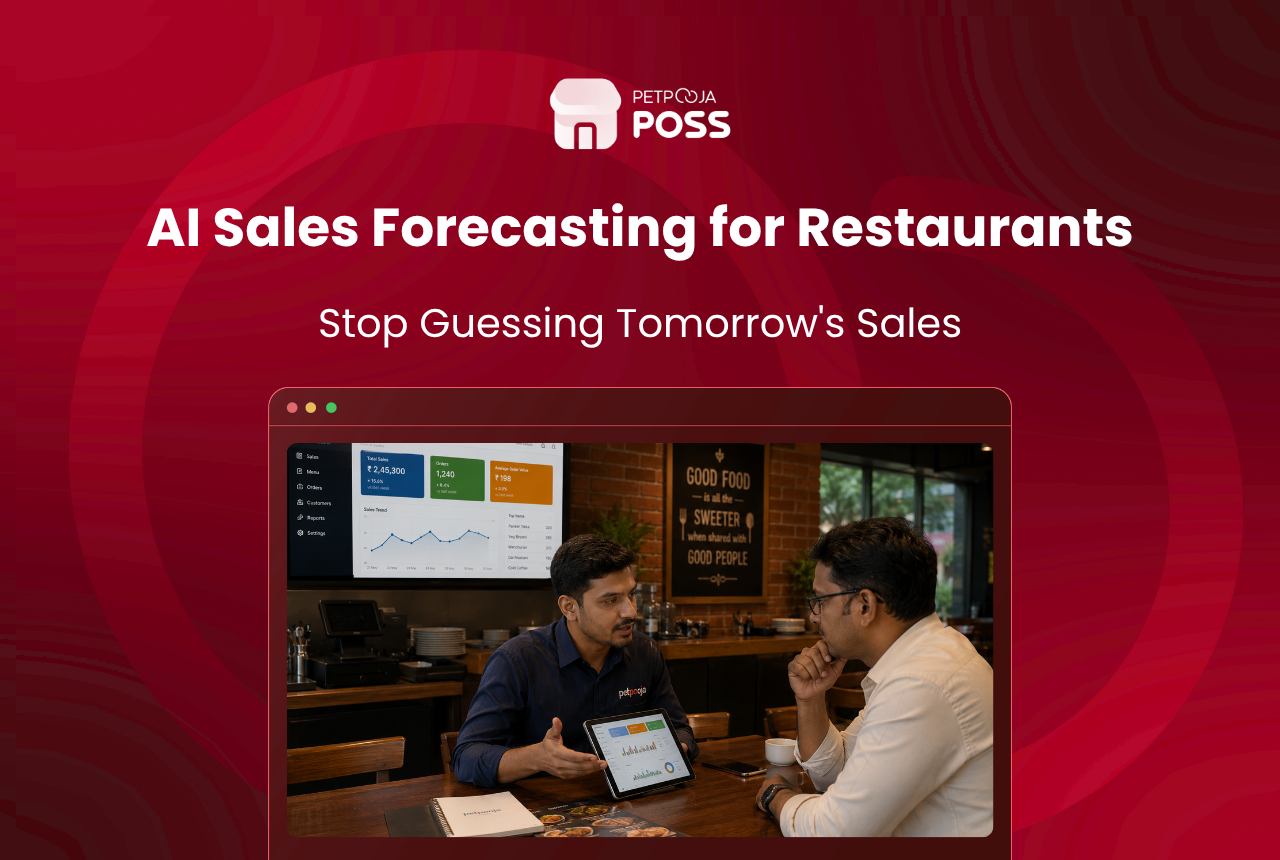
Most restaurant waste starts with a guess. You prep for a busy night that stays quiet. Or you run short on a slow day that surprises you. Either way, the money leaks. AI sales forecasting attacks that guess. It reads your own past sales and predicts what tomorrow will look like, so prep, stock and staffing match the demand, not the hope.
In plain terms, it is pattern-spotting at a scale no owner can hold in their head. The tool studies months of your bills and learns how a rainy Tuesday differs from a payday Friday. It turns that into a number you can plan against. You still make the call. The forecast just makes sure the call starts from evidence, not a hunch.
This guide covers what AI sales forecasting reads and the decisions it sharpens. It also covers how accurate it really is, and how to start with the sales data you already have. Across the restaurants on Petpooja, the ones that plan against a forecast waste less and scramble less than the ones that run on feel.
Key Takeaways
- AI sales forecasting reads your POS history to predict demand by day, time and season.
- It sharpens five decisions: prep, purchasing, staffing, cash flow and promotions.
- Forecasts are directional, not perfect, so treat them as a strong starting number.
- You do not need a data scientist; the forecast runs on the sales data your POS already holds.
What Is AI Sales Forecasting in Restaurants?
AI sales forecasting is a feature that predicts how much a restaurant will sell over a coming period, using its own sales history. It is not a separate app you buy; it usually sits inside the POS or restaurant software you already run. Instead of a manager guessing from memory, it finds the real pattern in the data and projects it forward.
The core input is simple: what you sold, when, and how much of it. Feed a model enough of that and it learns your rhythms: the lunch spike, the weekend lift, the monsoon dip. It then predicts the next day or week against them. It is one of the quieter parts of AI for restaurants, and often the first to pay back.
It helps to be clear on what it is not. A sales report tells you what already happened. A forecast tells you what is likely next. The report is the rear-view mirror, the forecast is the road ahead, and you need both. Only one of them, though, lets you plan before the day arrives.
What Factors Are Used to Forecast Sales in Restaurants?
A forecast is only as good as what feeds it. The main ingredient is your own POS sales report, because your past sales carry most of the signal about your future ones. On top of that, the model reads a handful of factors that reliably move demand.
| What it reads | What it captures |
|---|---|
| Past sales by day and hour | Your normal rhythm, and the busy and quiet slots |
| Day of week | The weekend lift and the mid-week dip |
| Season and month | Festival demand, summer coolers, monsoon slowdowns |
| Local events | A cricket match, a nearby concert, a long weekend |
| Weather | Rain that keeps walk-ins home or lifts delivery |
The best part is that a restaurant already owns the main ingredient. Every bill you have ever punched is training data, sitting in your POS, waiting to be read.
Not every tool uses every input. The extra signals like weather and events matter less than a clean, complete sales history. Get the base data right first, and the fancier inputs only add polish. Skip the base, and no clever signal will save the forecast.
5 Decisions AI Sales Forecasting Sharpens
A forecast is only useful if it changes what you do. Here are the five decisions it improves most, in the order restaurants tend to feel them.
1. Kitchen Prep
This is the clearest win. When the kitchen knows Saturday will pull more covers than a quiet Tuesday, it preps to that number, not to a hunch. Less runs out mid-service. Less gets binned at close, which cuts straight into the food waste that quietly drains margin. The prep sheet stops being a gamble and becomes a plan the whole kitchen can follow.
2. Purchasing and Stock
If you know next week’s demand, you order to it. Forecasts let you buy perishables tight and stock non-perishables ahead of a known rush. That beats over-ordering to be safe and then binning what spoils. For a group buying through a central kitchen, that accuracy multiplies across every outlet it supplies. Tighter buying shows up in your food cost too, since you stop paying for stock that spoils before it sells.
3. Staff Rosters
Overstaff a slow shift and you burn wages. Understaff a rush and service falls apart, and both hit the same day differently. A demand forecast tells the roster how many hands each shift really needs, so you match staff scheduling to the day rather than to habit. You can size the saving with a staff cost calculator before you change a single shift. Over a month, trimming one over-staffed shift a week is real money the guest never notices.
4. Cash Flow Planning
A sales forecast is also a rough revenue forecast. If the next fortnight looks soft, you know to hold a big purchase. If it looks strong, you know a vendor payment is safe to make. Read it next to the P&L from your POS, and you plan the money, not just the kitchen. That is the difference between reacting to a lean month and seeing it coming.
5. Promotions and Menu
Forecasts show your soft slots, and a soft slot is where a promotion earns its keep. Push an offer into a predictably quiet Wednesday rather than a full Friday, and you fill capacity you were going to lose anyway. Discounting a Friday that would have sold out just gives away margin.
The same data flags which items to prep more of when a rush is coming. Knowing a big weekend is due, you can pre-position the ingredients your top sellers need, so the kitchen is not caught short on the one dish everyone orders.
How Accurate Is AI Sales Forecasting?
Here is the honest part. A forecast is a strong estimate, not a guarantee, and any tool that promises perfect numbers is overselling. It reads the past well, but it cannot see a sudden road closure, a viral reel or a competitor’s opening night.
Accuracy improves with data. A model with a year of your sales reads your patterns far better than one with a month. A stable menu also forecasts more cleanly than one that changes every week.
So treat the number as your starting point. Then adjust it with the local knowledge only you have, like a festival the model has not seen before (an example). Used that way, it beats a pure guess on most ordinary days, and the ordinary days are where the savings add up.
How to Start With Sales Forecasting
You do not need a project or a data team. You need clean sales history and a first honest test.
- Keep your POS data clean. Bill every order, and keep item names and codes consistent, since the forecast is only as good as the history behind it.
- Pull a few months of sales. A model needs enough past to learn from, so give it at least a season, ideally a year, of your own numbers.
- Start with one decision. Use the forecast for tomorrow’s prep first, where the feedback is fastest, before you touch rosters or purchasing.
- Compare forecast to actual. Each week, check what it predicted against what happened, so you learn how far to trust it and where to adjust.
A POS that already holds clean, complete sales history makes this a report rather than a project. That is the foundation a platform like Petpooja POSS provides. A simple daily sales report is a fair place to begin reading the pattern by hand.
Conclusion
AI sales forecasting does not replace a restaurateur’s judgement. It arms it. It turns months of your own sales into a clear number for the days ahead, so you can prep, buy and staff against real demand instead of a guess. India’s food services industry was valued at ₹5,69,487 crore in FY24, per the NRAI India Food Services Report 2024. At that scale, better planning at each outlet adds up quickly.
Start small: clean your data, forecast one decision, and check it against reality each week. Indian households alone throw away about 55 kg of food per person a year, per the UN Food Waste Index Report 2024. The waste you cut from better prep alone usually pays for the effort long before the fancier gains arrive.
Frequently Asked Questions
Mainly your own POS sales history: what sold, when, and in what quantity, over months. From that it learns your patterns by day, time and season. Some tools add weather and local events on top, but clean past sales are the foundation, and a restaurant already has them in the POS.
The near term is where it is most useful and most reliable: tomorrow, this weekend, next week. It can sketch a month ahead for rough planning, but the further out you go, the wider the margin of error. Use the short-range numbers for prep and rosters, the longer ones for direction only.
It is directional, not perfect. A forecast built on a year of your own sales beats a guess most days, but a festival, a road closure or a viral reel can still throw it off. Treat it as a strong starting number you adjust with what you know, not a promise.
No. The forecasting sits inside the software, and it reads the sales data your POS already records. You read the output as a number for tomorrow’s prep or next week’s roster. The skill you need is acting on it, not building the model.
Yes. It needs sales history, not scale, so any outlet billing on a POS for a few months can start. A small kitchen often feels the benefit fastest, because one over-prepped batch or one short-staffed rush is a bigger share of its day than it is for a large chain.








