


Cutting vegetables takes up a lot of time than actually cooking them. And as a restaurant owner, a big responsibility for you and your staff is to reduce the kitchen preparation time. This can be done easily by improving your cutting techniques.
So, do you want to make your kitchen staff a pro at chopping?
Then you’ve come to the right place. This is your go-to guide for training your kitchen staff to make them more efficient. If a proper technique is followed then you can cut vegetables so easily with very little effort.
We’ve got you covered on everything from how to hold the knife correctly to different types of cuts.
These are core cutting techniques that every Chef should be familiar with:
1. The Bridge Chopping technique
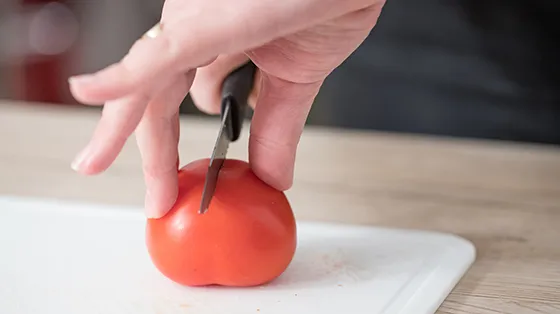 The Bridge Chopping technique
- Using Chopping Board at all times.
- Make a bridge with your hand over the vegetable or fruit. The fingers should be on one side and the thumb on the other.
- With the other hand, pick up the knife and make sure the blade is facing down.
- Take the knife and run it under the bridge and over the tomato. Press the knife down and pull it out of the bridge to cut the vegetable or fruit.
- Imagine the knife as a train that goes under the bridge.
2. The Claw Chopping technique
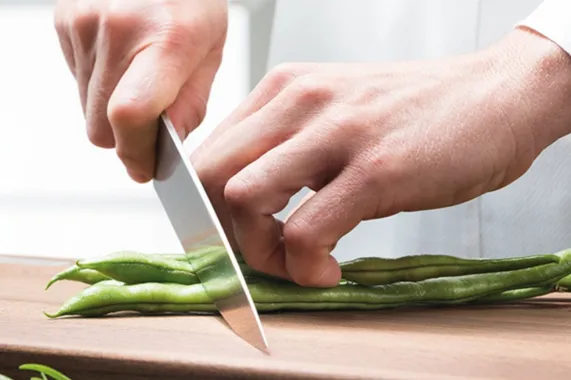 The Claw Chopping technique
- Create a claw by partly curling your fingers together into a claw shape.
- With your other hand, pick up the knife and make sure the blade is facing down.
- Press the tips of your fingers (nails) against the food to be gripped and then lean your fingers slightly forward of your nails so that you can’t see your nails when you look down on your hand.
- Tilt the knife and slice through the vegetable or fruit, guiding yourself with your fingers.
- Maintain the vertical position of your fingers, almost as if you were digging in your fingernails.
- Keep the thumb well back and away from the knife.
3. Peeling Technique
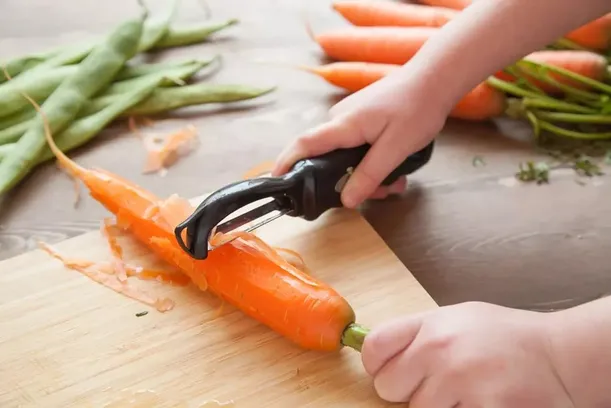 Peeling Technique
- Always use a chopping board.
- Place the end of the vegetable on the board.
- Always peel away from yourself and not towards yourself while using a peeler.
- Hold one end of a long food, such as a carrot, and peel from the middle away from you. Then, holding the peeled end, repeat the process, peeling from the centre to the chopping board.
4. Grating Technique
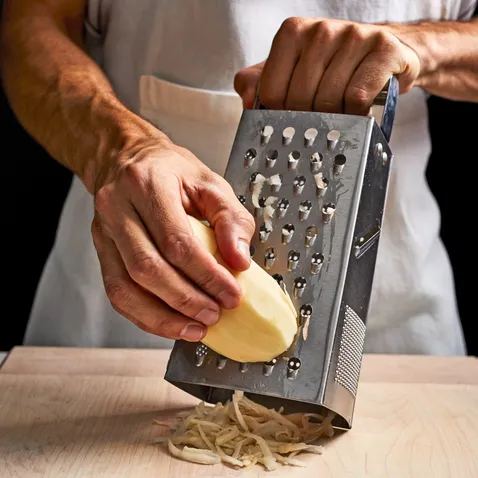 Grating Technique
- Hard vegetables, like carrots, potatoes, beetroot, cauliflower, broccoli, peppers and parsnip, are the best suited to this technique.
- Remember that you do not have to grate every bit of the food.
- It is best to leave a small chunk at the end to hang on to.
- This means that fingers are not pressed against the grater.
5. Scissors Technique
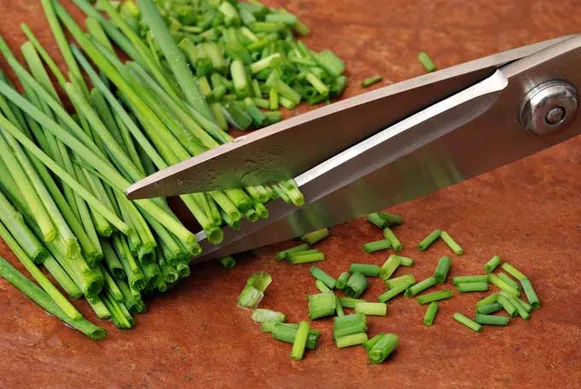 Scissors Technique
- Use when you don’t need vegetables cut into uniform shapes and sizes.
- Multi-purpose kitchen scissors are safer than using a knife.
- Kitchen scissors can sometimes be a useful alternative to a knife.
- Scissors are good for snipping herbs and spring onions – even pepper slices.
- For example: Cut celery stalks directly into the pot for stock, slice through green onions, even cut through sturdy plum tomatoes if they’re going into a sauce (but start by piercing the tomato through the stem end and wear an apron).
Once you teach them the right way to cut, you will see how much time can be saved on prepping! Every kitchen staff should learn and become an expert on these basic cutting techniques. Don’t worry if your staff is new; it will get better with practice. Speed will come with time.
Hope this blog was helpful. Happy chopping!
Do share your comments on the techniques you use at your restaurant.
Thanks. This helps us make the next article better.

Hi there! I’m Simran Jain, and I am so happy that you are here. My favorite thing in life is time spent in the kitchen. And all the better with being able to share my experience with y'all. I love everything related to food and I am always writing or cooking.