
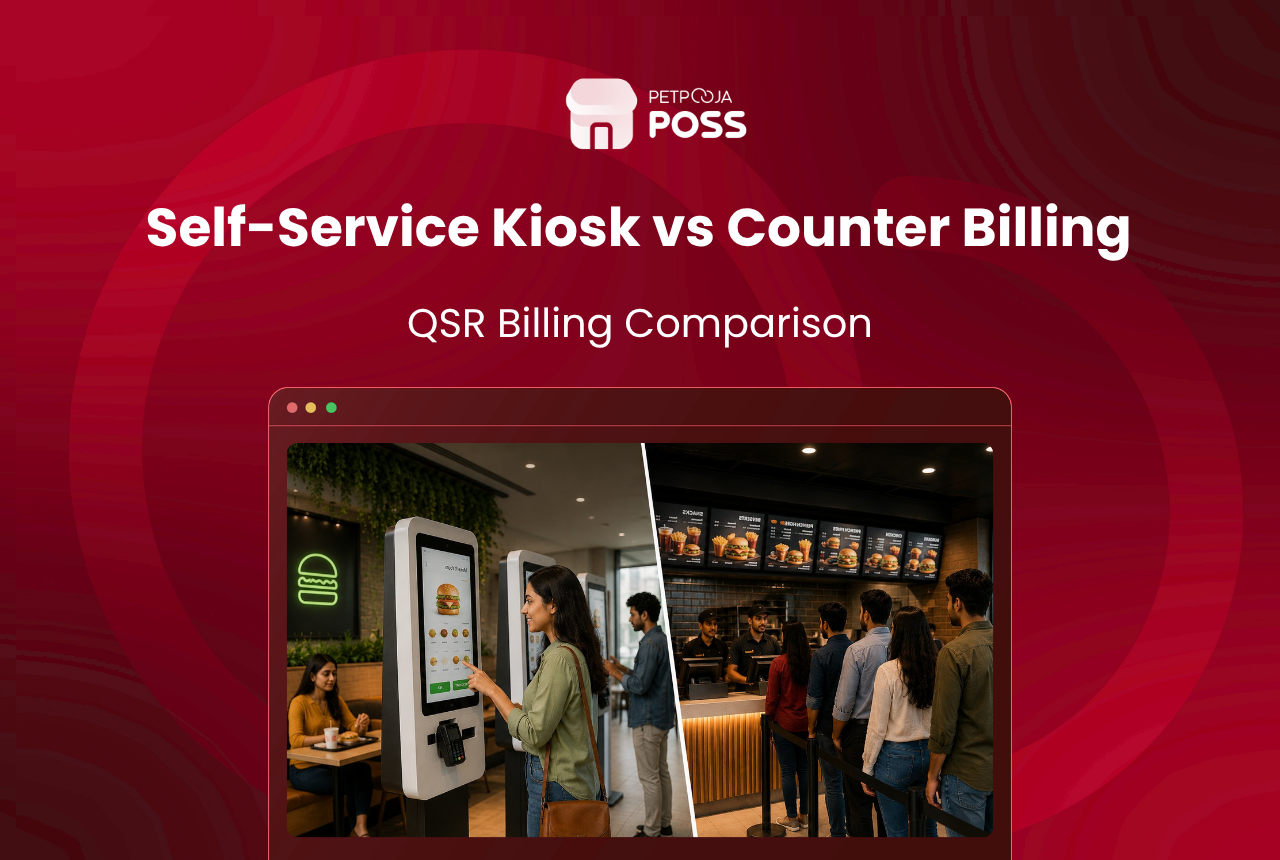
Kiosk wins if your QSR pushes 150-plus orders a day on a fixed menu. Counter billing wins if your outlet runs fine dine service, caters mostly to customers over 55, or does fewer than 80 orders daily. That is the short version, and it holds true for about 90% of the QSR owners we talk to at Petpooja.
The longer version involves numbers that are harder to ignore: a kiosk closes an order in roughly 90 seconds versus 2.5-3 minutes at a cashier counter. Kiosk tickets come in 15-35% fatter because nobody is standing behind the customer tapping their foot. And the cashier earning Rs 15,000-20,000 a month who quits after three months? The kiosk does not have that problem.
Key Takeaways
- Kiosks process orders in ~90 seconds; counter cashiers take 2.5-3 minutes during peak hours
- Kiosk ticket sizes are 15-35% higher than counter tickets due to visual upsells and zero queue pressure
- Counter billing works better for fine dine, low-volume outlets, and locations with older customer demographics
- Most QSRs keep one counter active alongside kiosks during the transition period
- Break-even on a kiosk is typically 4-6 months of saved cashier salary and increased revenue
The Numbers, Side by Side
| Metric | Self-Service Kiosk | Counter Billing |
|---|---|---|
| Order time per customer | ~90 seconds | 2.5-3 minutes |
| Average ticket size | 15-35% higher | Baseline |
| Staff needed at billing | 0-1 (floor helper) | 1-2 cashiers |
| Order accuracy | High (customer selects) | Depends on cashier |
| Upsell consistency | Every order, on autopilot | Varies by cashier mood and rush |
| Peak-hour throughput | 2-3x with multiple kiosks | Limited by cashier count |
| Upfront cost | Hardware purchase | None (existing counter) |
| Recurring cost | Minimal (maintenance) | Monthly salary + PF/ESIC |
The table gives you the overview. What it cannot show is how each of these differences plays out at 1:15 pm on a Saturday when your outlet is packed and the kitchen is already behind.
The 90-Second Gap Matters More Than It Looks
A trained cashier at a QSR counter near Hinjewadi, Pune handles one customer at a time. Greeting, reading back the order, punching it into the POS, waiting for the UPI scan or counting cash, printing the receipt. Even the fastest cashier takes 2.5 minutes when the queue is deep. Eight people in line means the last person waits 20 minutes just to place an order. Some of them leave. You never count those lost orders because they never made it to your POS.
Two kiosks running side by side cut that wait to under 5 minutes. Each one wraps up an order in about 90 seconds. No greeting, no read-back, no “sorry, can you repeat that?” The customer taps a photo-based menu, pays by scanning a UPI QR, and walks away with a token number.
Here is the throughput difference visualised:
Two kiosks do the work of three cashiers. And they do not need a tea break at 3 pm.
Why the Ticket Goes Up (and the Cashier Cannot Replicate It)
A Future Ordering study across multiple QSR brands measured kiosk cheques coming in 15-35% higher than counter cheques. McDonald’s global data showed a similar 30% bump.
The psychology behind it is not rocket science. A person ordering at a counter with four people waiting behind them picks what they know and moves on. No browsing. No impulse add-ons. Too much social friction to sit there comparing combos while someone’s lunch break is ticking away.
A kiosk kills that pressure. The screen shows a photo of loaded fries right next to the burger. A combo deal pops up: save Rs 40 by adding a drink. A cookie shows up at checkout for Rs 35. Nobody is watching. Nobody is waiting. They tap yes.
For example, a burger QSR in Kothrud, Pune running Rs 190 average at the counter saw that number climb to Rs 230 on kiosk orders within the first month. Over 200 daily orders, that is Rs 8,000 extra per day. Over Rs 2.4 lakh in a month. Same footfall, same menu, same kitchen.
A cashier can be trained to upsell. The problem is consistency. A motivated cashier might suggest the combo upgrade 7 times out of 10. During a rush, that drops to 3 out of 10. By the time the evening shift starts, the cashier has stopped suggesting altogether because they are tired of saying the same line 150 times. A kiosk does not get tired. It surfaces the upsell prompt at checkout for the 5th customer and the 200th, identically, without fatigue or mood swings.
QSR cashier attrition in India runs between 10% and 40% monthly, per NRAI workforce data. Every time someone quits, the replacement needs training on the menu, the POS, and the upsell script. A kiosk does not need onboarding. It does not resign via WhatsApp on a Sunday night.
The “No Onion, Extra Onion” Problem
This one does not show up in any ROI spreadsheet, but it costs real money.
A cashier mishearing “no onion” as “extra onion” at a noisy counter during the 1 pm rush means a remade dish, a delayed order, a wasted plate of food, and sometimes a one-star Google review from a frustrated customer. It happens more often than owners like to admit, especially in outlets where the counter and kitchen are separated by a wall and orders get relayed verbally.
On a kiosk, the customer taps exactly what they want. Customisations get printed on the KOT ticket exactly as selected. India’s UPI adoption, which crossed 16.6 billion monthly transactions by March 2026 per NPCI data, means most kiosk payments confirm in under 5 seconds with zero cash-handling errors on top. The kitchen reads a clean, typed modifier list instead of squinting at a scribbled chit or trying to recall what the counter person shouted two orders ago.
When the Counter Still Beats the Screen
Painting kiosks as the answer to everything would be dishonest. There are setups where a human cashier earns their salary many times over.
A fine dine restaurant in Lower Parel where the check average is Rs 1,500 per head sells experience, not speed. A host walking the guest to their table, a server describing the tasting menu, a sommelier suggesting a wine pairing. Bolting a kiosk to that entrance would feel like putting a vending machine in a five-star lobby.
A mithai shop in Maninagar, Ahmedabad where most walk-in customers are over 55 faces a different problem. These regulars have been buying kaju katli from the same counter for a decade. They want to speak to a person, pay in cash, and carry home a box with a handwritten receipt. A kiosk screen would confuse them, and confusion drives away the exact customer who comes back every week.
Low-volume QSRs also fall on the counter side. If your outlet does 50-80 orders a day, one cashier handles that comfortably. The ticket-size lift from a kiosk does not generate enough extra revenue to justify the hardware cost within a reasonable payback window.
Most Indian QSRs Are Not Choosing One. They Run Both.
The pattern we see most often across Petpooja’s client base is not replacement. It is layering.
Two kiosks near the entrance handle 70-80% of peak-hour orders. One billing counter stays active for cash customers, large group orders, and regulars who prefer a human. Both streams land on the same kitchen display and the same end-of-day sales report.
For example, a QSR chain in Ahmedabad with outlets in Vastrapur and Bopal runs this hybrid model. Their counter handles about 25% of total orders, mostly from older customers and cash payments. The remaining 75% flows through kiosks. Cashiers who used to stand behind two billing counters now manage the floor, handle takeaway packaging, and assist first-time kiosk users.
Track the revenue split between kiosk and counter using a restaurant P&L statement template to see exactly which channel is earning more per order.
Conclusion
A self-service kiosk beats counter billing on speed, ticket size, upsell consistency, order accuracy, and staff dependency for any Indian QSR doing 150-plus orders a day on a standardised menu. Counter billing holds its ground in fine dine restaurants, elderly-heavy locations, and outlets below the volume threshold where the hardware pays back. Most QSRs are not picking one or the other. They are running both, with the kiosk carrying the bulk and the counter catching the rest.
Explore Petpooja POSS to see how kiosk and counter billing run on the same POS backend.
Frequently Asked Questions
Yes. Both plug into the same backend. Kiosk orders, counter orders, and Swiggy/Zomato orders all appear on one kitchen display and sales dashboard. One report at night, no reconciliation headaches.
4-6 months for most single-outlet QSRs. The payback comes from two buckets: the Rs 15,000-20,000 monthly cashier salary you stop paying (plus 12-13% PF/ESIC on top), and the 15-35% ticket size bump on every kiosk order. After break-even, the kiosk costs printer paper and screen wipes.
Some will in the first week. Assign a floor helper to walk them through the first order. Most regulars figure out the photo-based menu within two or three visits because tapping pictures is simpler than reading a board above the counter. Keep one counter staffed during peak hours as a backup.
It works for most menus, but specialty coffee shops where every drink has 4-5 customisation steps (milk type, syrup, temperature, size, topping) can feel clunky on screen. Fixed menus with optional add-ons and simple modifiers translate best to a kiosk interface.
Easier. A billing counter needs a trained human present every operating hour. A kiosk needs a daily screen wipe, a printer paper check, and occasional firmware updates over Wi-Fi. Hardware failures on commercial-grade units from Indian manufacturers like Addsoft are rare.








