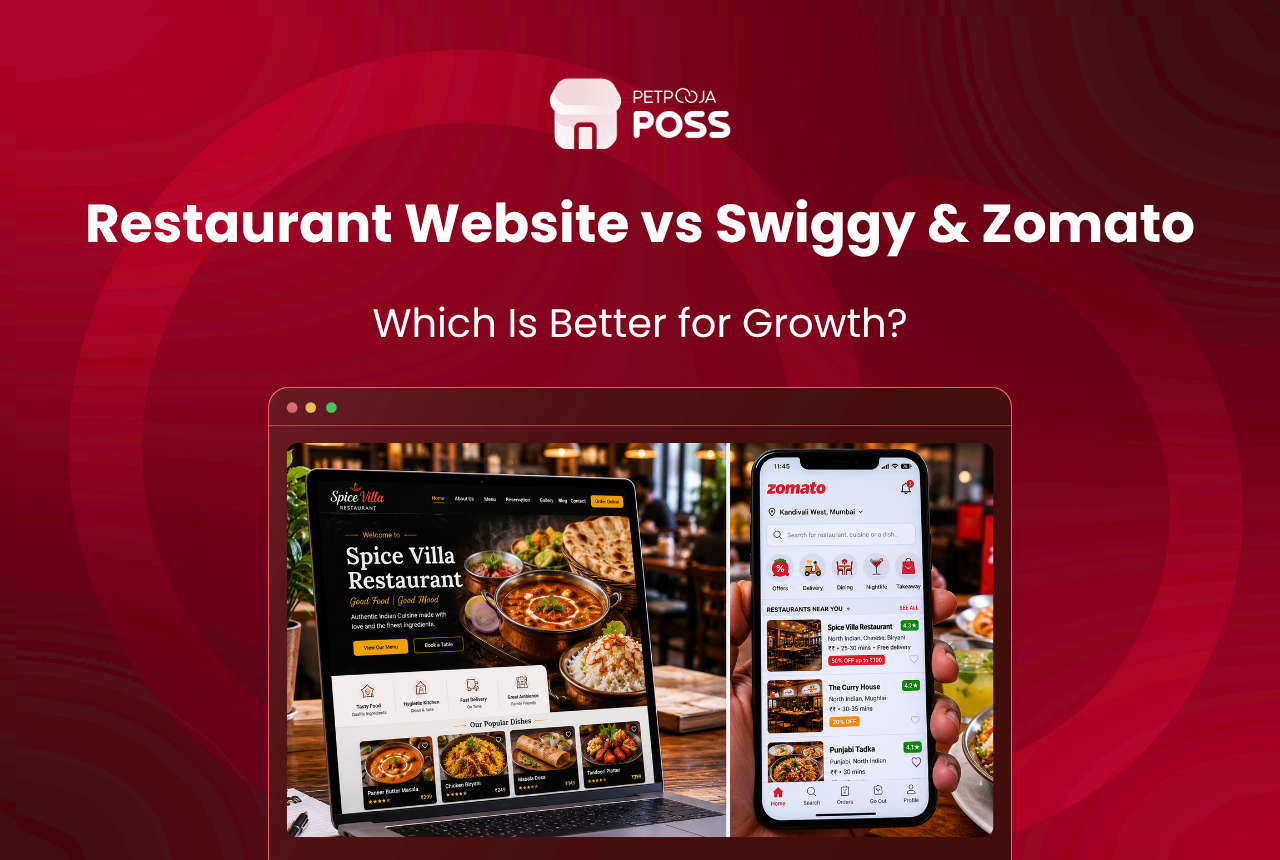
Yes. Most Indian restaurants need both, but for different jobs. Delivery apps bring new customers who have never heard of your outlet. Your own website gives those same customers a way to come back to you directly.
Key Takeaways
- Delivery apps are a discovery channel; your own website is a retention channel
- The two are not competing; they are doing different work at different stages
- Dropping delivery apps entirely cuts off new customer acquisition for most outlets
- Skipping the website means the customer relationship never becomes yours
- The practical goal is to give returning customers a direct route, not to abandon any channel
The debate is not either-or. It is about which channel does what, and how much of your order book each one should carry. The rest of this post breaks that down.
What Does Each Channel Actually Do?
Delivery apps solve a discovery problem. Someone in Jayanagar, Bangalore, opens an app at 9 PM, scrolls past thirty restaurants, and picks one they have never tried. The platform brought that customer to the outlet’s door. Without it, the customer would not have found the place.
A restaurant website solves a retention problem. The customer who already knows the outlet, who ordered last week and liked the food, who saved the number on WhatsApp, does not need an app to find the restaurant again. They need a direct way to reorder.
That is the core split: discovery on one side, retention on the other, with new customers and returning ones needing different things from you.
| Function | Delivery Apps | Your Own Website |
|---|---|---|
| Finding new customers | Strong (millions of daily users) | Weak (depends on SEO, social, word of mouth) |
| Retaining existing customers | The relationship sits with the platform | The relationship sits with you |
| Cost per order | Your contracted commission and fees | Your payment gateway charge, plus delivery |
| Customer data | Held by the platform | Held by the restaurant |
| Brand control | A listing in a shared format | Full design, menu, and storytelling control |
| Delivery logistics | Platform handles riders | Restaurant arranges own delivery or pickup |
How Do You Work Out What the Split Is Worth?
Do it on your own figures rather than on any number you read online, because the answer is specific to your contract and your costs.
Take a month of delivery orders. Apply the commission and fees on your own partner agreement to work out what those orders actually returned. Then price the same orders through a direct channel, using your payment gateway rate and what delivery costs you to arrange yourself.
The gap between the two is your real number. It moves with your average order value, your delivery distances and the terms you have signed. A figure quoted for someone else’s restaurant tells you very little about yours.
One thing the arithmetic will not show you is where the orders came from in the first place. That is the other half of the decision, and it is the reason this is not a simple cost comparison.
What Happens If You Drop Delivery Apps Entirely?
Some restaurant owners consider taking their listings off the apps altogether. We have watched a handful of Petpooja clients try this, and the pattern is consistent.
The first month feels liberating. Fewer deductions to track, fewer statements to reconcile, and a cleaner P&L at the end of it.
By the second month, new customer acquisition drops sharply. The regulars still order through the website or WhatsApp. But the flow of first-time customers, the ones who discovered the outlet while scrolling at lunch, dries up. Marketing spend has to increase to compensate.
By the third month, most of these outlets quietly re-list. The apps are simply too large a discovery channel for most independents to replace on their own.
The lesson is not that one channel is good and the other bad. They serve different purposes. Paying to acquire a brand-new customer is a defensible cost in any business. What is worth examining is whether every repeat order from that same customer needs to travel the same route.
What Happens If a Restaurant Skips the Website Entirely?
This is the more common scenario. The outlet lists on the apps, gets decent order volume, and never bothers building a website because “the apps bring enough business.”
Three things go wrong over time:
- No customer database of your own. In this model the order arrives through the platform, so the ongoing relationship is held there. A sweet shop in Bopal, Ahmedabad, for example, wanted to tell last Diwali’s mithai buyers about their new year hamper and had no list to send it to.
- No presence under your own name. When someone searches for the restaurant by name, what they find is whatever ranks. A website that ranks for your own brand name means the first result is yours rather than someone else’s page about you.
- No cheaper route for loyal customers. The regular who orders every Tuesday travels the same path, and carries the same cost, as a stranger ordering for the first time. Run a profit margin calculator across your channels and you will see how much of your book that describes.
What Is the Right Balance for Most Indian Restaurants?
Neither channel works alone. The practical approach, and the one we see performing best across Petpooja’s 1,00,000+ outlet base, splits the workload:
Apps handle acquisition. Keep your listings active for visibility, discovery and new customers. Treat what you pay as a customer acquisition cost rather than a transaction fee, because acquisition is the job it is doing.
The website handles retention. Give customers who already know you an easy direct route: your website link in your WhatsApp broadcasts, your own social profiles, and a loyalty programme that rewards ordering with you. Check your partner agreements before you run any offer that touches a platform order, since what you may and may not do there is set out in the contract you signed.
The POS ties both together. Orders from every app and from the restaurant website all land on the same billing screen. The kitchen does not care where the order came from. A POS like Petpooja POSS consolidates every channel into one KOT flow. No separate dashboards, no manual re-entry.
How Much Should a Restaurant Website Handle?
There is no universal number, but there is a way to find yours. Look at what share of last month’s orders came from customers who had ordered before. That repeat share is the pool your direct channel draws on first, because those are the people who already know your name well enough to look you up.
How much of that pool you actually win depends on outlet type, location, and how strong the local brand already is.
A cloud kitchen in Electronic City, Bangalore, with no dine-in traffic and no walk-in brand recognition, leans far more heavily on app discovery. Nobody can see your signboard, because there isn’t one.
A neighbourhood biryani joint in Maninagar, Ahmedabad, with ten years of regulars and a WhatsApp group of 400 customers, is in a different position. The brand is already known locally, so a direct channel has something to build on from day one.
Run the food cost calculator and the break-even calculator for your outlet, then work the channel costs out on your own agreements. Set yourself a target you can measure in 90 days.
Conclusion
Delivery apps are discovery engines that bring first-time customers to your kitchen. A restaurant website is a retention engine that gives those same customers a direct way back. Most Indian restaurants need both running in parallel, each doing the job it is actually good at.
The question is not “website or app.” The question is whether a customer who already knows you has any way to reach you except through someone else.
Frequently Asked Questions
Yes, for a reason that has nothing to do with volume. App orders bring you customers; a website starts building a relationship with them. Work the cost of each channel out on your own agreements to see what that is worth for your outlet. The website also earns its keep through catering enquiries, bookings and repeat orders.
Thousands of outlets run both, so the two are not mutually exclusive in practice. What you can and cannot do on each platform is set out in your partner agreement, so read yours rather than relying on what another restaurant tells you.
Make it easy to find and easy to use. Set up a direct online ordering system with UPI and COD. Keep your website link on your social profiles and WhatsApp broadcasts, and make sure the site loads properly on a phone.
Yes. A POS like Petpooja POSS consolidates app orders and website orders on one screen. The kitchen gets one KOT stream regardless of channel. QR ordering tied to the POS adds a third direct channel for dine-in customers.
Cloud kitchens depend more heavily on app discovery, since there is no storefront for anyone to walk past. A website still matters for repeat orders and catering enquiries, but the balance between the two channels will sit differently than it would for a restaurant with a street presence.