
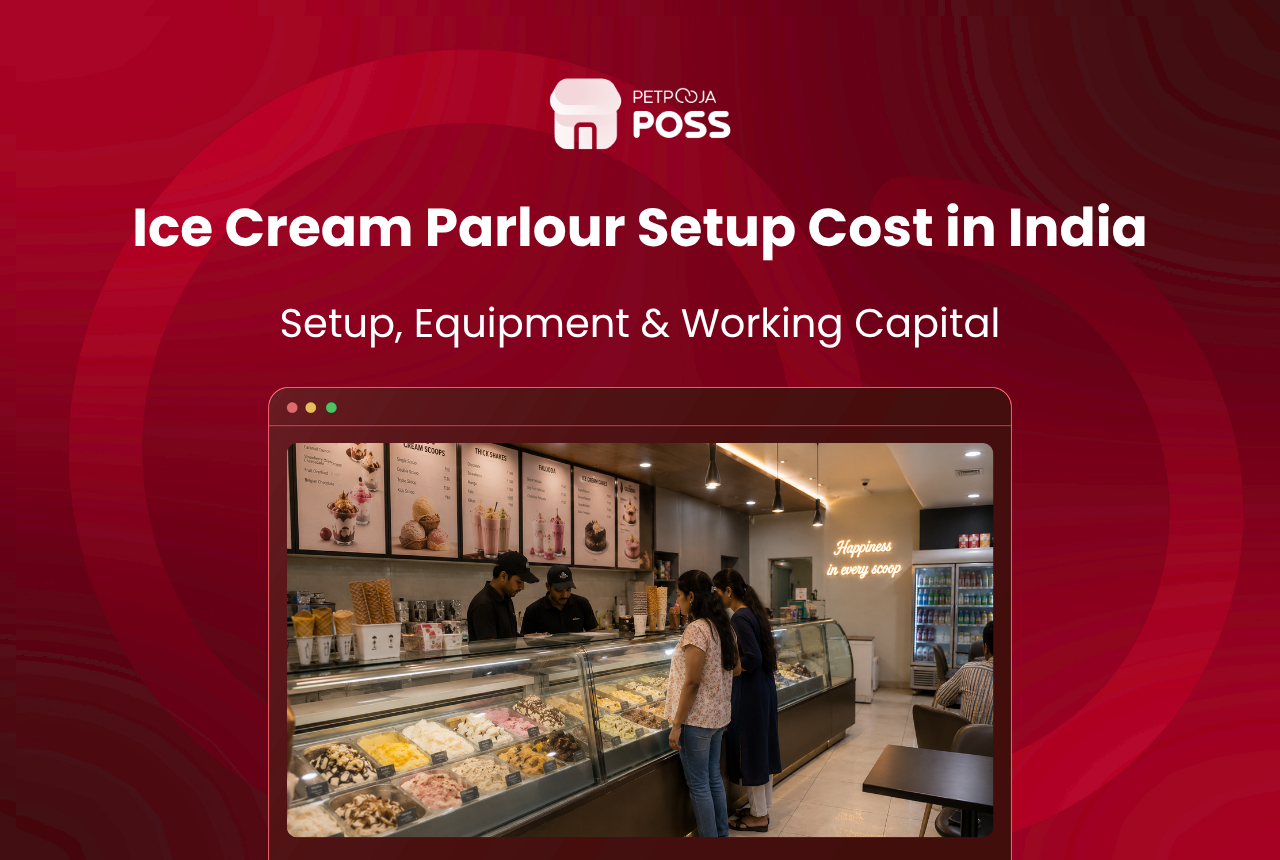
An ice cream parlour in India costs ₹2 lakh to ₹20 lakh to set up. Where you land in that range is decided before you buy a single tub.
An Amul scooping kiosk outside a women’s college in Indore sits at the bottom. A 400-square-foot parlour with imported display counters and dine-in seating off Linking Road, Bandra sits at the top. Interiors, a display freezer, the deposit and advance rent, and the FSSAI paperwork all stack up.
What separates the parlours that last from the ones that close before Diwali is usually not the product. It is knowing where the money goes before signing the lease.
This guide prices the setup line by line. Then the monthly bill, the licences, and the point at which the shop pays you back.
Key Takeaways
- Start with the format: about ₹3 lakh for Amul’s smallest kiosk, ₹20 lakh for a metro shop.
- Then price your build: ₹7.17 to ₹14.37 lakh for 300 sq ft in Tier-2.
- Next, running costs: ₹1,37,000 to ₹2,23,000 a month.
- Watch the fit-out, the widest line in the table.
- And allow 15 to 18 months to break even, nearer four years on a high-end build.
What Does an Ice Cream Parlour Setup Cost in India?
India’s ice cream market was worth ₹243.50 billion in 2025. It is forecast to grow 11.29% a year to ₹639.41 billion by 2034, on IMARC Group figures. That is the pull. This section is what chasing it costs.
First-time owners tell us they overestimated what the machines would cost and underestimated what the interior fit-out did to the budget. Consider a parlour in Vastrapur, Ahmedabad, that budgets ₹1.5 lakh for interiors. The final bill can easily touch ₹3.4 lakh. Branded counter cladding, a false ceiling, LED signage and the landlord’s demand for a proper exhaust duct all add up.
Here is what a 300-square-foot shop in a Tier-2 city like Surat or Jaipur typically spends:
| Cost Head | Budget Range |
|---|---|
| Shop deposit and advance rent | ₹1,20,000 to ₹2,40,000 |
| Interior fit-out (counter, seating, branding) | ₹1,50,000 to ₹4,00,000 |
| Display freezer (8-10 tub capacity) | ₹2,00,000 to ₹2,50,000 |
| Chest freezer 500L (back storage) | ₹35,000 to ₹45,000 |
| Soft-serve or batch freezer machine | ₹80,000 to ₹2,50,000 |
| Small wares, utensils, packaging | ₹30,000 to ₹50,000 |
| Initial raw material stock | ₹60,000 to ₹1,00,000 |
| POS billing system | ₹15,000 to ₹25,000 |
| Signage and outdoor branding | ₹25,000 to ₹60,000 |
| Licences and registrations (top end assumes a mall unit, which needs a fire NOC) | ₹1,600 to ₹17,000 |
| Total | ₹7,16,600 to ₹14,37,000 |
An Amul scooping kiosk in a Tier-3 town skips the interior fit-out altogether, which is the single biggest line it avoids.
The Amul scooping parlour listing puts investment at ₹2 lakh to ₹5 lakh for 100 to 500 square feet. The same page then prices the formats individually, and the two do not line up. It gives about ₹3 lakh for the smallest 100 to 150 square foot kiosk, and about ₹6 lakh for a scooping parlour above 300 square feet.
Budget against the format you want rather than the headline band. The ₹20 lakh at the other end of this guide’s range is not the 300-square-foot build priced above. That is a 400-square-foot metro shop with imported counters and dine-in seating, like the Linking Road one in the introduction.
The premium cold-stone end of the market publishes no investment figure at all. The table below sets out what each of the five big chains does and does not put in writing.
A mid-range independent ice cream parlour in a Tier-2 Indian city costs ₹7.17 lakh to ₹14.37 lakh to set up in 2026. That covers rent deposits, interiors, display and chest freezers, a billing system and FSSAI registration. Amul’s listing puts its band at ₹2 lakh to ₹5 lakh and prices its own formats at about ₹3 lakh to ₹6 lakh.
Five Parlour Chains, and What Each One Publishes
Five names come up in almost every parlour plan: Amul, Giani’s, Naturals, Havmor and Cream Stone. On their own franchise pages and listings, read in October 2026, only two of the five publish what a franchise costs. One is not taking applications at all.
| Brand | What the brand publishes | What it means for your budget |
|---|---|---|
| Amul | ₹2 lakh to ₹5 lakh on the listing quoted above, with no franchise fee and no royalty | Budget on the format you want, not the headline band |
| Giani’s | ₹5 to ₹6 lakh franchise fee, ₹15 to ₹25 lakh total, 100 to 400 sq ft, 400+ stores | The only full set of numbers of the five. Its ₹25 lakh top sits above this guide’s range |
| Naturals | No deposit and no franchise fee at present, and the page says that is about to change | The same page says it is not accepting franchise requests right now |
| Havmor | Nothing. Its enquiry form asks which bracket you can invest in, the top one being ₹40 lakh and above | You name a budget before the brand names a cost |
| Cream Stone | No figures. Franchisees are picked on “capital, commitment and competence” | You are picked before you are quoted. Individuals only, living in the city the store is in, one store each |
Only Amul and Giani’s publish what a build costs. Naturals publishes one thing, that it charges nothing today; Havmor and Cream Stone publish nothing. Build the plan on the two that do, and send the other enquiries early, remembering that one of the three is closed to applications.
Every franchise figure here was read on the brand’s own page or listing in October 2026. Confirm it before you commit.
Franchise or Own Brand: Which Investment Is Lower?
An Amul scooping parlour gives you the supply chain and the brand recognition from day one, at the format prices above. Building your own costs more than twice an Amul kiosk before the first customer walks through the door.
That cost gap is not the whole picture. Ingredient sourcing is usually locked to the franchisor’s rates, and menu pricing is often not yours to set. Whether a royalty applies at all varies by brand, so read your own agreement rather than assuming.
A franchisee keeps less of each sale, because the franchisor’s ingredient rates, and a royalty where one applies, both come off before anything reaches the owner.
An independent operator in Aundh, Pune who sources cream locally and holds food cost under 35% keeps more. How much more depends on where you land in the cost table, which the break-even section below works through. Our ice cream profit margin breakdown takes it further.
Owners who have run both tell us the difference shows up in the second year rather than the first. Our guide to ice cream franchise costs goes through seven brands in more detail.
| Factor | Franchise | Own Brand |
|---|---|---|
| Setup cost | Amul ₹2-5 lakh listed, ₹3-6 lakh by format; Giani’s ₹15-25 lakh | ₹7-20 lakh |
| Time to fit out | 30-45 days | 60-90 days |
| Net margin | Lower, after sourcing and any royalty | See the break-even example |
| Menu freedom | Limited | Full |
| Supply chain | Provided | Build it yourself |
Neither model is wrong. The franchise suits someone who doesn’t want to think about vendor relationships at 7 AM. The own-brand route suits someone willing to put in their own hours for a bigger share of each sale.
How Much Does an Ice Cream Parlour Cost to Run Monthly?
Monthly operating costs for a mid-size ice cream parlour in India sit between ₹1.37 lakh and ₹2.23 lakh. Rent, electricity, staff and raw materials carry about ₹1,27,000 of that low end between them. The table below breaks out all six lines.
Picture this: the shop opens and footfall is decent in April. By August the owner is staring at a ₹55,000 rent-and-power bill while selling 30 cups on a rainy Tuesday. That is the reality nobody’s Instagram reel talks about.
For a parlour doing 80 to 100 bills a day during peak months:
| Expense | Monthly Cost |
|---|---|
| Rent (Tier-2 city, high-street spot) | ₹25,000 to ₹45,000 |
| Electricity (freezers draw power 24/7) | ₹12,000 to ₹18,000 |
| Staff salaries (3 people, one a supervisor) | ₹40,000 to ₹60,000 |
| Raw materials and packaging | ₹50,000 to ₹80,000 |
| Delivery platform commissions | ₹5,000 to ₹12,000 |
| Miscellaneous (cleaning, repairs, WiFi) | ₹5,000 to ₹8,000 |
| Total | ₹1,37,000 to ₹2,23,000 |
Electricity catches people off guard. For example, take a 280-square-foot parlour in Electronic City, Bangalore, running two display units and one chest freezer. Its summer bill can reach ₹17,000.
Parts of UP, Bihar, and Jharkhand deal with daily load-shedding. An inverter battery or diesel generator adds ₹3,000 to ₹5,000 monthly. Skip it and a long outage puts the whole display at risk.
Raw materials and staff are nearly two thirds of the bill between them. That is why spoilage and staff scheduling are where the money is won or lost.
Five Ice Cream Parlour Costs Most Plans Miss
Five costs land on an ice cream parlour that a standard business plan template leaves out or under-counts. Together they are the difference between a plan that holds and one that needs a loan by August.
Off-Season Cash Crunch
Ice cream demand falls through the monsoon and winter months. Rent, electricity, and salaries stay exactly where they are. Consider a parlour that opens in March and rides a wave until June. By August it is short on cash, because walk-ins have dried up. Keep two months of running costs as a buffer before opening, which is about ₹2.74 lakh to ₹4.46 lakh on the monthly cost table. Before opening, not after.
The Delivery Channel Takes Its Share
Commission and fees come off before the money reaches you, at the rate in your own partner agreement. Price the delivery menu off what actually lands in the account, not off what the customer paid. The margin you worked out on walk-in pricing does not survive the trip.
Spoilage Nobody Tracks
Say unsold Belgian chocolate sits in the display for three days. The surface frosts over. The tub gets scooped into a shake the owner drinks himself. Multiply that across eight flavours and a month, and the loss is real. Two things help. Switch from 10-litre to 5-litre batches, and track inventory per flavour.
Counter Staff Disappear
Entry-level counter staff typically earn ₹10,000 to ₹15,000 a month each, and a ₹500 raise from the shop next door takes them. Two of them plus a supervisor on more is how the salary line reaches ₹40,000 to ₹60,000. Budget ₹3,000 to ₹5,000 every quarter toward hiring and training the replacement.
Power Backup Is a Capital Cost Too
The ₹3,000 to ₹5,000 a month an inverter or generator adds to the power bill is only the running side. Buying the unit is ₹25,000 to ₹40,000 for a 2 kVA inverter, plus a battery every three or four years. It rarely appears in a setup table, including the one above, so add it where load-shedding is routine.
Which Licences Does an Ice Cream Parlour Need?
Five registrations apply to an ice cream parlour, and the fees come to ₹1,600 to ₹17,000 in year one. None is expensive on its own. FSSAI, the Shop and Establishment registration and the trade licence apply to every parlour. GST starts at the turnover threshold and the fire NOC above 500 square feet or inside a mall.
The FSSAI Licence
The FSSAI food licence tops the list, and which one you need depends on turnover. Under ₹12 lakh it is basic registration at ₹100 a year. Cross that mark and the State licence kicks in at ₹2,000 to ₹5,000 annually (FSSAI FoSCoS portal). The FoSCoS portal takes 30 to 60 days to process an application. File before the paint dries on the walls, not after the grand opening.
What GST Rate Applies to an Ice Cream Parlour?
GST registration costs nothing to file, and the rate is the part worth knowing first. CBIC settled this for parlours in Circular 164/2021. The circular’s test is cooking. Parlours “do not engage in any form of cooking at any stage”, so selling already-made ice cream is a supply of goods “even if the supply has certain ingredients of service”. Seating does not change that. It attracts 18% GST, not the 5% a restaurant pays.
One caveat. If you churn or bake on the premises, you are outside what the circular describes, so take advice before you price the menu.
Because you supply goods, your threshold is ₹40 lakh of turnover, not the ₹20 lakh that applies to services under section 22 of the CGST Act. In the special category states the goods threshold is ₹20 lakh. Billing ₹3 lakh a month, you cross it in your second year, not your first.
The rate matters more than the threshold. Price the menu on 18% from the start, because adding it later means either absorbing it or putting prices up.
The Full Set of Registrations
Here is the whole set, with FSSAI split by turnover:
| Registration | Fee per year | Who it applies to |
|---|---|---|
| FSSAI basic registration | ₹100 | Turnover under ₹12 lakh |
| FSSAI State licence | ₹2,000 to ₹5,000 | Turnover above ₹12 lakh |
| GST registration | Free to file | Above the turnover threshold |
| Shop and Establishment Act | ₹500 to ₹2,000 | Every parlour |
| Trade licence, municipal | ₹1,000 to ₹5,000 | Every parlour |
| Fire NOC | ₹2,000 to ₹5,000 | Above 500 sq ft, or inside a mall |
Year-one total for licences runs ₹1,600 to ₹17,000, depending on turnover and whether a fire NOC applies to your size of shop. Nobody’s plan dies here. The real weight sits in the setup costs.
When Does an Ice Cream Parlour Break Even?
Gross margins on ice cream land between 60% and 70% (Snackfax). That is the gross figure. What trips people up is confusing it with what the owner actually takes home.
A worked example for a ₹12 lakh investment in a Tier-2 city:
- Average bill the customer pays: ₹120
- What you keep after 18% GST: ₹102
- Daily transactions in season: 85
- Monthly revenue after GST: ₹2,60,100
- Raw material at 35% of that: ₹91,000
- Fixed costs other than materials, at the low end of the monthly table: ₹87,000
- Net monthly profit: ₹82,100
- Recovery of a ₹12 lakh investment: about 15 months
That ladder is the steady state, after you are registered. Skip step 2 there and 15 months looks like 11, but the GST is not yours to keep. In year one, under the ₹40 lakh threshold, there is none to hand over and the payback runs faster than the ladder shows.
The ladder also assumes the cheaper of two builds, because its fixed costs come from the low end of the monthly table. Run the same ₹12 lakh and the same 85 bills a day at that table’s high end instead. The net falls to about ₹26,000 a month, which is a payback of nearly four years.
And July and August barely break even on top of that, because rains kill walk-in traffic. Parlour owners we work with put the realistic figure at fifteen to eighteen months on a low-end build, once the monsoon and winter dip is set against a season that runs April to June. Build at the high end and it is the four years above, not eighteen months.
Worth flagging: opening in February buys five clear months before the monsoon drag begins in July, and March buys four. A September launch means carrying the shop through the quiet months before the first good season.
The Setup Decision That Protects Your Margin
The decision most guides skip is where the billing happens. Not a calculator and a notebook, but a restaurant POS that logs every scoop, topping and combo across the day.
Nobody opens a parlour thinking billing matters. Then, for instance, a staff member gives free toppings to a friend’s kid. A butterscotch batch sits unsold for four days until it crystallises. A combo priced at ₹149 costs ₹104 to make. A 35% food cost would allow ₹52, so it costs double what it should, and nobody ran the maths. These are invisible losses, and they add up faster than most owners expect.
Owners tell us the same thing once billing is in place: the losses were always there, but nobody had the numbers to see them. Pair the POS with a thought-out menu layout and you can see what each item earns next to what it costs.
Conclusion
An ice cream parlour in India costs ₹2 lakh at the bare minimum and ₹20 lakh for a well-fitted independent shop. The market is growing and gross margins are good, though net margin is a long way below them.
The parlours that survive past the first Diwali do three things. They budget for August. They track spoilage from day one. And they price the menu on 18% GST from the start.
Start from the number you can actually afford. Decide franchise or own brand on how much margin you are willing to share. Keep that two-month buffer untouched before cutting the ribbon.
After that, the number to watch daily is your cost per scoop: what one serve costs you to make, against what you charge for it. Your billing system should tell you that daily, not at stock-take.
Frequently Asked Questions
The Amul listing gives ₹2 lakh to ₹5 lakh as its investment band, and about ₹6 lakh for a scooping parlour above 300 square feet. The same listing shows no franchise fee. No dine-in seating at this budget, but kiosk setups near college gates and market entrances do well enough.
Depends on season and footfall. A parlour running 80-100 daily transactions at a ₹120 average bill nets about ₹72,000 to ₹1,12,000 a month. That is after 18% GST, after rent, electricity and staff at the low end of the cost table, and with materials at 35% of sales. April through June is the best window. July and August often just cover costs, nothing more.
There is no way around it. Basic registration costs ₹100 a year under ₹12 lakh turnover, and the state licence runs ₹2,000 to ₹5,000 past that. File 60 days before you open.
Neither is cleanly cheaper. A franchise hands over brand recognition and a supply chain. It usually sets your menu prices and controls your sourcing, so less of each sale reaches you. Going independent starts around ₹7 lakh and you source everything yourself. Hold food cost under 35% and more of each sale stays with you. The question is whether you prefer paying for certainty or building from zero.
The display freezer, at ₹2 to ₹2.5 lakh for an 8-10 tub unit. A batch freezer or soft-serve machine can match that at the top of its own ₹80,000 to ₹2.5 lakh range. Together they are 39% of a low-end build and 35% of a high-end one. Full equipment breakdown here.


