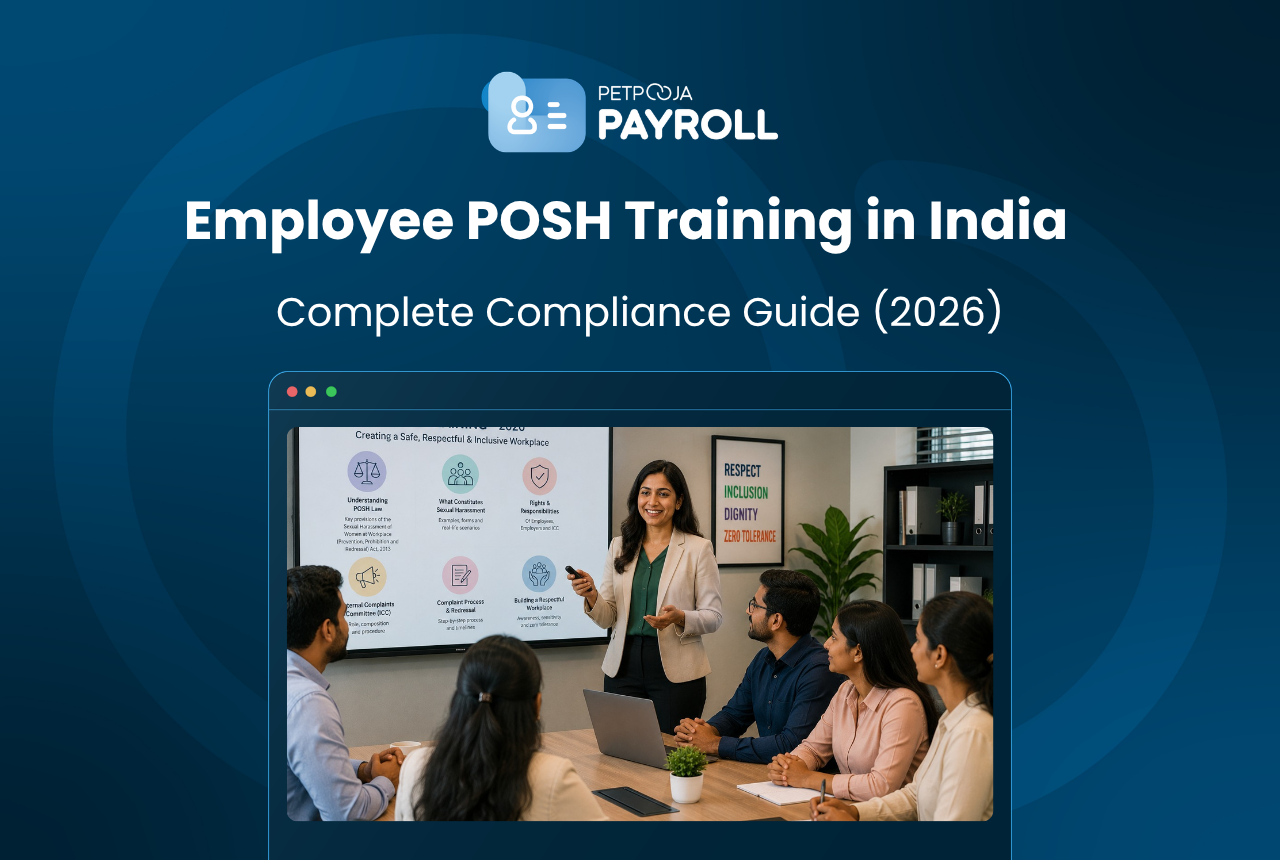
Every employer with 10 or more employees must conduct POSH awareness training at least once a year. The Sexual Harassment of Women at Workplace (Prevention, Prohibition and Redressal) Act, 2013 requires employers to organise “workshops and awareness programmes at regular intervals.” Skip this, and you face fines of up to ₹50,000 under Section 26. The bigger problem surfaces when a complaint lands and your staff was never told their rights. That missing session turns into a legal liability that money alone cannot fix.
Key Takeaways
- Annual POSH awareness training is a legal requirement for every Indian employer with 10+ staff
- All employees must attend: full-time, contractual, interns, apprentices, and consultants working on-site
- ICC members need separate, deeper training on inquiry procedures and report writing
- Every session must be documented with attendance records and signed acknowledgements
- The SHe-Box portal recommends quarterly sessions for managers, with coverage of digital harassment
Who Must Attend POSH Training?
Under Section 2(f) of the POSH Act 2013, every person at the workplace must attend awareness training: full-time employees, contractual workers, interns, apprentices, and on-site consultants. Section 19 places the legal duty of organising these workshops directly on the employer.
A hospital in Adyar, Chennai with 35 permanent staff and 12 contractual housekeeping workers? All 47 need to be in the room. Contractual hires brought on for a Diwali rush, unpaid interns doing a two-month college placement, even a CA consultant who sits in your office three days a week all fall under Section 2(f).
Management sits in the same session, not above it. Section 19 also recommends additional modules for managers on handling disclosures and escalation protocols.
ICC members are a different case. Their workshop has to cover inquiry procedures under Sections 9 to 13, evidence handling, report writing, interim relief, and Section 14 on malicious complaints. Expecting someone who attended a general awareness session to then conduct a 90-day inquiry is like asking a receptionist to run payroll because they once saw a salary slip.
How Often Should You Conduct POSH Training?
Indian courts and compliance auditors treat one annual POSH training session as the minimum frequency. The Ministry of Women and Child Development’s SHe-Box portal guidance for 2026 recommends quarterly workshops for managers and ICC members, plus at least one full-workforce session per year.
Fall below once a year and you are treated as non-compliant during inspections.
A garment manufacturer in Surat with 80 workers across two shifts typically runs the big session in January, before the annual report deadline, and does a quieter manager refresher around July.
New joiners are a gap most employers miss. If you onboard 5 people in March and 3 more in June, those 8 should not sit untrained until the next January session. Build a 15-minute POSH induction module into your onboarding checklist.
What Must the POSH Training Cover?
Seven content areas need to be addressed. Miss one, and a compliance auditor or judge will point to the gap.
Defining harassment with real examples
Start with the legal definition from Section 2(n), but translate it into scenarios your employees would recognise. A supervisor at an electronics store on CG Road, Ahmedabad commenting on a sales associate’s outfit. Unwanted physical contact during a shift handover at a warehouse in Bhiwandi.
The five types of harassment and digital conduct
The Act lists five forms: physical contact and advances, demand or request for sexual favours, sexually coloured remarks, showing pornography, and any other unwelcome conduct of a sexual nature. What most pre-2024 training decks missed is digital harassment. The Madras High Court has ruled that intent does not matter when assessing whether conduct qualifies, and WhatsApp messages, Instagram DMs, and video call behaviour now fall under the Act.
The complaint process and ICC visibility
This is where most sessions fall short. Employees need to walk out knowing whom to approach (ICC members by name and phone number), what the 3-month filing window means, and what happens after they file. A diagnostic centre in Navi Mumbai with 22 staff printed ICC details on the back of every employee’s ID card for roughly ₹1,200 in reprints.
Confidentiality, consequences, and retaliation protection
Three areas that should be covered together. Section 16 makes it a punishable offence to disclose the identity of the complainant, respondent, or witnesses. If a complaint is upheld, the employer has 60 days to act, with outcomes ranging from a written apology to termination. Employees who file complaints are shielded from adverse action by law: transfers, being passed over for promotion, or cold-shouldering are separate violations the ICC can flag.
What Does a 90-Minute POSH Training Agenda Look Like?
A court-defensible POSH training session runs 60 to 90 minutes, covers all seven mandated areas, includes a group exercise, and ends with signed attendance documentation. Sessions under 30 minutes have been rejected by Indian courts as insufficient proof of compliance.
We have tested this agenda across different industries, from hotel chains in Gujarat to auto-parts manufacturers near Pimpri-Chinchwad. Swap the examples to match your workplace.
| Time | Topic | Format |
|---|---|---|
| 0:00 to 0:10 | Welcome and purpose of the session | Brief opening by senior management |
| 0:10 to 0:25 | What is sexual harassment? Definition and five types | Presentation with industry-specific examples |
| 0:25 to 0:40 | Complaint process and ICC introduction | ICC Presiding Officer walks through steps |
| 0:40 to 0:55 | Scenario discussion: two workplace situations | Group activity, not lecture |
| 0:55 to 1:05 | Digital harassment, confidentiality, retaliation | Short presentation |
| 1:05 to 1:20 | Q&A with ICC members | Open floor |
| 1:20 to 1:30 | Attendance sign-off and acknowledgement forms | Individual signatures |
The 40-minute scenario exercise is where the session stops feeling like a compliance checkbox. Pick two situations your employees would actually face. For a hotel chain in Rajkot, one scenario might involve a guest making advances toward housekeeping staff, because third-party harassment from customers is covered under the Act. For a manufacturing unit in Pimpri, the second could be persistent remarks from a shift supervisor during the 10 PM to 6 AM shift.
Across 30,000+ Attendo clients at Petpooja, we have seen that businesses including a group exercise get noticeably better post-training comprehension than those running a slide deck alone.
How Do You Handle POSH Training for Multilingual Teams?
For multilingual Indian workplaces, the National Commission for Women and POSH compliance consultants recommend translating the POSH policy, complaint form, and ICC contact list into every language spoken on the premises. Teams of 50 or more need separate language sessions to maintain comprehension.
A single English session falls flat when your floor staff speaks Hindi, your kitchen team speaks Tamil, and your accounts department operates in Gujarati.
A Surat-based textile exporter had their documents translated into Gujarati and Hindi through a local service in Varachha for roughly ₹8,500. One-time cost, years of use.
For the session itself, pick one of three approaches based on team size:
- 50+ employees: Separate sessions in each language. Yes, it takes more time, but the alternative is half the room tuning out
- Two common languages: A bilingual trainer who switches mid-session. Works well in cities like Ahmedabad where most people follow both Gujarati and Hindi
- Under 50 people: One session with translated handouts and language-specific Q&A at the end
Documenting Your POSH Training
Five records must be filed after every POSH workshop: a signed attendance register, individual acknowledgement forms, training materials, trainer credentials, and session photographs. Under Rule 14 of the POSH Rules 2013, the employer must include details of awareness programmes in the annual report submitted to the District Officer.
An undocumented session, in the eyes of a court two years later, is a session that never happened. Here is what to file:
- Attendance register with employee names, IDs, and individual signatures against the date
- Signed acknowledgement forms confirming each person understood the policy and the complaint process
- Training material: the slides, handouts, or printed agenda used during the session
- Trainer details: name, organisation (if external), POSH certification or qualifications
- Session photographs, which carry weight during audits as proof the workshop actually took place
Keep digital copies alongside the physical register. If you use Attendo (formerly Petpooja Payroll) for attendance and employee records, cross-checking your active employee list against training attendance during a surprise audit takes minutes, not a two-day scramble through old registers.
When you have 3 or 4 branches, tracking whether Surat completed its session but Vapi did not slips through the cracks. A task management tool lets you assign deadlines per branch and verify completion with photo proof.
What Are the Most Common POSH Training Mistakes?
Squeezing it into 10 minutes. Some employers tack the session onto a Monday standup, flip through four slides, and mark it done. Courts have thrown out records where the workshop lasted under 30 minutes. Block 90 minutes on the calendar, or 60 at minimum.
Reusing a generic IT-company deck. A presentation built for a software firm in Bengaluru does not land with warehouse workers loading trucks in Bhiwandi at 6 AM. The examples and scenarios need to mirror what your employees actually do.
Not giving the ICC its own session. An ICC member at a pathology lab in Koregaon Park, Pune who has never been walked through Sections 9 to 13 cannot conduct a valid investigation. Committee members need focused training on inquiry procedures before they sit through the general one.
Pretending digital harassment does not exist. A logistics company in Whitefield found this out in February 2025 when a complaint cited messages from an internal WhatsApp group and their training materials had never mentioned online behaviour.
The “we did it in 2022” excuse. When an ICC member’s term expires, when you onboard new hires during Diwali season, or when you open a new branch, the training schedule has to keep pace. Put a recurring reminder in your HR calendar for the first week of January, before the annual POSH report filing deadline.
Conclusion
POSH awareness training needs to happen every year, cover all seven areas the Act requires, and reach every person on your premises. Tailor examples to your industry, run the workshop in languages your team actually speaks, and give ICC members their own session. Block the date, collect signed acknowledgements, and file records before your next annual report is due.
Frequently Asked Questions
The ICC obligation kicks in at 10 employees, but the Act asks all employers to conduct awareness programmes. Smaller businesses should still run a basic session because complaints route to the district-level Local Complaints Committee, and zero training on record weakens your position.
Yes, provided you document attendance, collect digital acknowledgements, and include something interactive like a Q&A or scenario discussion. A pre-recorded video with no sign-off or participation tracking will not hold up during an audit.
Both work. Most SMEs with 15 to 40 employees have their ICC Presiding Officer run the annual session and bring in an external POSH consultant for ICC-specific training. External trainers in Pune, Ahmedabad, and Hyderabad charge ₹8,000 to ₹25,000 per session.
Document the refusal in writing. The employee is still covered by the Act whether they attended or not, but their refusal weakens any defence they might raise later. Some organisations treat repeated no-shows as a disciplinary matter under their standing orders.
No, they sit in the same session as permanent staff. Their names must appear on the attendance register and they must sign the acknowledgement form. The District Officer will expect every active worker on that list.