
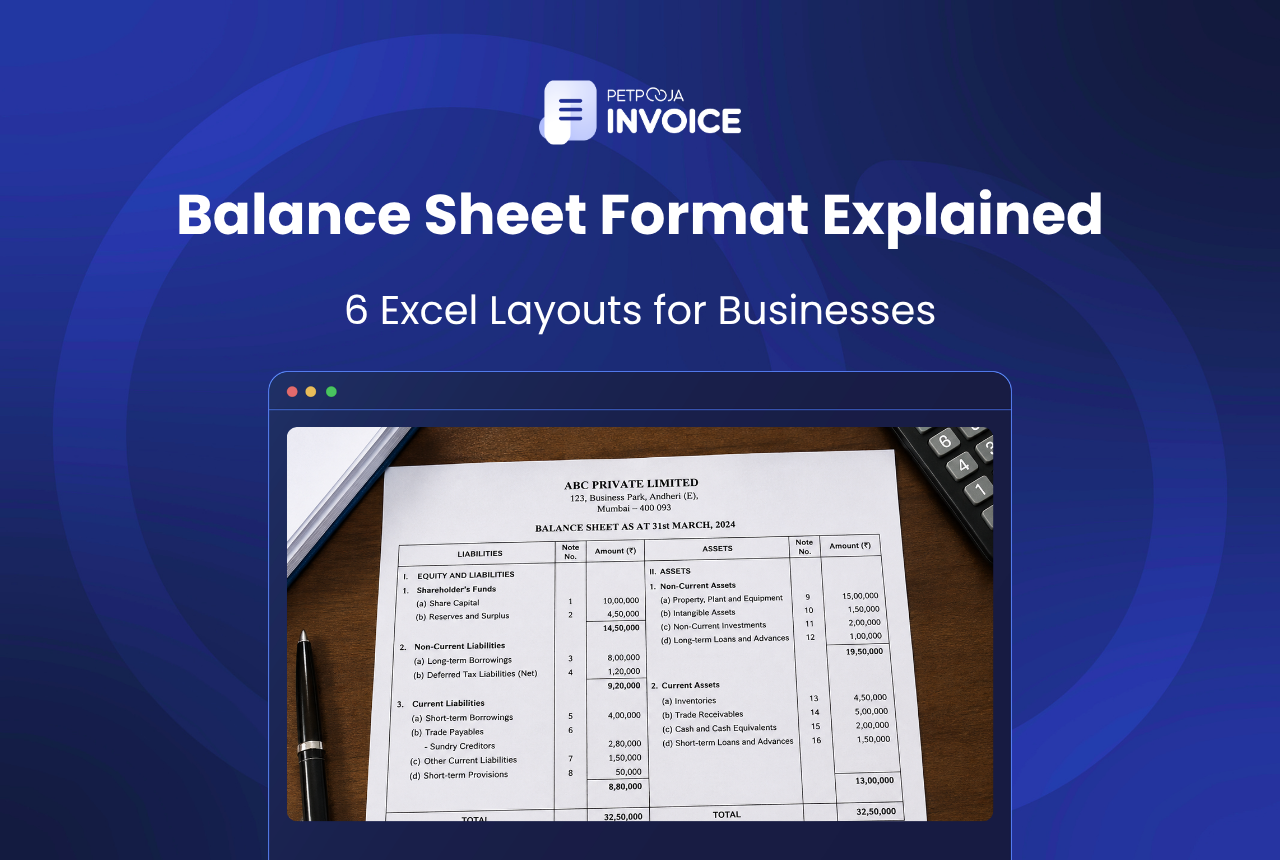
A balance sheet is a statement of what a business owns and what it owes on one specific date. Assets sit on one side, liabilities and the owner’s capital on the other, and the two sides are always equal by construction.
It describes a single day rather than a period, which is what separates it from a profit and loss account. The layout you use depends on the kind of business: a private limited company has a format prescribed by law, a proprietor or partnership firm does not.
Below are six formats with worked figures. Every one of them balances, and each is laid out so you can copy the row labels straight into a spreadsheet. Across the businesses billing on Petpooja Invoice, the trouble is rarely the layout, it is the underlying numbers not agreeing.
Key Takeaways
- Assets always equal liabilities plus capital. If they do not, something is missing.
- Companies must use the vertical Schedule III format. Others may choose.
- Proprietors and partnerships still commonly use the horizontal T-format.
- Comparative and common-size layouts are for reading the sheet, not filing it.
What a Balance Sheet Actually Shows
Every balance sheet rests on one equation:
Assets = Liabilities + Capital
Whatever the business owns had to be funded by somebody. Either a lender put it there, in which case it is a liability, or the owner did, in which case it is capital. There is no third source.
That is why the two sides match. It is not a coincidence or a check, it is the structure. A balance sheet that does not tally has a missing entry, not a formatting fault.
The figures come from your general ledger, which is why the journal entries feeding it have to be right first.
Which Balance Sheet Format Applies to You
Only one of the six below is compulsory, and only for companies.
| Type of Business | Format You Must Use |
|---|---|
| Private or public limited company | Schedule III vertical format, Companies Act 2013 |
| Limited liability partnership | Form 8 under the LLP Rules, 2009 |
| Partnership firm | No prescribed format |
| Sole proprietorship | No prescribed format |
An LLP is the case people get wrong. Schedule III does not apply to it, but it is not free to choose either. An LLP files its yearly financials in Form 8 under the LLP Rules, 2009, which sets out its own presentation.
Schedule III sits inside the Companies Act, 2013 and has three divisions. Division I covers companies on Accounting Standards, Division II those on Ind AS, and Division III covers NBFCs.
Everyone else is free to choose. That freedom ends the moment a bank, a buyer or an income tax officer asks for a specific presentation, so pick a format and stay with it year on year.
The 6 Balance Sheet Formats
Formats 1 to 4 use the same worked example so you can see the same business presented four ways: a Coimbatore textile trading firm with total assets of ₹30,00,000 (an example).
1. Schedule III Vertical Format
This is the statutory layout for companies. Everything is stacked in one column, and assets and liabilities are each split into non-current and current.
| Particulars | Amount (₹) |
|---|---|
| I. EQUITY AND LIABILITIES | |
| Shareholders’ funds: Share capital | 10,00,000 |
| Shareholders’ funds: Reserves and surplus | 5,60,000 |
| Non-current liabilities: Long-term borrowings | 6,00,000 |
| Current liabilities: Trade payables | 7,15,000 |
| Current liabilities: Other current liabilities | 1,25,000 |
| Total | 30,00,000 |
| II. ASSETS | |
| Non-current assets: Property, plant and equipment | 12,50,000 |
| Current assets: Inventories | 8,40,000 |
| Current assets: Trade receivables | 6,20,000 |
| Current assets: Cash and cash equivalents | 2,90,000 |
| Total | 30,00,000 |
Trade payables carry an extra requirement. Amounts owed to micro and small enterprises must be shown separately from everything else, so keep those two lines apart in your ledger from the start. Whether a supplier counts depends on its Udyam registration, so collect that number when you onboard a vendor.
2. Horizontal or T-Format
The older layout, with liabilities on the left and assets on the right. No company may file in this form, but proprietors and partnerships use it widely because both sides sit side by side and the match is obvious.
| Liabilities | Amount (₹) | Assets | Amount (₹) |
|---|---|---|---|
| Capital account | 15,60,000 | Fixed assets | 12,50,000 |
| Long-term loan | 6,00,000 | Closing stock | 8,40,000 |
| Sundry creditors | 7,15,000 | Sundry debtors | 6,20,000 |
| Outstanding expenses | 1,25,000 | Cash and bank | 2,90,000 |
| Total | 30,00,000 | Total | 30,00,000 |
3. Sole Proprietorship Format
A proprietor has one capital account rather than share capital and reserves. Drawings are deducted from capital, never shown as an expense, which is the single most common error in proprietor accounts.
| Particulars | Amount (₹) |
|---|---|
| Liabilities | |
| Capital at start | 5,20,000 |
| Add: Profit for the year | 1,45,000 |
| Less: Drawings | (1,85,000) |
| Capital at close | 4,80,000 |
| Bank loan | 2,00,000 |
| Sundry creditors | 1,60,000 |
| Total | 8,40,000 |
| Assets | |
| Fixed assets | 3,20,000 |
| Closing stock | 2,75,000 |
| Sundry debtors | 1,45,000 |
| Cash and bank | 1,00,000 |
| Total | 8,40,000 |
Figures here are for a Nashik FMCG distributor (an example).
4. Partnership Firm Format
Same structure as a proprietorship, with one change that matters: each partner’s capital is shown on its own line. Lump them together and you will be unpicking it at the next admission or retirement.
| Particulars | Amount (₹) |
|---|---|
| Liabilities | |
| Partner A capital | 6,00,000 |
| Partner B capital | 4,00,000 |
| Term loan | 3,00,000 |
| Sundry creditors | 2,50,000 |
| Total | 15,50,000 |
| Assets | |
| Plant and machinery | 7,20,000 |
| Closing stock | 4,10,000 |
| Sundry debtors | 2,80,000 |
| Cash and bank | 1,40,000 |
| Total | 15,50,000 |
5. Comparative Balance Sheet
Two dates side by side, with the change between them. This is not a filing format, it is a reading format, and it is the one most owners should look at.
| Particulars | 31 Mar 2026 (₹) | 31 Mar 2025 (₹) | Change (₹) |
|---|---|---|---|
| Property, plant and equipment | 12,50,000 | 11,00,000 | +1,50,000 |
| Inventories | 8,40,000 | 7,20,000 | +1,20,000 |
| Trade receivables | 6,20,000 | 5,40,000 | +80,000 |
| Cash and cash equivalents | 2,90,000 | 2,15,000 | +75,000 |
| Total assets | 30,00,000 | 25,75,000 | +4,25,000 |
| Capital and reserves | 15,60,000 | 13,80,000 | +1,80,000 |
| Long-term borrowings | 6,00,000 | 5,00,000 | +1,00,000 |
| Trade payables | 7,15,000 | 5,90,000 | +1,25,000 |
| Other current liabilities | 1,25,000 | 1,05,000 | +20,000 |
| Total | 30,00,000 | 25,75,000 | +4,25,000 |
Read the change column, not the totals. Stock up ₹1,20,000 and receivables up ₹80,000 against profit of ₹1,80,000 tells you where the year’s earnings actually went.
6. Common-Size Balance Sheet
Every line expressed as a percentage of total assets. It strips out size, so you can compare this year against last year, or your firm against a larger one.
| Particulars | Amount (₹) | % of Total |
|---|---|---|
| Property, plant and equipment | 12,50,000 | 41.7% |
| Inventories | 8,40,000 | 28.0% |
| Trade receivables | 6,20,000 | 20.7% |
| Cash and cash equivalents | 2,90,000 | 9.7% |
| Total assets | 30,00,000 | 100% |
Percentages are rounded to one decimal, so a column may not add to exactly 100. Nearly 29% of this firm’s money sitting in stock is the number worth arguing about.
Use these six in two groups. Formats 1 to 4 are how you present the sheet, and only one of them applies to your business. Formats 5 and 6 are how you read it, and both apply to everybody.
Most owners only ever prepare the first kind. That is why a year-on-year rise in stock and receivables goes unnoticed until cash runs short, even in a business that looks profitable on paper.
Building These Formats in Excel
Three columns do most of the work: label, current year, prior year. Build it once and every later year is a copy of the same sheet.
- Put the row labels in column A, worded exactly as they appear above. Consistency year on year is what makes the comparative view possible later.
- Total each block with its own SUM. A single SUM down the whole column counts subtotals twice, and the sheet still appears to balance.
- Add a check cell set to total assets minus total liabilities and capital.
- Apply conditional formatting to that cell so any figure other than zero turns red.
The check cell is the whole point of building it yourself. It tells you the sheet is wrong before a lender or an auditor does. Our annual financial summary template already carries that structure if you would rather not start from a blank file.
Why a Balance Sheet Does Not Tally
The format is almost never the problem. These five are.
- Closing stock left out. It belongs on the asset side and in the trading account. Miss it in one place and the sheet is out by exactly that amount.
- Drawings treated as an expense. Money the owner took out reduces capital, and is never a business cost.
- Bank charges never recorded. They appear on the statement, not on an invoice, which is why a bank reconciliation catches them and nothing else does.
- A one-sided entry. Someone recorded the debit and never the matching credit.
- Receivables never written off. An invoice from 2023 nobody will ever collect still sits as an asset, quietly overstating what the business is worth. Ageing the debtor list finds these.
Most of these trace back to how transactions were captured in the first place. Petpooja Invoice posts the stock, party and tax side of a bill as you raise it, so a one-sided entry is far harder to create.
Left unchecked, these are the small errors that compound into the pattern we describe in how retail shops lose profit.
Conclusion
Pick the format your business is entitled to use and then leave it alone. A company files Schedule III; everyone else should choose between the vertical and T-format on readability and stay consistent.
The layout is the easy half. Getting stock, receivables and payables to reflect reality is the hard half, and that comes from how you bill and record day to day. Petpooja Invoice builds those balances from your invoices as you raise them, so the figures are already there when the year closes.
Frequently Asked Questions
No. Schedule III binds companies registered under the Companies Act. A proprietorship or partnership can use any sensible layout, which is why the T-format is still common. Banks and lenders may still ask for a particular presentation, so check before you prepare one for a loan file.
A profit and loss account covers a period and shows whether you earned or lost money over it. A balance sheet is a single date and shows what you own and owe on that date. One is a video of the year, the other a photograph of 31 March.
Almost always a missing or one-sided entry rather than a formatting problem. Common causes are an unrecorded bank charge, closing stock left out, a payment posted to the wrong side, or drawings treated as an expense instead of a reduction in capital.
Once a year is the legal minimum for most businesses, at 31 March. Quarterly is more useful, because a balance sheet is where creeping receivables and rising creditors show up long before they become a cash problem. Software that keeps ledgers current makes the quarterly version cheap, as our retail billing software guide covers.








