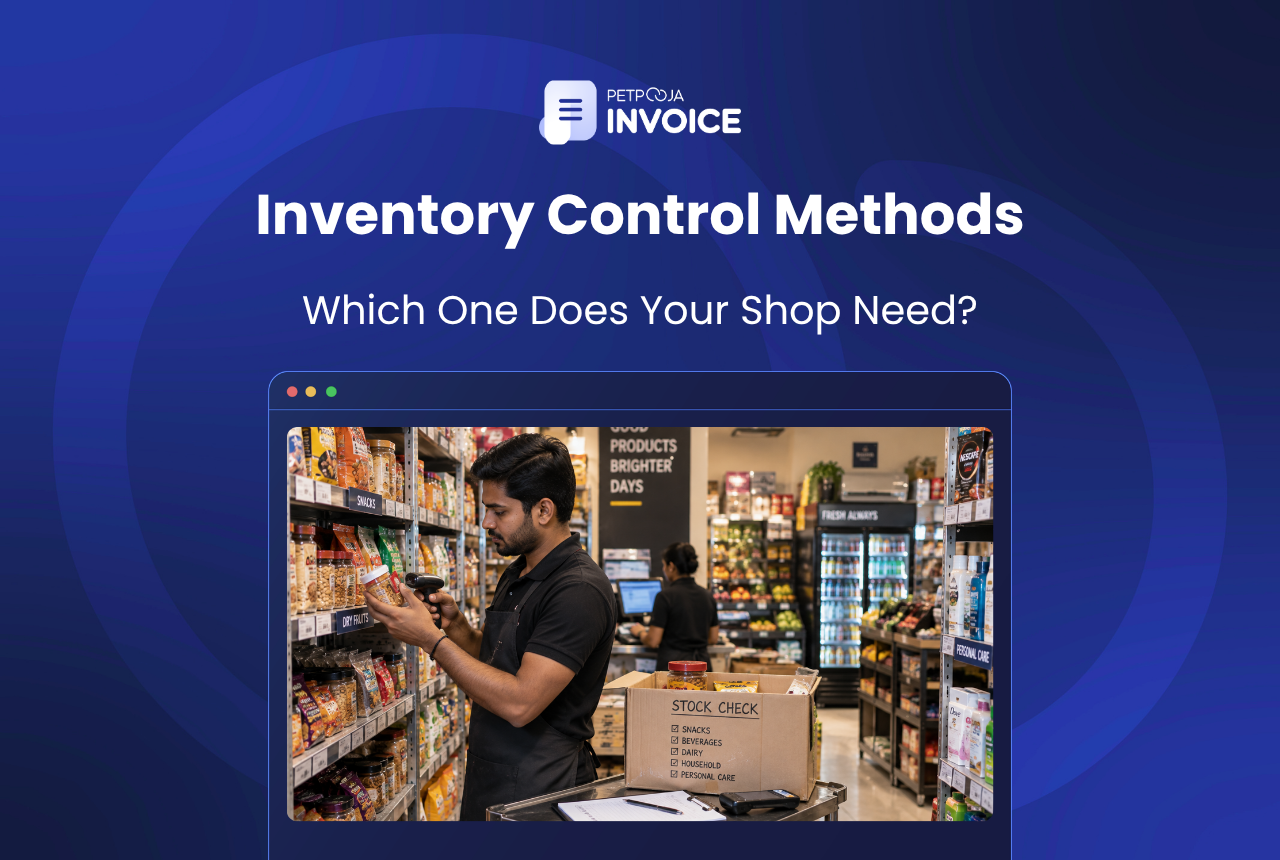
Inventory control is the job of deciding how much of each item to hold and when to buy more. It is the narrow half of inventory management, which also covers forecasts, suppliers and storage.
Five methods do most of the work, and every guide you will read lists all five. Almost none of them tells you which one your business needs, which is the only question you actually have.
This post covers what each method does, three questions that point you at one of them, and the cost of picking wrong.
Key Takeaways
- One method is usually enough, not five. Running more than you can maintain is why stock control quietly stops.
- Your stock decides it, not your size. A shop with 80 lines and one with 800 can land on the same method.
- A method your software runs for you costs nothing to keep. One that needs remembering is the one you stop doing.
What Is Inventory Control?
Inventory control governs the stock you already own, which is what separates it from the wider job of inventory management. This section covers the split and why it matters when you go looking for a tool.
Control answers two questions. How much of this item should sit on the shelf, and at what point do I reorder it?
Management is the bigger circle around that. It takes in demand forecasts, supplier terms, store layout and what you choose to stock at all.
This matters when you buy software. Software sold as “inventory management” often does forecasting you will never switch on. The control features are the ones you use daily.
The 5 Inventory Control Methods, Briefly
Each method answers a different question, and that is the fastest way to tell them apart. The table below is the summary; the section after it is the part that helps you choose.
| Method | The question it answers | Fits |
|---|---|---|
| ABC analysis | Which items deserve my attention? | Wide catalogues where value is uneven |
| Economic Order Quantity | How much should I buy at once? | Steady, predictable demand |
| Safety stock | How much buffer covers a late delivery? | Unreliable suppliers or long lead times |
| Reorder point | When exactly do I place the order? | Almost everyone, as a baseline |
| FIFO | Which unit leaves the shelf first? | Anything that expires or dates |
Here is what each one actually does, and who it is for.
1. ABC Analysis
ABC analysis sorts your range by how much each item earns. A small group brings in most of the money and gets counted often. The rest is left alone. Our post on retail inventory mistakes works through the bucket percentages in detail.
2. Economic Order Quantity (EOQ)
EOQ weighs the cost of placing an order against the cost of storing what you bought. It gives you one number: the order size where both costs are lowest.
3. Safety Stock
Safety stock is buffer. It is the amount you hold purely so that a late delivery does not become an empty shelf.
4. Reorder Point
The reorder point is the stock level that triggers a purchase. Safety stock plus whatever you will sell while waiting for delivery.
5. FIFO
FIFO means oldest stock sells first. On anything with a date on it, this is not optional.
Which Inventory Control Method Do You Need?
Three questions settle it for most businesses, and they are about your stock rather than your size. Answer them in order.
Each question is worth a closer look, because the answer changes what you set up first.
Question 1: Does Your Stock Expire?
If it does, FIFO stops being a choice. A pharmacy, a grocery, a dairy counter or a cosmetics shop has to move the oldest unit first. Anything else gets written off.
This overrides everything below it. Get FIFO working, then pick a second method.
Question 2: Is Demand Steady or Does It Swing?
Steady demand suits EOQ, because the formula assumes you can predict what you will sell.
Demand that swings with festivals, weather or a school term does not fit that. Those shops get more from safety stock, which guards the shelf rather than tuning the order size.
Question 3: How Many Items Do You Carry?
Below roughly 200 items you can watch the lot, and ABC adds work while answering a question you did not have. That cut-off is our own rule of thumb rather than a standard.
Above that you cannot count it all each week, and ABC decides what gets watched.
Our View: Start With One Method
This is a preference rather than a rule. Start with reorder points on your top 20 items and nothing else. It is the smallest change that stops stockouts, and a shop that gets that working will keep it. A shop that starts with three methods at once usually keeps none.
Petpooja Invoice is the fastest and most reliable invoicing software made by Petpooja, used by 8,000+ businesses across India. It comes from a company that has built software for Indian SMEs for over a decade.
What Happens When You Pick the Wrong Method
The cost of the wrong method is rarely dramatic, which is why it runs for years. This section covers the two failures worth knowing.
Running EOQ on Swinging Demand
Order sizes come out confidently wrong. The formula answers precisely, on an assumption that does not hold. The shop ends up overstocked after the season and short during it.
Skipping FIFO on Dated Stock
The damage shows up as write-offs nobody traces back to a method. A textile wholesaler in Surat carrying seasonal fabric found last season’s rolls behind this season’s on the same rack (an example). Nothing was stolen and nothing spoiled, but the older stock became unsellable at full price.
The pattern in both is the same. The method was not wrong in general, it was wrong for that stock.
Does Your Billing Software Already Run Inventory Control?
Most of this is decided by the system you bill on rather than by a decision you make. This section covers what to check before you commit to a method by hand.
Reorder points and FIFO are usually built in, and most GST billing systems carry both. The system knows current stock, so it can flag a level. It knows the order items arrived in, so it can sell them in that order.
Kitchens get the same thing from a different place. In a restaurant the stock moves when a bill is raised, so the control sits in the restaurant POS rather than in a separate tool.
ABC normally needs a sales report rather than a built-in feature. Sort items by sales over 90 days and the three buckets show up.
EOQ is the one that rarely exists as a button. It needs order and storage costs that the software does not hold.
Check what runs without anybody remembering to do it. Retailers using Petpooja Invoice tell us the method that lasts is the one nobody has to start. A method that needs someone to open a spreadsheet every Monday is the first to lapse. Our comparison of retail billing software covers which systems carry which of these.
How Does Inventory Control Affect Your Accounts?
Stock is an asset until it sells, so the control method you use changes numbers beyond the stockroom. Here is where it surfaces.
Closing stock feeds your trading account. A wrong count moves the gross profit you report.
FIFO means something different here, and this is worth separating. On the shelf it is the order you physically sell stock in. In the accounts it is a cost-flow assumption, which is the price you attach to what sold. A shop can rotate stock FIFO and still value it at weighted average.
That accounting choice moves your profit. FIFO and weighted average can value the same shelf at different amounts, and when prices are rising FIFO leaves a higher closing stock value. Higher closing stock means lower cost of goods sold, and a higher reported profit on identical trading.
Neither method is more correct. What matters is that you use one and keep using it, because switching mid-year makes two periods impossible to compare.
Stock also ties up cash that does not appear in your profit figure. A shop can be profitable on paper while every rupee sits on a shelf. That is why stock levels belong in a cash flow review, not only in a stock report.
Our stock inventory template lays out the counts in the format the accounts need.
Conclusion
Inventory control is how much to hold and when to reorder. The five methods each answer a different question, and you almost certainly need fewer of them than the guides suggest.
Run the three questions on your own stock. Expiry decides FIFO, demand pattern decides between EOQ and safety stock, and catalogue size decides whether ABC earns its admin.
Then check which of them your billing system already does on its own. For a shop that is Petpooja Invoice; for a kitchen it is your restaurant POS. That is the method still running next year.
Frequently Asked Questions
No. Control is the narrower job of deciding stock levels and reorder timing. Management includes that plus forecasting, supplier selection and warehousing. Most software sold under that label is really doing control.
Yes, and two is usually enough. FIFO plus reorder points is the common pair. The limit is not technical, it is whether anybody maintains the second one.
Not for your accounts. The Indian accounting standards for valuing inventories, AS 2 and Ind AS 2, permit FIFO and weighted average only. LIFO is not allowed here, so treat it as a textbook concept rather than a method to run.
The software tracks what was billed, not what walked out. A monthly count on your top-value items catches the gap, and our inventory audit checklist covers what to record. The full catalogue can wait for the annual count.
Set a reorder level for your twenty best-selling items and check them weekly. It takes an hour to set up, prevents the most expensive failure, and gives you a habit to build on.