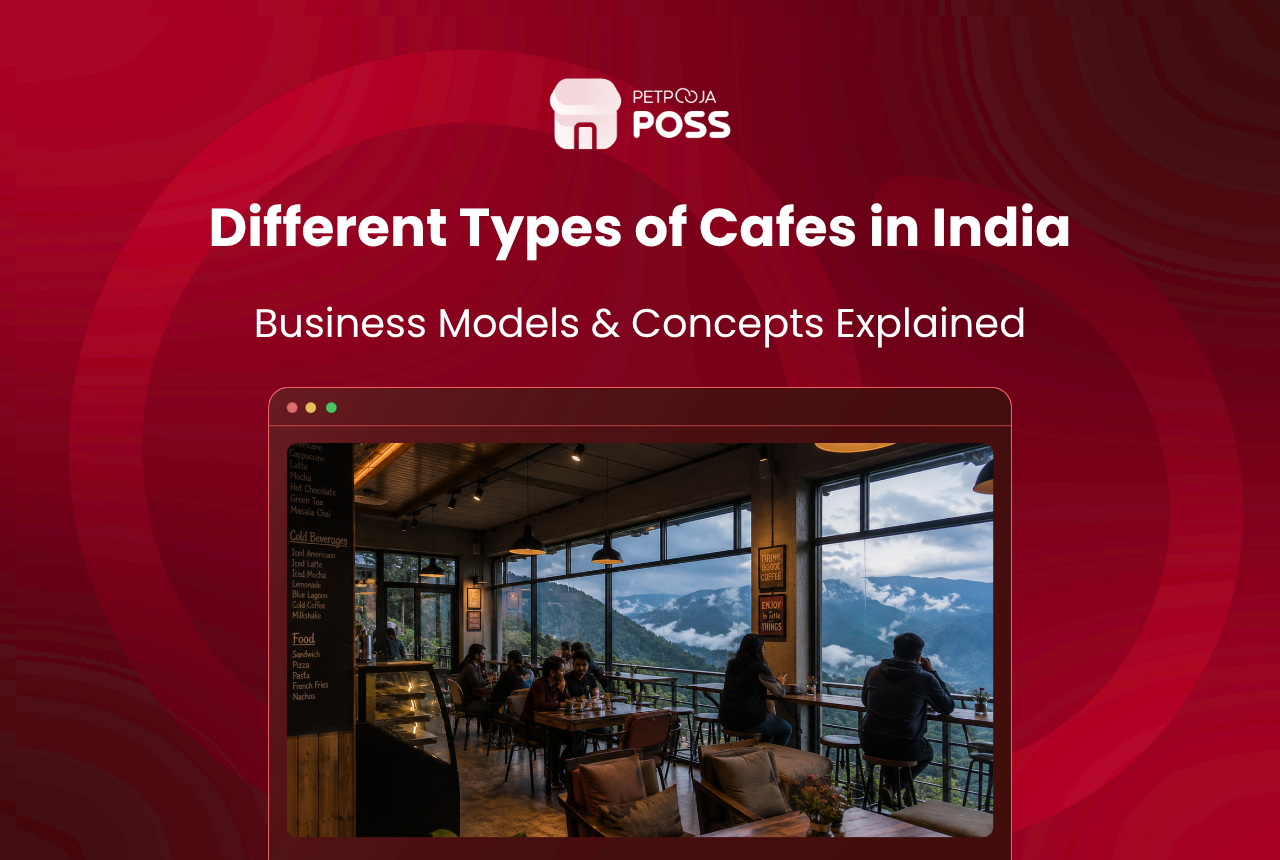
India has at least twelve distinct cafe formats. A pour-over bar in Indiranagar sells a single cup for Rs 380. Three streets away, a branded chai kiosk moves the same volume at Rs 40. Both turn a profit. Both get called cafes. The similarity ends there.
According to Mordor Intelligence, this market crossed USD 18.83 billion in 2025. Independent outlets still own 76% of it, though branded chains are chipping away at that share every quarter.
Below is what each format looks like from the inside, who actually walks in, and how the money works.
Key Takeaways
- India has 12 distinct cafe formats, from Rs 2 lakh kiosks to Rs 80 lakh hybrid cafes
- Chai cafes and QSC outlets offer the fastest payback (8-12 months in tier-2 cities)
- Cloud kitchens let you run multiple brands from one kitchen for Rs 5-12 lakh
- Specialty coffee works in metros but struggles below tier-1 cities
- Every format needs FSSAI registration and a billing system that handles multi-channel orders
- Hybrid cafes (cafe by day, bar by night) need the highest capital (Rs 40-80 lakh) but pull the highest ticket sizes
What Does a Specialty Coffee Cafe Look Like?
Specialty coffee is the highest-investment cafe format in India and the most geography-dependent. It prints money in Indiranagar or Bandra, but a 40-seat outlet in a tier-2 city struggles to fill tables on a Tuesday afternoon.
Third Wave Coffee reportedly crossed 200 outlets by late 2025, per company announcements. Blue Tokai operates over 200 cafes across 50-plus cities, with roasteries attached to some locations. Walk into either chain and the menu looks more like something from a wine bar. Beans listed by estate: Chikmagalur, Araku Valley, Coorg. Brew methods by name: pour-over, Aeropress, Chemex, cold drip.
Who pays Rs 350 for a black coffee with no sugar? Mostly urban under-35s in metros. That’s the audience, and it’s narrow. The cost side surprises first-time owners too. A commercial Mazzer or Mahlkonig grinder alone goes for Rs 2 lakh to Rs 5 lakh, and good luck finding a barista in Pune who understands extraction ratios without three months of training. All in, Rs 25 lakh to Rs 60 lakh.
Why Do Chai Cafes Scale So Fast?
Chai cafes have the widest margin gap among all cafe formats in India, which is why two chains alone crossed 800 outlets between them by early 2026. The franchise model keeps entry costs low, and summer menu pivots protect revenue through the off-season.
Do the maths on a kulhar of chai. It retails for Rs 80. The tea leaves, milk, sugar, and elaichi that go into it cost you maybe Rs 7 or Rs 8. That gap is why this format scales the way it does.
Chai Sutta Bar claims 650-plus outlets across 390 cities as of early 2026. Chaayos is close to 200 locations, per its investor updates, and started putting espresso drinks on the menu to bump the average bill. Both run on franchise models. Rs 15 lakh to Rs 25 lakh, and a brand with tight SOPs will have your outlet open in 45 to 60 days.
One thing catches new owners off guard, though. Between April and June in most of North India, hot chai sales drop hard. The outlets that stay afloat through summer are the ones that added iced teas, cold coffees, and snack combos early enough to hold per-visit spending above Rs 100 even when the temperature hits 42 degrees.
How Do Quick-Service Cafes Make Money?
Quick-service cafes are the highest-volume, lowest-dwell-time format. Everything is optimised for four-minute turnarounds, and the menu is deliberately short so three staff can handle a full rush.
Picture a 350 sq ft Starbucks counter at a Gurugram office park. Eight drinks on the board, no sofas, no WiFi password taped to the wall. You order, they make it, you leave. Under four minutes. CCD does the same thing near Pune railway station and a dozen college gates across Mumbai.
The only way this format pays rent is volume. Rs 150 to Rs 250 per person walking in, which means you need 250-plus of them every single day. Three staff on a shift can handle it because the same espresso base and the same milk jug feed seven of the eight menu items.
Which Types of Cafes in India Sell the Experience?
Some types of cafes in India have stopped selling the beverage as the main draw. They’re selling the room. Book cafes, board game cafes, and hybrid cafes like Social all fall into this category, and they run on repeat visitors rather than high daily footfall.
Book Cafes
Atta Galatta in Bengaluru is the reference point. Nobody taps your table and asks if you’d like the bill. People sit for two hours, three sometimes, nursing a flat white that went cold forty minutes ago.
Revenue per table per hour is terrible compared to a QSC, but these same people show up again next Saturday. And the Saturday after that. Leaping Windows in Mumbai works the same way.
You want this format near a university or a neighbourhood full of freelance writers. Aundh in Pune. Salt Lake sector V in Kolkata. Not inside a mall. Setup runs Rs 15 lakh to Rs 30 lakh, and you’ll be surprised how much of that budget goes into buying 800-odd books that guests will dog-ear, annotate, and spill cold brew on.
Board Game Cafes
Board game cafes collect a cover charge (Rs 150 to Rs 300 per head) on top of whatever food gets ordered. Most of the week’s revenue lands on Saturday afternoons (birthday parties) and Friday nights (group outings with college friends who don’t want to go to a bar).
Owners rarely budget for game replacement upfront. Then they watch a copy of Catan disintegrate after six months of daily use. Cards get bent in half, dice end up in someone’s jacket pocket, and instruction booklets go missing.
Hybrid Cafes
The hybrid cafe is Social’s invention, more or less. Laptops and cold brew before lunch. Cocktails and a DJ set after 7 PM. Bandra, Hauz Khas, Church Street.
Running one means your kitchen preps two completely different menus during the same shift, and the morning cooks and the evening bartenders share almost zero skills. Rs 40 lakh at minimum. Closer to Rs 80 lakh in a high-street spot where the landlord knows you need the address.
Which Cafe Formats Have the Lowest Entry Cost?
You don’t need Rs 30 lakh and a 1,000 sq ft shop to call yourself a cafe. The cloud kitchens and kiosks let you enter the market for as little as Rs 2 lakh, though each comes with its own set of trade-offs.
Cloud Kitchens
Cloud kitchens have no dine-in at all. A 200 to 400 sq ft room, sometimes a residential basement, sometimes a lane behind a commercial complex.
One operator we know of in Vastrapur, Ahmedabad, lists three separate cafe brands on Swiggy and Zomato. Different names, different logos, different menus. Same kitchen, same four cooks. Customers ordering a “Brew Bar” iced latte and a “Chai Republic” masala chai have no idea the two brands share a gas stove. That’s the cloud kitchen trick.
Rs 5 lakh to Rs 12 lakh to get going. The downside is that your entire existence hangs on your aggregator rating. One week of late deliveries, your Zomato score drops, and the order pipeline dries up overnight. We’ve written a longer breakdown in our cloud kitchen guide.
Kiosks and Takeaway Counters
Kiosks are the cheapest route in. Counter window at a metro exit or a mall food court. Fifty to 150 sq ft. Two people. No chairs. Rs 3 lakh to set up in a city like Nagpur or Bhopal. The catch: each customer spends Rs 80 to Rs 150, so unless 200-plus people buy something every day, the rent eats you alive.
What About Niche and Emerging Cafe Formats?
Both pet cafes and co-working cafes target narrow audiences in specific geographies. Neither works everywhere, but in the right city and neighbourhood, both can hold their own.
Pet cafes are the Instagram format. Rs 200 to Rs 500 entry. Cats walking between tables. Customers spending more time filming reels than drinking. Marketing costs are close to zero because the content makes itself.
The problem is everything behind the scenes: a vet on call, animal welfare board approvals, trained animal handlers on every shift, and deep-cleaning cycles that are twice as frequent as a normal cafe. When a reel goes viral, the next four weekends are fully booked. When it doesn’t, you’re staring at empty tables. This model only survives in Mumbai, Bengaluru, and parts of Delhi where the Rs 600-plus weekend-outing customer actually exists in large enough numbers.
Co-working cafes are a post-2020 invention, mostly. Freelancers and startup people stopped paying for WeWork memberships and started camping at whichever cafe had a stable connection and didn’t glare at them for sitting four hours on one coffee.
Some cafe owners in Jaipur, Chandigarh, and Ahmedabad caught on and started putting power sockets at every seat, buying a proper router, and charging Rs 200 to Rs 400 for a day pass on top of the regular menu. Works best in tier-2 cities where co-working chains haven’t colonised every block yet.
How Do Dessert Cafes and Franchise Models Work?
Dessert cafes and franchise outlets sit at opposite ends of the ownership spectrum. One you build from scratch; the other you buy as a ready-made playbook. Both can work, but the economics look nothing alike.
At a bakery cafe, the glass display counter does the selling. Croissants, layered cakes, artisanal sourdough, plated desserts with microgreens on top. The coffee and chai exist mostly so that people have something to drink while they eat the cake they came for. Metro outlets pull Rs 350 to Rs 600 per visit, and October through December is a different business entirely: birthday cakes, Diwali hampers, Christmas orders. Half the year’s profit can come from those three months. We cover the money side of this format in our bakery business types and revenue guide.
Franchise cafes are not really about you building anything. You’re paying for someone else’s playbook. Chai Sutta Bar, Chaayos, Tim Hortons, Barista. Their SOP manual, their supply chain, their brand name on the signboard. You pay royalty on sales. A chai franchise starts near Rs 15 lakh. An international brand like Tim Hortons runs past Rs 50 lakh once you factor in fit-out, equipment, and the security deposit. Note that some large chains like Starbucks (Tata JV) and CCD are entirely company-owned in India and don’t offer franchise models. Our post on cafe franchises worth investing in lays out each brand’s numbers.
What Must Every Cafe Format in India Get Right?
Regardless of which types of cafes in India you’re considering, three things are non-negotiable: FSSAI registration, a billing system that keeps up with multi-channel orders, and weekly food cost tracking.
- FSSAI registration — no exceptions, no minimum-size exemption. Turnover below Rs 12 lakh? Basic registration through the FoSCoS portal costs Rs 100. Cross that threshold and you’ll need a state FSSAI licence. Our FSSAI compliance checklist maps out every document and deadline
- A billing system that handles multi-channel orders — a kiosk with ten items can scrape by on a basic app, but a hybrid cafe taking dine-in, Swiggy, Zomato, and takeaway orders across 80-odd SKUs needs digital KOTs, split bills, and stock counts from one screen. Petpooja POSS handles that spread
- Weekly food cost tracking — check your food cost ratio every week, not every month. At Petpooja, we’ve seen too many cafe owners discover a margin problem in their month-end P&L that started bleeding in the first week
Conclusion
The types of cafes in India range wildly. On paper, a Rs 8 lakh cloud kitchen in Maninagar, Ahmedabad, and a Rs 55 lakh specialty roaster on MG Road, Bengaluru, belong to the same industry. In practice, they share almost nothing. Not the customer, not the equipment, not the daily routine. Pick a format that fits your city, your capital, and the kind of mornings you’re willing to have for the next three years. Then go sit in five cafes in your target neighbourhood before signing any lease. Watch where the money comes from. That tells you more than any comparison table.
Frequently Asked Questions
Chai cafes and quick-service outlets, usually. Ingredient costs are minimal, footfall is high, and a chai cafe in Indore or Surat with rent under Rs 25,000 a month can recover its investment within 8 to 12 months. Format matters less than location and how tightly you run operations.
Depends entirely on format. A kiosk can start at Rs 2 lakh. A mid-range independent cafe in a tier-1 city lands between Rs 15 lakh and Rs 40 lakh. International franchise brands can run past Rs 50 lakh. Our guide on opening a cafe in India has a format-by-format breakdown.
Yes. There is no exemption for size.
Chai cafes, kiosks, and bakery-dessert formats. Familiar products, accessible prices. Specialty coffee is showing up in Jaipur and Coimbatore now, but the customer base willing to pay Rs 300 for a pour-over is still small outside the top six or seven metros.
Yes, cloud kitchen operators do this all the time. You list two or three virtual brands on Swiggy and Zomato, each with a different name and menu, and produce everything from the same unit. You’ll need a POS that routes orders to the right brand queue so the kitchen doesn’t mix up a cold brew order with a chai order from a different brand.
Social in Mumbai is the easiest reference point. Full meals on the menu, but the vibe is casual. No dress code, no reservations, WiFi is a given, and nobody minds if you sit for four hours. A restaurant, by comparison, wants you to finish and leave so the next table can sit down. That’s the core difference. We’ve covered this model in more detail in our hybrid restaurant post.