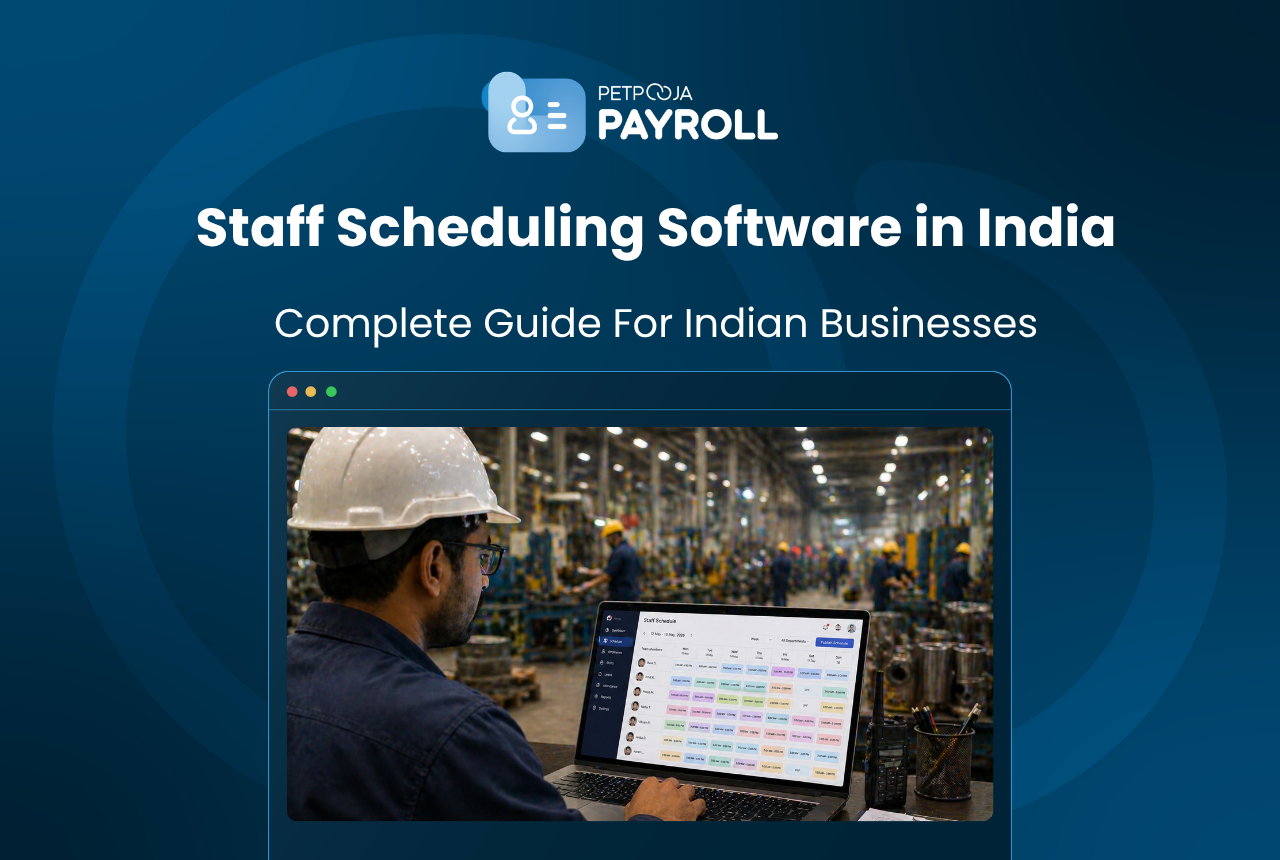
Staff scheduling software is a digital roster builder that takes your operating hours, employee availability, and demand patterns, then produces a conflict-free weekly timetable and pushes it to every worker’s phone. It replaces Excel sheets, WhatsApp group forwards, and handwritten registers with a system that flags overtime breaches, unfilled gaps, and compliance violations before they cost you money.
If you manage 10 or more shift-based workers in India, scheduling software will cut your roster-building time from 4-6 hours a week to under 30 minutes, reduce overtime budget overruns, and help you retain frontline staff who would otherwise quit over unpredictable shifts.
A garment factory in Pimpri-Chinchwad running three shifts for 85 tailors found an undetected roster overlap on 14 March 2025 that cost ₹41,600 in unbudgeted overtime for one week alone. A diagnostic lab chain in Salt Lake, Kolkata lost two senior technicians in January 2026 after back-to-back double shifts went unnoticed until resignation letters landed on the HR desk. These are not edge cases. At Petpooja, we see this pattern repeat across 30,000+ Attendo clients every quarter.
Key Takeaways
- Roster-building time drops from 4-6 hours weekly to under 30 minutes with scheduling software
- India’s workforce management software market is growing at 6.17% CAGR through 2031, with Asia Pacific being the fastest-growing region
- Frontline worker attrition in India ranges from 25-35%, and predictable scheduling is one of the cheapest retention levers available
- Average daily wages for casual workers rose from ₹294 in 2017 to ₹455 in 2025, making every unplanned overtime hour costlier than ever
- Businesses publishing rosters 7 days in advance retain 20-25% more frontline staff over 12 months
What Does Staff Scheduling Software Do?
Three inputs go in: staff availability, business hours, and demand patterns. One output comes out: a weekly timetable that respects leave requests, overtime caps under the Factories Act, and mandatory rest days under Indian labour law.
The software distributes finished rosters to employee phones, so nobody needs to check a notice board or wait for a manager’s WhatsApp message on Sunday night.
| Feature | What It Solves |
|---|---|
| Auto-roster generation | No more Monday morning manual scheduling |
| Shift swap via app | Staff trade shifts themselves instead of calling managers at 11 PM |
| Overtime alerts | Warns before exceeding 48 hours/week under the Factories Act |
| Gap notifications | Unfilled shifts flagged Saturday, not on the day itself |
| Attendance sync | Scheduled shifts match punch-in data for accurate salary calculation |
| Multi-branch dashboard | One screen view across all your locations |
Staff scheduling software is a digital roster builder that takes employee availability, operating hours, and demand patterns as inputs, then generates conflict-free weekly timetables. It distributes schedules to staff phones, flags overtime breaches under the Factories Act, and syncs with biometric attendance for accurate payroll processing.
Most business owners overlook the attendance sync row in that table, but it matters more than everything else combined. Without it, you end up reconciling two separate systems at month-end: what was planned versus what actually happened. That reconciliation alone eats 3-4 hours for a 50-person team.
Why Does Scheduling Matter More in 2026 Than It Did in 2022?
The short answer: labour got expensive, workers got choosy, and software got cheap. All three happened in the same four-year window.
According to the Periodic Labour Force Survey by MoSPI, average daily wages for casual workers climbed from ₹294 in July 2017 to ₹455 by 2025. That is a 55% jump. For a 40-person QSR chain in Hyderabad or a two-shift manufacturing unit in Bhiwandi, every unplanned overtime hour now burns through a much bigger chunk of the monthly wage bill than it did even two years ago.
Then there is the attrition problem. India’s overall attrition rate stood at 17.1% in 2025, but among frontline and blue-collar workers the number sits between 25% and 35% across manufacturing, logistics, and retail. The NRAI India Food Services Report 2024 found close to 60% of food service operators face shortages in kitchen and service roles. Unfair rosters are a top reason people walk out. When the same person keeps drawing the Sunday closing shift while others skip it, that person resigns. Good scheduling software distributes shifts equitably without the manager having to think about fairness.
Average daily wages for casual workers in India climbed 55% from ₹294 in 2017 to ₹455 in 2025, according to the Periodic Labour Force Survey by MoSPI. Frontline attrition runs between 25% and 35%, and the NRAI found 60% of food service operators face kitchen and service staff shortages, making automated scheduling a financial priority for Indian SMEs.
On the pricing side, cloud-based roster tools now account for over 68% of deployments worldwide. Flat annual subscriptions have replaced per-employee pricing that balloons every time you hire someone new.
Which Industries in India Need Roster Planning Software?
Over 70% of India’s workforce operates outside a desk setup, according to IBEF. If your workers rotate through shifts, you need scheduling software regardless of what your business sells or makes.
Manufacturing plants are the most obvious case. Three rotational shifts, mandatory weekly rest days under the Factories Act, and missing even one rest day triggers a compliance violation that costs more than a full year of software subscription. A plastic moulding unit in Bahadurgarh with 60 operators on rotating shifts cannot afford to build rosters on a whiteboard.
Hospitals and diagnostic labs sit at the other end of the complexity spectrum. They need 24/7 coverage without any staff member exceeding 10-hour daily caps. Consider a pathology chain expanding from 4 to 9 centres across Pune. The operations head simply cannot remember who worked where last Tuesday, let alone plan next week’s coverage across all branches.
Retail chains face a different version of the same headache. Morning, afternoon, and closing shifts across multiple locations in the same city. No store manager should spend Sunday evenings on WhatsApp asking “who’s coming tomorrow?”
For quick commerce and logistics firms, rider shift start times directly determine whether delivery promises get met. Zepto, a Attendo (formerly Petpooja Payroll) client, operates at this intensity across hundreds of dark stores daily.
Coaching centres round out the list. A chain in Jaipur with 12 faculty members teaching at three centres needs shift visibility that a shared Google Sheet cannot provide, especially when two teachers call in sick on the same morning.
Over 70% of India’s workforce operates outside a desk setup, according to IBEF. Manufacturing plants, hospitals, retail chains, logistics firms, and coaching centres all manage rotating shifts. Any business with 10 or more shift-based workers faces the same scheduling coordination problem regardless of industry.
How Do You Pick the Right Scheduling Tool?
Every tool claims to “solve scheduling.” Here is what actually separates the useful ones from the rest.
1. Attendance hardware integration. If your biometric device runs on a separate system, you will still spend hours reconciling shift data with punch data every month. Attendo connects scheduling, biometric attendance, and salary calculation in one flow. It ships with its own face-recognition hardware, so there is nothing extra to buy or integrate.
2. Support for non-standard shift patterns. Hotel housekeeping teams in Goa often work split shifts: 6-10 AM, then back at 4-8 PM. BPOs in Bangalore rotate between day, evening, and night on a weekly cycle. If a tool only handles standard 8-hour blocks, it will not survive contact with your actual operations.
3. Mobile notifications for staff. Notice board rosters do not work when your delivery riders or field sales team never set foot in the office. The tool needs to push next-week schedules to employee phones via an app, not rely on managers forwarding PDFs on WhatsApp at 10 PM.
4. Indian labour law awareness. The Shops and Establishments Act, the Factories Act 1948, and state-specific rules all cap working hours, mandate rest days, and limit overtime. A good tool warns you before the roster goes live. A bad one stays quiet until the labour inspector shows up.
5. Pricing at scale. Run the numbers. Per-head pricing at ₹80/employee/month becomes ₹1.92 lakh annually for 200 employees. Flat-rate pricing does not penalise you for hiring.
The Factories Act 1948 caps weekly working hours at 48 and mandates overtime pay at double the ordinary rate. Any scheduling tool that does not flag these limits before roster approval is a compliance risk, not a productivity tool.
How Do Popular Scheduling Tools Compare?
| Feature | Attendo | greytHR | Keka | PagarBook |
|---|---|---|---|---|
| Shift scheduling | Auto-roster | Yes | Yes | Basic only |
| Biometric/face attendance | Built-in hardware | Third-party | Third-party | Mobile punch only |
| Indian labour law alerts | Auto-flags violations | Manual setup | Partial | No |
| Mobile app for staff | Android + iOS | Yes | Yes | Android only |
| Pricing model | Flat annual fee | Per-employee/month | Per-employee/month | Per-employee/month |
| Multi-branch roster view | Yes | Paid add-on | Yes | No |
Do Predictable Rosters Actually Reduce Staff Turnover?
Here is something we have noticed across our Payroll client base: businesses that publish rosters 7 days ahead see 20-25% fewer monthly exits compared to those announcing schedules just 24-48 hours before.
Why? Because a delivery executive in Hyderabad who knows Wednesday is his off day can book a doctor’s appointment without anxiety. A retail associate in Vastrapur who discovers her shift changed at 9:30 PM the night before does not call in sick. She opens Naukri.
Replacing a single frontline worker costs roughly 40% of their annual salary, according to TeamLease. Businesses that publish rosters seven days in advance retain 20-25% more frontline staff over 12 months compared to those announcing shifts 24-48 hours before, making predictable scheduling one of the cheapest retention tools available.
The maths backs this up. Replacing a single frontline worker costs roughly 40% of their annual salary once you factor in recruiting, training, and the productivity dip during the transition period. For a team of 50 people earning average monthly salaries of ₹18,500, losing 5 workers per quarter to avoidable attrition burns through over ₹4.4 lakh a year. Predictable rosters cost nothing extra to implement through software. The retention benefit shows up in lower rehiring bills by the third month.
Conclusion
Any Indian business with 10 or more shift-based workers is spending more on manual rostering in 2026 than it would on software. Daily wages climbed 55% since 2017. Frontline attrition runs at 25-35%. Every overtime miscalculation and every resignation triggered by an unfair roster has a rupee value attached to it, and that value keeps going up.
Attendo bundles shift scheduling with biometric attendance and salary processing into one flat-fee package with no per-employee charges. If your operations manager still builds Monday’s roster on an Excel sheet that needs corrections by Wednesday, the fix is not a better spreadsheet.
FAQs
You feed it three things: employee availability, your operating hours, and demand patterns. The software builds a weekly roster, pushes it to staff phones, and flags conflicts like double-bookings or overtime limit breaches before the schedule goes live. It also syncs with attendance hardware so payroll runs off actual data, not guesswork.
Manufacturing, hospitals, retail, logistics, coaching centres, and restaurants all deal with rotating shifts. A textile factory in Surat running two shifts faces the same coordination headache as a multi-branch diagnostic lab in Chennai. If you have 10 or more workers on shifts, the industry does not matter.
It does, and the mechanism is simple. People who know their schedule a week ahead can plan their lives around work. Businesses publishing rosters on Saturday for the coming week retain 20-25% more frontline staff over a 12-month period compared to those announcing shifts one day before.
The Factories Act caps weekly hours at 48. The Shops and Establishments Act mandates rest days. State-specific rules add more constraints. A good scheduling tool flags all of these before you approve the roster, not after a labour inspector shows up at your gate.
Per-employee pricing runs ₹50 to ₹150 per month and gets expensive fast once you cross 80-100 staff. Flat-rate annual plans bundle roster planning, attendance, and salary processing at a fixed cost no matter how many people you hire. Growing businesses almost always save more with flat-rate models.