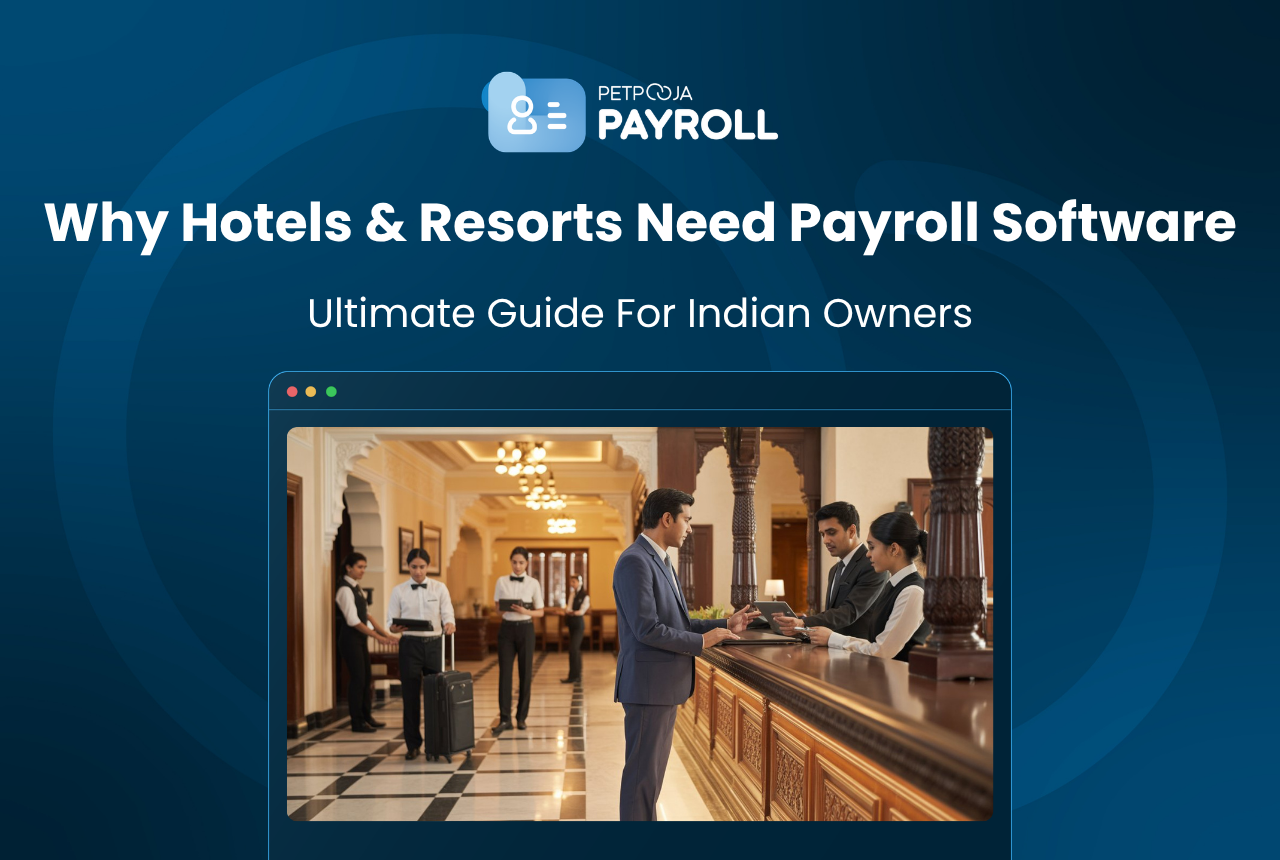
Hotels and resorts need payroll software because their operations don’t follow a standard Monday-to-Friday pattern. Your front desk runs three shifts. The kitchen works split hours. Housekeeping scales up in October and halves by June. And somewhere between tracking PF for permanent staff, ESIC for contract housekeepers, and minimum wages that differ between Rajasthan and Kerala, your HR manager is losing two full days every month just reconciling attendance registers before salaries can even be processed.
The problems go deeper than slow processing. Buddy punching at 11 PM shift changes, overtime miscalculations for cooks working broken hours, and the ₹87,000 a year that a 90-room property bleeds from ghost attendance entries alone. Payroll software built for shift-based, multi-department operations fixes all of this. The generic kind built for corporate offices doesn’t.
India’s tourism sector supported 46.5 million jobs in 2024 (IBEF, 2025). Bulk of those jobs sit inside hotels and resorts. Yet most mid-size operators in cities like Udaipur, Kochi, or Rishikesh still run payroll through Excel or their CA’s office.
Key Takeaways
- Hotels run 6+ departments on rotating shifts, making manual payroll slow and error-prone.
- Indian hospitality sees 30% annual attrition, and late salaries are a top reason staff walk out.
- Switching to payroll software brings monthly processing down from 5-7 days to under 6 hours.
- Face recognition attendance kills buddy punching at shift-change hours for good.
What Makes Hotel Payroll So Different?
A textile unit in Surat runs two fixed shifts. A diagnostic lab in Pune might run three. But a 120-room hotel in Jaipur? That’s a 24-hour, 365-day operation spread across six departments, and none of them follow the same shift pattern.
Front office rotates between morning, evening, and night. Housekeeping staffing depends on occupancy, which changes weekly during wedding season. The kitchen operates split shifts where a cook clocks in at 7 AM, goes home at 11, and comes back at 5 PM for dinner prep. Banquet waiters only show up when there’s an event booked. Security runs 12-hour cycles. Each group earns differently too.
Consider the pay math alone. A front office executive drawing ₹18,500 per month follows a different salary structure from a banquet server earning ₹650 per event, or from a contract housekeeping staffer whose wages are pegged to state-level minimum wage notifications.
Then there’s seasonality. A beach resort in South Goa might have 45 staff during monsoon and 110 from November through March. No spreadsheet handles a workforce that triples and shrinks back without breaking something, usually the March payroll.
What Are the Biggest Payroll Problems in Hotels?
1. Ghost attendance bleeds money quietly
Nobody’s watching the register at 11 PM when the night shift starts. Staff punch in for absent colleagues, and unless someone cross-checks CCTV footage the next morning (which nobody does consistently), those entries stick. Five ghost punches a month at ₹580 average daily wage across a 90-person property? That’s ₹87,000 gone every year. You won’t spot it in any single month’s numbers, but it compounds.
2. Split-shift overtime is a nightmare on paper
Your tandoor cook clocks in at 7 AM, leaves by 11, returns at 5 PM, and wraps up by 10 PM. That’s 9 hours of work with a 6-hour gap in between. Now someone in HR has to pull two attendance entries, add them up, compare against the daily hour limit, and check if overtime applies. Do this for 30 kitchen staff over 30 days and you’re staring at 1,800 manual calculations for one department alone.
3. Mixed workforce, mixed compliance rules
At Petpooja, we’ve seen this pattern across hundreds of hotel clients: three types of workers on one property, simultaneously. Permanent staff enrolled in PF and ESIC. Contract housekeeping workers supplied by an outside agency. Seasonal hires on fixed-term agreements for the tourist rush. Each group falls under different statutory deduction rules. Miss a PF deposit for even one category, and Section 14B of the EPF Act kicks in: up to 5% p.a. damages for delays under two months, scaling to 25% p.a. for delays beyond six months, plus 12% annual interest on the unpaid amount (SimpleTaxIndia, 2025).
4. Late salaries push your best people out the door
Here’s the reality of hospitality staffing. The attrition rate sits at 30% nationally, and 60% of the workforce is under 30 (WiFi Talents, 2026). At one five-star property in Bangalore, 70% of a new recruit batch resigned within 16 months, driven by gruelling 12-hour shifts, erratic schedules, and cancelled weekly offs (Deccan Chronicle, 2025). Younger workers don’t wait around. A 200-room resort near Mahabaleshwar shared with us that they lost four trained front-desk executives in one quarter because salary credits kept slipping past the 7th of the month. The replacement cost per hire, between job postings, training, and the gap period, ran closer to ₹35,000 each time.
5. Minimum wages differ by state, and they keep changing
Suppose your hotel chain operates in Rajasthan, Kerala, and Maharashtra. That’s three different minimum wage schedules right there. Rajasthan revised its rates in January 2026. Kerala classifies hotel workers separately from general unskilled labour. Maharashtra has its own notification timeline. Keeping track manually is doable for one property, maybe. For three or more? That’s where compliance mistakes creep in, usually without anyone noticing until an inspection.
What Does the Right Payroll Software Actually Do for Hotels?
Most hotel owners think payroll software is basically a salary calculator. Fair assumption, but wrong. The real value shows up in attendance tracking and shift management, which is where 70% of the month-end chaos originates.
Take face recognition attendance, for instance. Instead of a register or a fingerprint scanner that fails when kitchen staff have greasy hands, you mount a device at the staff entrance. The person looks at it, gets marked in under two seconds, done. Buddy punching becomes impossible. Petpooja Payroll’s face scanner ships with a lifetime warranty and works in the dim lighting typical of hotel back-of-house corridors.
Shift management is the other big piece. You create templates for your morning, evening, night, and split shifts once. Assign them department-wise. From that point, the system maps each attendance punch to the correct shift and calculates regular hours, overtime, and shortfalls on its own. No more HR staff sitting with a calculator on the 28th.
For compliance, the software applies PF, ESIC, and TDS deduction rules based on each person’s salary bracket, employment type, and state. Your CA gets reports in the exact format they need.
What we’ve noticed across 30,000+ Payroll clients: Hotels that move from manual to software-based payroll cut processing from 5-7 days to 4-6 hours per month. The biggest chunk of time saved comes from attendance reconciliation, not the salary math.
And a small touch that matters more than you’d think: salary slips land on each employee’s WhatsApp the moment payroll is done. The “sir, mera salary slip?” messages to HR on the 2nd of every month? Gone.
How Should Hotels Choose the Right Payroll Software?
Not every payroll product works for hospitality. Most are built for Monday-to-Friday office setups and fall apart the moment you need rotating night shifts or seasonal headcount swings. Before committing, make sure the software handles these specifics:
| Feature | Why It Matters for Hotels |
|---|---|
| Face recognition hardware | Kills buddy punching during unsupervised shift changes at odd hours |
| Flexible shift module | Lets you map morning, evening, night, split, and on-call shifts per department |
| Multi-department pay structures | Supports different salary grades for F&B, housekeeping, front office, banquet |
| PF/ESIC/TDS engine | Applies the right statutory rules to permanent, contract, and seasonal workers |
| Employee self-service app | Staff check their own attendance, leave balance, and payslips from their phone |
| Geo-tagged mobile attendance | Tracks banquet and outdoor event staff working away from the main property |
| Multi-property dashboard | Centralises payroll across all your hotel locations in one place |
| WhatsApp reports | Sends attendance summaries and salary slips straight to each person’s phone |
Petpooja Payroll ticks all eight boxes. It ships with its own biometric and face recognition hardware bundled into the subscription, so you’re not buying devices from one vendor and software from another. Over 30,000 businesses, including hotels, factories, retail chains, and restaurant groups, already run on it.
Getting Started: What Setup Looks Like for a Typical Hotel
The onboarding usually wraps up within a week. Here’s how it played out for a 70-room property in Coimbatore that we onboarded last quarter:
First, they mapped out their six departments (front office, housekeeping, F&B service, kitchen, maintenance, security) and defined four shift templates. Took about an hour on the dashboard.
Next, the Petpooja team shipped two face scanner devices. One went at the main staff entrance near the loading bay, the other at the basement corridor. Both connected over Wi-Fi in minutes. Each device handles up to 200 employees.
Employee data went in through a bulk upload. They exported their existing staff list from Excel, cleaned up the columns, and uploaded 68 people in about 90 seconds. Name, department, salary, PF number, ESIC status, all in one go.
After one full month of attendance data, they ran their first payroll cycle. PF, ESIC, and TDS got calculated based on the rules they’d configured during setup. The whole run took under two hours, down from the four days their admin team used to spend.
Want to see if it fits your property? Reach out to the Petpooja Payroll team at +91-72280 34343 or drop a mail to getpayroll@petpooja.com.
Conclusion
A hotel’s payroll isn’t like an office payroll, and treating it like one creates problems that show up as salary delays, compliance penalties, and staff walkouts. Between rotating shifts, seasonal hiring, split-hour kitchen schedules, and PF/ESIC rules that change by worker category and state, the manual approach simply can’t keep pace once you cross 40-50 employees.
The right software takes over attendance reconciliation, shift mapping, and statutory calculations so your HR team can focus on hiring and retention instead of firefighting spreadsheets every month-end. If your hotel still runs payroll on Excel, the shift-based attendance and payroll tools available today are worth a serious look.
Ready to make the switch? See how Petpooja Payroll works and decide for yourself.
Frequently Asked Questions
Absolutely. A good system lets you define split shifts where one person clocks in and out twice in the same day. The software adds both stints together, checks the total against daily hour limits, and flags overtime if needed. Petpooja Payroll supports split, rotating, and fixed shift types, and you can assign different patterns to different departments.
It should, and most decent ones do. PF is calculated at 12% of basic wages, ESIC applies for employees earning up to ₹21,000 per month. The software generates challans in the format needed for online filing. Where hotels benefit most is in handling permanent and contract workers under the same roof, since each group follows different eligibility rules that are easy to mix up manually.
The scanner uses infrared sensors, so lighting doesn’t matter much. Staff stand in front of the device for about two seconds, and the system logs them with a timestamp. It’s more reliable than fingerprint-based devices for hotel settings because kitchen and housekeeping staff often have wet or greasy hands that cause fingerprint misreads.
Cloud-based tools typically charge ₹20 to ₹80 per employee per month. For a 60-person hotel, that lands between ₹1,200 and ₹4,800 monthly. Compare that with the ₹9,000 to ₹18,000 your HR team spends in admin hours doing it manually. Some providers, like Petpooja payroll, bundle hardware with the Software subscription, which brings the total cost of ownership down further. Here’s a comparison of the best payroll software for small businesses in India.
Yes, provided it has multi-property support. Each location keeps its own departments, shift schedules, and state-specific compliance settings while your head office sees everything from a single dashboard. This matters when you’re operating across states like Rajasthan and Kerala where minimum wage rates and labour classifications differ.