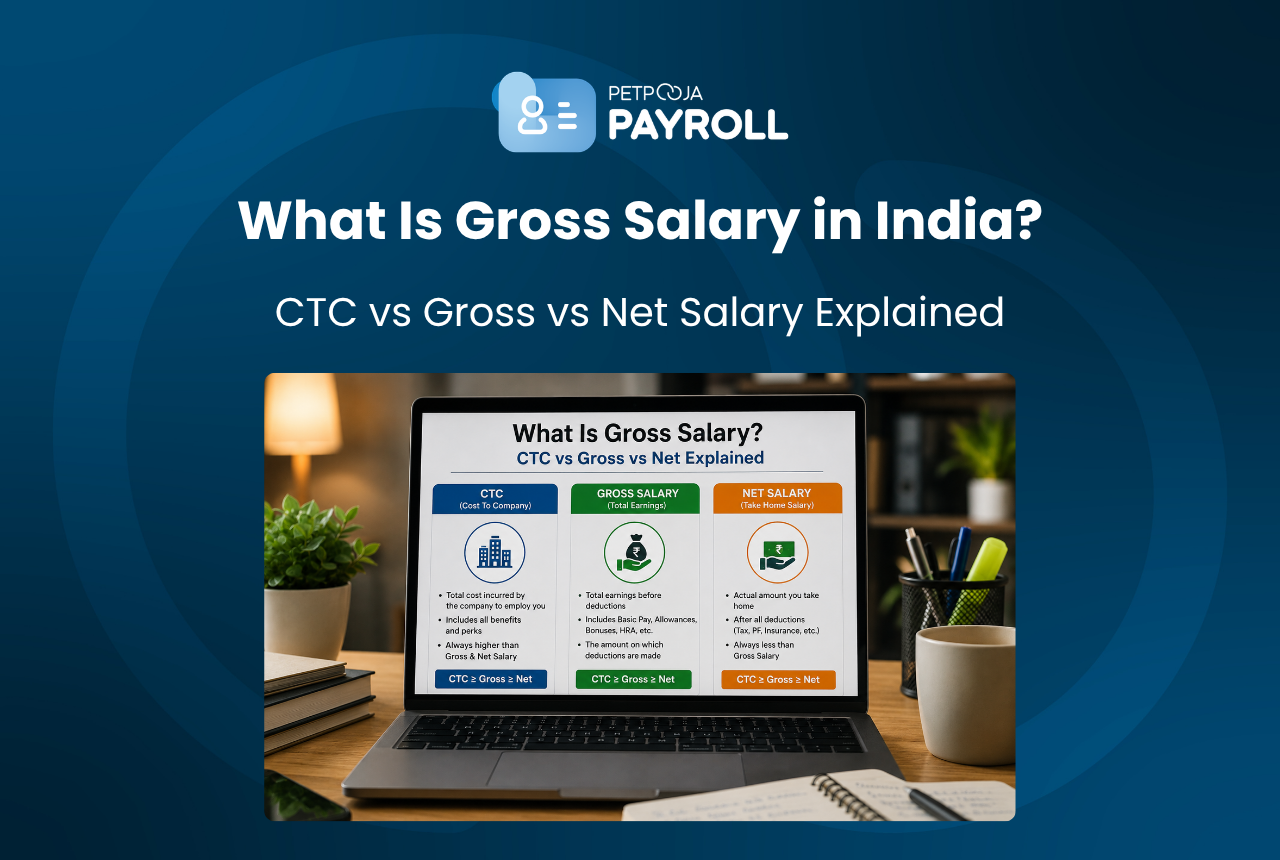
Gross salary is what an employee earns before deductions but after the employer’s hidden costs have been pulled out of CTC. The formula: Gross = CTC minus Employer’s PF minus Employer’s ESI minus Gratuity. Net salary is the bank-account number: gross minus the employee’s own PF, ESI, income tax, and professional tax.
Every Indian salary slip carries three figures. CTC sits at the top and includes money the employee never touches. Gross lives in the middle. Net, the one that matters on the 1st of the month, sits at the bottom. The distance between CTC and net at most companies is 20-30%, and the rest of this post unpacks where that chunk disappears.
Key Takeaways
- CTC is the total cost the employer bears, including their PF, ESI, and gratuity contributions.
- Gross salary = CTC minus employer PF, employer ESI, and gratuity.
- Net salary = Gross minus employee PF, employee ESI, TDS (income tax), and professional tax.
- Basic pay is typically 40-50% of CTC. HRA is usually 40-50% of basic.
- Employee PF contribution is 12% of basic plus dearness allowance.
What Actually Goes Into CTC?
CTC stands for Cost to Company. Not a salary figure. The total annual bill the employer pays for one person, including things that bypass the employee’s bank account entirely.
Basic salary makes up 40-50% of CTC at most Indian companies. HRA rides on top of that at 40-50% of basic. Then comes a “special allowance” or “flexible benefit plan,” which is really just the residual number that plugs the gap between the named components and the CTC total. Payroll teams in Surat, Indore, and Coimbatore all have their own names for this line item, but the purpose is identical everywhere: it absorbs whatever is left.
The parts the employee never sees in the bank:
- Employer’s PF contribution: 12% of basic + DA, capped at Rs 1,800 per month when basic crosses Rs 15,000
- Employer’s ESI contribution: 3.25% of gross wages, but only when gross stays at or below Rs 21,000 per month as per the ESIC
- Gratuity provision: 4.81% of basic, representing 15 days’ wages per year under the Payment of Gratuity Act, 1972
- Annual performance bonus, if the company guarantees it in the offer
An offer letter that reads Rs 6,00,000 CTC does not deposit six lakhs into anyone’s account. After twelve months of payslips, the bank statement adds up to somewhere around Rs 4,20,000 to Rs 4,70,000. The missing Rs 1,30,000 to Rs 1,80,000? PF, gratuity, TDS, professional tax, and sometimes ESI. Nobody stole anything. The money just lives in different pockets.
How Does Gross Salary Fit Between CTC and Net?
Strip out the employer’s contributions from CTC and what remains is gross. The employee did not pay those contributions. The employer did. But CTC counts them because CTC measures cost, not pay.
Gross = CTC – Employer’s PF – Employer’s ESI – Gratuity
Take the example of an operations executive at a 40-person packaging unit in Baddi, Himachal Pradesh. CTC: Rs 4,80,000 per year, or Rs 40,000 per month.
| Component | Monthly (Rs) | Annual (Rs) |
|---|---|---|
| Basic salary (45% of CTC) | 18,000 | 2,16,000 |
| HRA (50% of basic) | 9,000 | 1,08,000 |
| Special allowance | 7,160 | 85,920 |
| Employer’s PF (12% of basic) | 2,160 | 25,920 |
| Employer’s ESI (3.25% of Rs 34,160 gross) | 1,110 | 13,320 |
| Gratuity (4.81% of basic) | 866 | 10,392 |
| Performance bonus | 1,704 | 20,448 |
| CTC | 40,000 | 4,80,000 |
Gross = Rs 40,000 – Rs 2,160 (employer PF) – Rs 1,110 (employer ESI) – Rs 866 (gratuity) = Rs 35,864 per month.
That Rs 35,864 is the number printed against “gross salary” on the payslip. The other Rs 4,136 the employer routed to PF, ESI, and the gratuity reserve never touched the employee’s hands. Both figures are accurate. They describe different things. Download our CTC salary structure calculator template to build this breakup for your own team.
What Eats Into Gross Before the Bank Transfer?
Four bites come out of gross every month. They are not all the same size, and they do not all go to the same place.
The biggest one is PF. The employee pays 12% of basic plus dearness allowance into their EPF account under EPFO rules. On a basic of Rs 18,000, that is Rs 2,160 per month. This money is not lost. It sits in the employee’s PF balance and is withdrawable on resignation or retirement. But it does not show up in the bank on salary day.
Then comes ESI, at 0.75% of gross, but only for workers whose gross wages fall at or below Rs 21,000 per month. In our Baddi example, gross is Rs 34,160, which crosses the ceiling. So ESI does not apply here. We included the employer’s ESI line in the CTC table above to show where it would sit when applicable. For a warehouse helper in Manesar earning Rs 16,800 gross, though, the 0.75% deduction of Rs 126 comes off every month.
TDS is the unpredictable one. The accounts team estimates annual taxable income, picks the applicable slab under whichever regime the employee chose, and spreads the tax across twelve months. Under the new tax regime for FY 2025-26, a Rs 75,000 standard deduction applies before the slabs kick in. Our salary structure guide breaks down how each regime changes the payslip.
Last, professional tax. State-level, capped at Rs 2,500 per year under Article 276. Maharashtra takes Rs 200 a month (Rs 300 in February, because someone in the state legislature decided one month should be different). Karnataka also charges Rs 200. Rajasthan charges nothing.
Net = Gross – Employee PF – Employee ESI (if applicable) – TDS – Professional Tax
Back to the Baddi example: no ESI (gross is above Rs 21,000), TDS of roughly Rs 1,458 under the new regime, professional tax of Rs 200. Net lands at Rs 35,864 – Rs 2,160 – Rs 1,458 – Rs 200 = approximately Rs 32,046 per month. Plug it into our in-hand salary calculator to verify, and use the PF & ESI compliance checklist to make sure deposit dates are not missed.
Why Does Every Offer Letter Lead With CTC?
Bigger number. That is the honest reason.
The operational reason is different. When the accounts head at a textile showroom in Surat budgets for a new floor manager, the line item is CTC because that is what the company actually pays out across salary, PF, ESI, and gratuity. The floor manager, meanwhile, only cares about what hits the bank.
We have watched this gap create problems across our Payroll client base. A Rs 5,40,000 CTC offer sounds like Rs 45,000 a month to the candidate sitting across the table. The first payslip lands at Rs 36,800 in the bank. Nobody explained the breakup. The employee assumes the accounts department made an error. By the second month the relationship is already strained. A single CTC-to-net table stapled to the offer letter, the same kind of table we printed above for the Baddi example, would have killed that confusion before it started.
One more thing worth knowing: the Income Tax Act, 2025 (effective FY 2026-27) keeps the standard deduction at Rs 75,000 under the new regime. Tax exemptions under the old regime (80C, 80D, HRA) still exist but only if the employee opts in. For most workers drawing a CTC below Rs 12,00,000, the new regime leaves more in the bank.
Conclusion
CTC is what the company spends. Gross is what is left after the company’s own PF, ESI, and gratuity obligations come off the top. Net is what survives the employee’s deductions and actually reaches the bank. The 20-30% gap between CTC and net is not a mystery once the components are laid out.
Attendo (formerly Petpooja Payroll) breaks CTC into the right components, runs PF and ESI at the correct rates, calculates TDS against the regime the employee picked, and prints the in-hand figure on every payslip. Use the free CTC calculator to run the numbers before the next offer goes out.
Frequently Asked Questions
No. Basic is one slice of gross. Gross adds HRA, special allowance, and every other recurring pay head on top of basic before deductions are taken out.
Happens all the time. Consider the example of two delivery supervisors at a logistics firm in Pune, both at Rs 5,00,000 CTC. One files under the old tax regime claiming 80C and 80D. The other picks the new regime. Monthly in-hand differs by Rs 1,500 to Rs 2,500 between them, and neither payslip is wrong.
The employer’s 12% goes from the company’s pocket to the PF account. It does not touch gross or net. The employee’s 12%, on the other hand, comes straight out of gross before the bank transfer.
When basic plus DA crosses Rs 15,000 a month, the employer has the option to cap PF at 12% of Rs 15,000 = Rs 1,800 instead of 12% of actual basic. Not every company exercises this option. The ones that do save on employer PF cost, and the employee’s monthly PF deduction drops too.
CTC includes it. Gross does not. The employer sets aside 4.81% of basic each month as a reserve. The employee only receives that money after five continuous years of service, as per the gratuity calculation rules.