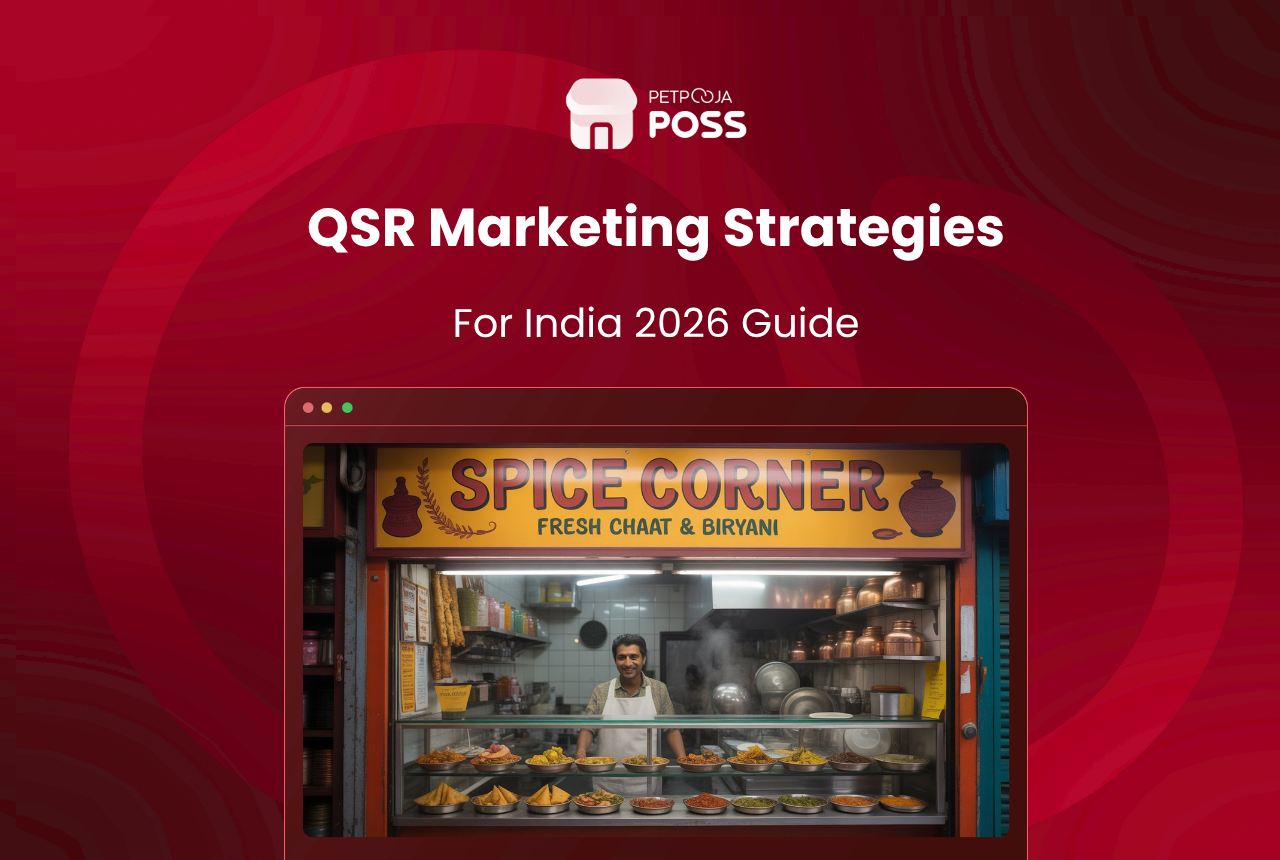
The five marketing strategies that work best for Indian QSRs right now are: setting up your Google Business Profile properly, posting hyper-local social media content, running a loyalty programme through your POS, optimising your Swiggy and Zomato listings, and partnering with micro-influencers in your city. Each one costs less than a full-page newspaper ad and brings in measurable footfall or orders.
India’s quick-service restaurant market is worth USD 27.80 billion as of 2025 and is projected to cross USD 47 billion by 2031. With over 5,00,000 outlets operating across the country, the competition is intense. You do not need a big budget to stand out. You need the right five tactics, done well and done consistently.
This guide breaks down each strategy with specific steps, real examples, and costs, so you can start this month.
- Google Business Profile is free and drives the most local discovery for QSRs in tier-2 and tier-3 cities.
- Social media posts featuring real kitchen or staff moments outperform polished brand creatives by a wide margin.
- A POS-integrated loyalty programme lifts repeat visits without adding manual work for your counter staff.
- Swiggy and Zomato ads are pay-to-play now, but menu photo quality and reply speed decide your conversion rate.
- Micro-influencers (5,000 to 50,000 followers) in your city give better ROI than celebrity endorsements for single-outlet QSRs.
Why Does Marketing Matter More for QSRs in 2026?
A QSR in Koramangala, Bangalore, might have eight direct competitors within a 500-metre radius. A burger joint in Vastrapur, Ahmedabad, competes not just with other burger brands but with every ₹99 meal deal on Swiggy.
According to a TouchBistro Diner Trends Report, 74% of diners now use social media to decide where to eat, and 68% check a restaurant’s social profile before walking in. If your QSR is not showing up where people search, you are invisible to nearly three-quarters of potential customers.
The delivery segment alone is growing at a 10.58% CAGR according to the Mordor Intelligence report cited above, outpacing dine-in. Generation Z accounts for 40% of QSR spending in India. This generation does not read newspaper ads or pick up flyers. They scroll Instagram Reels, check Google reviews, and tap “order” on Zomato before they have even left bed.
Outreach for a quick-service brand is not about big budgets. It is about being in the right five or six places where your buyers already look.
How Should You Optimise Your Google Business Profile?
Google Business Profile (GBP) is the single most under-used free tool for quick-service outlets in India. It costs nothing, takes 30 minutes to set up, and puts your outlet in front of people who are already searching for food nearby. When someone in Pimpri, Pune, types “burger near me” at 1 PM, Google shows a map pack of three results. If your profile is incomplete, you will not be in that pack.
What to do right now:
- Fill in every field: name, address, phone, operating hours, and website. Google rewards completeness.
- Upload 15 to 20 high-quality photos of your food, counter, and seating area. A BrightLocal study found that businesses with more than 100 photos get 2,717% more direction requests than the average listing.
- Ask every satisfied dine-in customer for a Google review. A QSR in Salt Lake, Kolkata, moved from 3.8 to 4.4 stars in four months just by printing a QR code on their bill receipts.
- Reply to every review within 24 hours, positive or negative. Google tracks response rate, and it affects your local ranking.
- Use Google Posts weekly to announce new menu items, combo deals, or festival offers. These posts show up directly in search results.
If you run multiple outlets, learn how to grow your QSR chain with a structured expansion plan alongside your GBP work. Setting up a separate, verified profile for each outlet is non-negotiable.
How Does Hyper-Local Social Media Work for QSRs?
Posting a generic food photo with a caption like “Come try our new burger!” does not work anymore. What works in 2026 is content that feels local, real, and specific to your outlet.
A Domino’s franchise in Electronic City, Bangalore, does not need the same Instagram grid as the Domino’s in Connaught Place, Delhi. Hyper-local means your content references your neighbourhood, your regular customers, and your daily specials.
Tactics that get results:
- Behind-the-kitchen reels: A 15-second clip of your chef assembling a wrap gets more engagement than a studio-shot menu photo. According to the TouchBistro report cited earlier, 40% of diners try a restaurant after seeing food photos online, and raw kitchen footage feels more trustworthy than polished ads.
- Staff spotlight stories: Feature your cashier, delivery rider, or kitchen team by name. A QSR in Madhapur, Hyderabad, gained 2,300 followers in six weeks by running a “Meet the Team Monday” series.
- Neighbourhood shoutouts: Tag nearby offices, colleges, or gyms. When those accounts reshare, you reach their audience for free.
- Festival and event tie-ins: Navratri combos, IPL match-day deals, exam-season student discounts. Time your posts to what your locality cares about right now.
Post three to five times per week. Use a mix of reels, carousels, and stories. Build a social media calendar so your team does not scramble for content ideas every morning.
How Does a POS-Integrated Loyalty Programme Work?
Loyalty programmes are not new, but most QSRs still run them on paper punch cards that customers lose within a week. A POS-integrated loyalty programme is different. It tracks every bill, adds points on its own, and sends reward messages via WhatsApp or SMS without your cashier lifting a finger.
At Petpooja, we have seen QSR chains move from a 22% repeat rate to over 35% within three months of switching to a POS-based loyalty setup. When a customer pays, the system logs the visit, adds points, and triggers a reward message on its own. No extra work at the counter.
How to set it up:
- Define a simple earn-and-burn structure. For example, ₹1 spent = 1 point, and 200 points = ₹50 off the next order.
- Avoid over-complicated tier systems. A college student ordering a ₹149 meal deal does not want to think about Gold vs. Platinum status.
- Send birthday and anniversary offers via WhatsApp. Personal touches drive redemption. A QSR chain in Surat saw a 19% redemption rate on birthday offers versus 6% on generic weekly deals.
- Track which items get redeemed most. If your free cookie offer drives more repeat visits than your ₹30-off coupon, double down on the cookie.
Petpooja POSS comes with a built-in CRM and loyalty module that handles this without needing a separate app or vendor. Points, offers, and customer data sit right inside the billing system. For ideas on which loyalty models work best, check out these loyalty programme ideas.
How Do You List Smartly on Swiggy and Zomato?
Being on Swiggy and Zomato is no longer optional for Indian quick-service brands. India’s online food delivery market hit USD 55.58 billion in 2025 and is growing at 22% year on year. But a listing alone is not enough. Thousands of eateries are listed and still get barely 3 to 5 orders a day.
What separates high-performing listings:
| Factor | Low-performing listing | High-performing listing |
|---|---|---|
| Menu photos | Stock images or no photos | Real, well-lit photos of each item |
| Description | “Delicious burger” | “Smashed double patty, 160g, with house chipotle sauce” |
| Review replies | Ignored | Every review replied within 12 hours |
| Menu structure | 80 items in one list | Categorised: Combos, Bestsellers, New, Value Meals |
| Ad spend | None | ₹2,000 to ₹5,000/month on promoted listings |
- Photograph every menu item yourself. A phone camera with natural light is enough. Listings with real photos get 2x to 3x more clicks than those with stock images.
- Keep your menu under 40 items. A focused menu loads faster, reduces customer decision fatigue, and cuts kitchen prep time.
- Run promoted listings during peak hours (12 PM to 2 PM and 7 PM to 10 PM). A QSR in Aundh, Pune, spent ₹3,200/month on Zomato ads and saw a 28% jump in evening orders within the first month.
- Monitor your average delivery time. Aggregators push faster restaurants higher in search results.
Across 1,00,000+ restaurants on Petpooja POSS, we see that outlets managing Swiggy and Zomato orders through a single POS dashboard fill orders 15% to 20% faster than those toggling between tablets.
Why Partner With Micro-Influencers in Your City?
Celebrity endorsements cost lakhs and reach people who will never visit your outlet. Micro-influencers, food bloggers with 5,000 to 50,000 followers in your city, cost a fraction and bring in buyers who can actually walk through your door.
A chai QSR in Sarkhej, Ahmedabad, invited three local food bloggers for a free tasting in January 2026. Total spend: ₹4,500 (food cost for three meals). Result: 47 Instagram stories, 12,000+ combined reach, and a noticeable walk-in spike over the following weekend.
How to find and work with micro-influencers:
- Search Instagram and YouTube for “[your city] + food blogger”. Look for accounts with 5,000 to 50,000 followers and genuine engagement (comments, not just likes).
- Offer a free meal in exchange for an honest review. Do not script their content. Audiences spot a rehearsed plug instantly.
- Ask them to tag your location and use a unique hashtag so you can track which influencer drove the most profile visits.
- Build ongoing relationships with two or three creators rather than doing one-off invites. A QSR in Lower Parel, Mumbai, works with the same two food vloggers every month and attributes roughly ₹78,000 in monthly orders to their content.
For a detailed playbook, read how to do influencer marketing for your restaurant.
How Do You Track What Works and Cut What Does Not?
None of these strategies matter if you do not measure results. Pick four numbers and check them at the end of every month:
- New vs. repeat customer ratio from your POS data
- Google Business Profile views and direction requests from your GBP dashboard
- Swiggy/Zomato order volume and average order value from your aggregator reports
- Social media profile visits and saves (not just likes) from Instagram Insights
A QSR owner in Hosur, Tamil Nadu, told us he spent ₹12,000/month on newspaper ads for two years before switching entirely to Google ads and influencer tie-ups. His monthly marketing spend dropped to ₹8,500, and his walk-in count went up by a third.
Conclusion
Growing a quick-service brand in India is no longer about who spends the most. It is about showing up where your diners already search, building habits through loyalty, and making your Swiggy listing work harder than your competitor’s.
Start with Google Business Profile because it is free and gives the fastest results. Layer in social media and influencer work over the next 30 to 60 days. Set up a POS-based loyalty programme so every new customer has a reason to come back. Optimise your delivery listings so aggregator orders do not plateau.
These five strategies, done consistently for 90 days, can shift a QSR from “one of many” to the go-to spot in its neighbourhood. And if your POS already handles billing, inventory, and CRM in one place, half the marketing infrastructure is already built into your daily operations.
Frequently Asked Questions
A single-outlet QSR can start with ₹5,000 to ₹10,000 per month. Allocate about 40% to Swiggy/Zomato promoted listings, 30% to influencer tie-ups (even a free meal counts), and keep the remaining 30% for occasional Instagram boosts. Google Business Profile costs nothing, so there is no excuse to skip it.
Yes, and in some ways it works better for single outlets than for large chains. You can post hyper-local content that references your street, your college crowd, or your lunch rush timing. Chains cannot do that at scale. A vada pav shop in Andheri West with 6,800 Instagram followers generates more local walk-ins per post than many chain outlets with 50,000 followers spread across cities.
Check which platform gets more orders in your specific pin code. In some neighbourhoods in Hyderabad and Chennai, Swiggy dominates. In parts of Mumbai and Delhi, Zomato leads. Run promoted listings on both for one month, compare cost per order, and then shift 70% of your budget to the winner.
Search Instagram for hashtags like #[YourCity]Food, #[YourCity]Foodie, or #[YourCity]Eats. Look for creators with 5,000 to 50,000 followers who post regularly and get genuine comments (not just emoji replies). Send a direct message offering a complimentary meal in exchange for an honest review. Most local food bloggers respond within 48 hours.
A POS like Petpooja POSS stores customer data, purchase history, and visit frequency. That data powers loyalty rewards, birthday offers, and re-engagement campaigns. Without a POS tracking this, you are guessing which customers are regulars and which offers actually drive repeat visits.