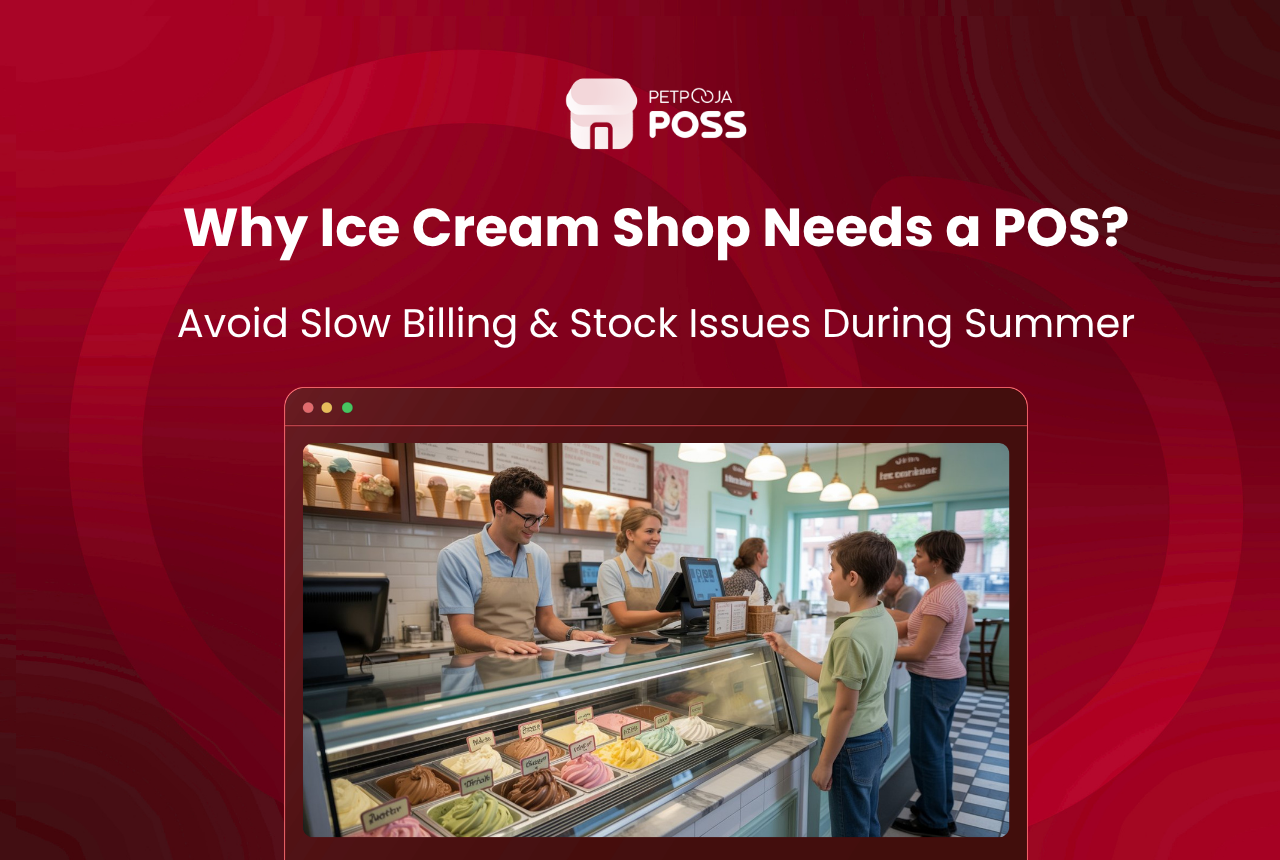
An ice cream POS system handles billing for size and topping combinations in under 30 seconds, tracks perishable stock with expiry alerts so nothing melts into waste, pulls Swiggy and Zomato orders onto one screen, and tells you which flavours actually make money. If your parlour still runs on a cash register and a ruled notebook, summer will punish that setup harder than any other season.
India’s ice cream market reached INR 312.76 billion in 2025, with projections pointing to INR 1,192.40 billion by 2034 at a 16.03% CAGR (IMARC Group, 2025). Per-capita consumption climbed from 400 ml in 2011 to 1.6 litres by 2023, and the organised segment now holds 60-65% market share (IBEF, 2025).
Summer 2026 alone saw a 30-40% spike in ice cream consumption across India driven by record heatwaves (Whalesbook, 2026). That kind of volume surge separates parlours with systems from parlours with chaos.
Key Takeaways
- India’s ice cream sector saw a 30-40% consumption spike in summer 2026 (Whalesbook, 2026)
- A POS tracks per-scoop profitability, batch expiry, and topping add-ons from one screen
- Manual billing breaks down once a parlour crosses 150-200 orders on a peak summer day
What Makes Summer Different for Ice Cream Billing?
Volume. The 30-40% summer consumption spike reported by Whalesbook in 2026 isn’t spread evenly across months. A parlour in Vastrapur, Ahmedabad that does 80 bills on a regular February weekday can cross 250 on a Saturday in April. It hits like a switch the week temperatures cross 38 degrees, and your billing counter either keeps pace or creates a queue that spills out the door.
Manual billing falls apart in three specific ways during summer:
- Speed at the counter. A customer ordering a medium chocolate cone with butterscotch topping and a small mango cup takes 40-50 seconds to bill by hand. Multiply that across a 15-person queue at 7 PM and you’re looking at 12-minute wait times. A POS with pre-set size and topping combos brings that single bill down to 10-15 seconds.
- Add-on capture. Toppings, waffle cones, and extra scoops are where the margin sits. When the counter is rushed, staff skip upselling because typing add-ons into a calculator takes too long. A POS prompts the add-on menu on every order.
- Closing reconciliation. After a 300-bill day, matching cash in the drawer to handwritten tokens takes 45 minutes or more. With a POS, the day-end report is ready before the shutters come down.
Why Does Perishable Stock Tracking Matter More Than You Think?
Ice cream base, fruit purees, and fresh toppings have short shelf lives. A tub of mango base that arrived on Monday might expire by Thursday. If nobody flags that tub before it goes into the machine, you’re serving expired product and risking an FSSAI notice.
A POS with batch-level inventory tagging solves this without requiring your staff to remember dates. When stock gets entered, the batch number and expiry date go in alongside it. The system sends an alert before any batch crosses its use-by date.
It also tracks consumption against sales. At the end of the week, you can see exactly how many kilograms of butterscotch base went into sold servings versus how much was wasted or unaccounted for.
For example, consider a parlour in Bopal, Ahmedabad running 12 flavours. Without a POS, the owner discovers at 3 PM on a Sunday that the strawberry base expired yesterday. With a POS, that alert fired on Saturday morning, and the staff moved the batch to the front of the line or wrote it off before it reached a customer.
For a detailed breakdown of how parlour inventory systems work, our ice cream inventory management guide covers the full process.
How Does a POS Handle the Swiggy and Zomato Rush?
Online orders from Swiggy and Zomato now account for a growing share of ice cream sales, especially in metro and tier-2 cities. Quick-commerce platforms like Zepto and Blinkit have compressed delivery windows to under 15 minutes. Your parlour is competing with packaged ice cream brands for the same customer, whether you planned for it or not.
Without a POS, each aggregator order means a separate tablet on the counter. The Swiggy tablet pings, someone reads it out, someone else writes a manual bill, and then they pack the order. During a summer evening rush, staff toggle between three screens and the walk-in queue. Orders get missed. The aggregator acceptance window expires. Your listing rank drops.
A POS with aggregator integration pulls every Swiggy, Zomato, and direct order onto a single screen. Each order auto-prints a KOT with the platform name, customer name, and items. No toggling. No missed acceptance windows. The kitchen or counter staff see one unified queue.
At Petpooja, we’ve seen this pattern across parlour chains in Pune and Jaipur: the ones that connect their aggregator accounts to the POS before March handle the April-May spike without adding counter staff. The ones that don’t end up hiring temporary help and still lose orders.
Which Flavours Make Money and Which Just Look Good in the Display?
Most parlour owners know their top seller by instinct. Butterscotch or chocolate, usually. But can you say which flavour has the best margin after accounting for base cost, wastage, and topping add-ons? That answer requires data, and a notebook doesn’t generate data.
A POS tracks item-level sales per day, per shift, and per counter. It also tracks the food cost tied to each SKU if you’ve mapped your recipes. So you don’t just know that mango sold 140 cups last week. You know that mango cost you ₹18 per serving to make, sold at ₹70, and had a 74% gross margin. Meanwhile, the Belgian chocolate variant cost ₹32 per serving, sold at ₹90, and had a 64% margin despite feeling like a premium product.
That kind of flavour-level P&L lets you make decisions before summer peaks, not after. You stock more of what actually earns. You run promotions on flavours with high margins and low footfall. You quietly retire the ones that sit in the display and melt before anyone orders them.
If you’re still figuring out which products to push this season, our guide to growing your ice cream parlour business covers menu strategy and seasonal planning.
What Should You Look for in an Ice Cream POS?
Not every POS works for a parlour. A system built for a sit-down restaurant has table management, reservation modules, and other features you’ll never touch. An ice cream shop needs something different.
Here’s what to check:
| Feature | Why it matters for a parlour |
|---|---|
| Size and topping variation billing | A single flavour might come in cup, cone, sundae, and family pack. Each has different pricing and topping combinations. The POS must handle this without manual overrides |
| Batch-level expiry tracking | FSSAI compliance requires traceability on perishable ingredients. The POS should alert staff before any batch crosses its use-by date |
| Aggregator integration | Swiggy and Zomato orders on one screen with auto-accept. No separate tablets |
| Add-on prompts at billing | Every order should trigger a prompt for toppings, extra scoops, or waffle cones. This is where the margin sits |
| Flavour-wise sales reports | Daily and weekly reports broken down by flavour, size, and platform |
| Multi-outlet sync | If you run 2-3 branches, inventory and sales data should sync to one dashboard |
Petpooja’s ice cream and dessert shop POS covers all six. It’s built for variation billing with scoops, cones, and toppings, integrates with Swiggy and Zomato, and tracks batch-level expiry on every ingredient. Parlour chains like Gianis already run on it.
The Cost of Waiting Until Summer Is Already Here
Most parlour owners think about a POS in May, after the queues have already formed and the problems are visible. By then, onboarding takes a week or two, staff need training, and you lose the first three weeks of peak season to setup.
The better move is to get the system running in February or March. That gives your staff two months of low-volume practice before the rush hits. Menu items get entered properly. Aggregator accounts get linked. Inventory baselines get set. When April arrives and the footfall doubles, your counter runs the same way it did in March, just faster.
For example, consider a two-outlet parlour in Maninagar, Ahmedabad. If the owner installs a POS in late February, the staff has all of March to learn the system during 60-80 bill days. By April, when bills jump to 200+, the team isn’t fumbling with a new interface. They’re billing at full speed while competitors are still taping handwritten tokens to packing boxes.
If you’re also thinking about staffing for the season, our guide to training ice cream parlour staff covers onboarding timelines and SOPs.
Conclusion
Summer doesn’t announce itself gradually for ice cream shops. One week the counter handles 80 orders comfortably, and the next week it’s 250. A POS gives you the speed at the counter, the stock visibility, the aggregator integration, and the flavour-level data to handle that jump without losing orders, wasting inventory, or guessing which products earn their shelf space.
If your parlour doesn’t have a POS yet, the time to set it up is before the heatwave, not during it. Explore Petpooja’s ice cream POS features to see what the system looks like in practice.
Frequently Asked Questions
The best ice cream POS handles variation billing for scoops, cones, and toppings, tracks batch-level expiry for FSSAI compliance, and integrates with Swiggy and Zomato. Petpooja POSS is built for this, with flavour-wise reporting and multi-outlet sync used by parlour chains across India.
Summer brings a 30-40% demand spike that hits within days, not weeks. A POS installed in February or March gives staff time to learn the system during low-volume months. Installing mid-season means losing peak weeks to onboarding while queues build up at the counter.
Yes. Batch-level expiry alerts flag ingredients before they cross their use-by date. Consumption tracking compares stock used against servings sold, so unaccounted wastage becomes visible in the daily report instead of hiding in the freezer until month-end.
The POS stores every size, cone type, and topping as a modifier linked to the base flavour. When a staff member selects “medium chocolate cone,” the system prompts available toppings and extra scoops. The final bill calculates in seconds, with no manual addition needed.
Yes. A POS with aggregator integration pulls orders from Swiggy, Zomato, and direct ordering channels onto one screen. Each order auto-prints a KOT with the platform name and items. No separate tablets needed at the counter.