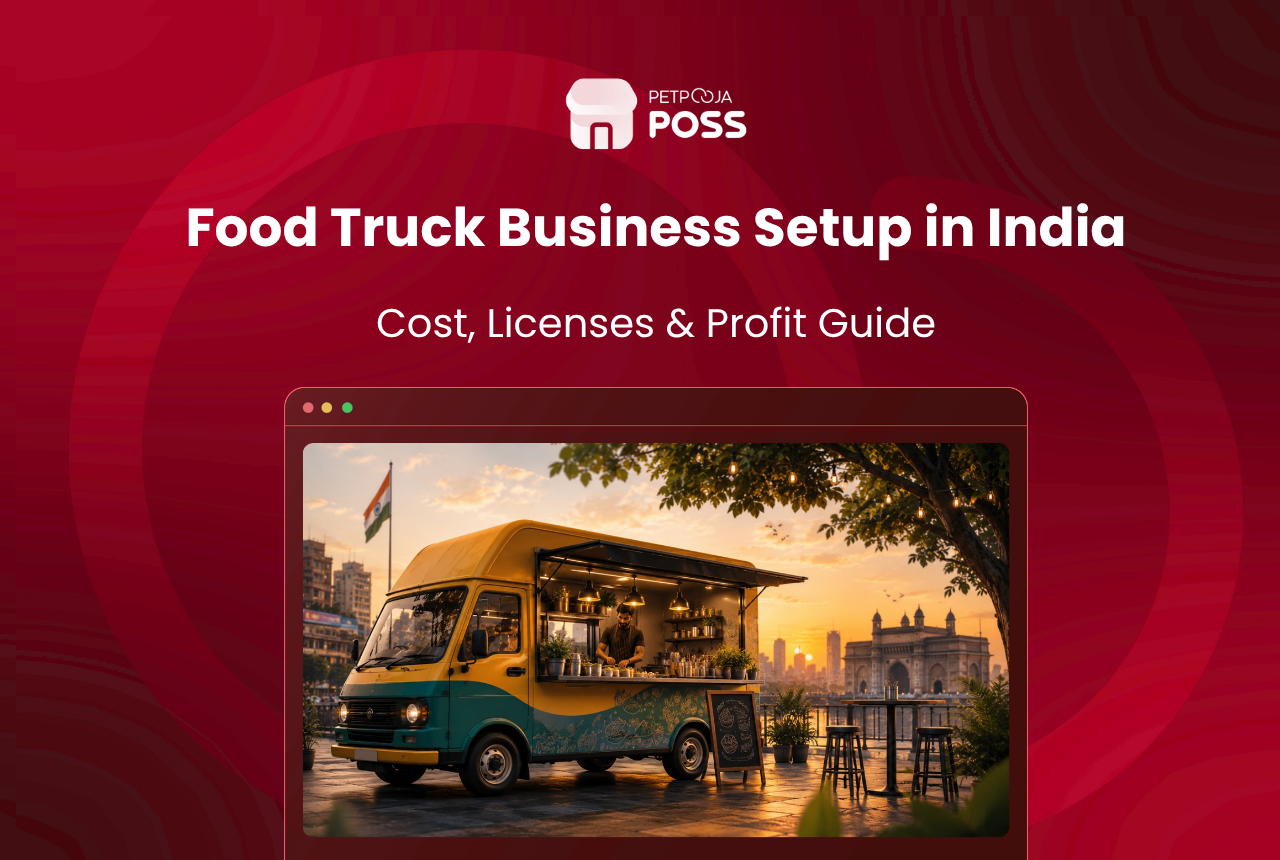
A food truck in India costs ₹10 to ₹25 lakhs to set up, brings in 20-40% profit margins, and most operators we work with at Petpooja break even between month 8 and month 14.
India’s mobile food services market is headed toward USD 277 million by 2029, growing at 9.23% CAGR. As a result, more first-time entrepreneurs are choosing trucks over brick-and-mortar restaurants.
However, market size alone will not tell you what actually matters. Location is the variable that separates a profitable truck from an expensive hobby. Example: a truck outside an IT park in Electronic City, Bangalore pulls in ₹2.5 lakhs a month, while the identical truck near Hebbal earns ₹40,000.
This guide covers the full setup: business plan, vehicle, FSSAI licences (big update in March 2026), equipment, parking spots, and marketing.
Key Takeaways
- A food truck in India costs ₹10-25 lakhs to set up (vehicle + equipment + licences + branding + cash buffer)
- Profit margins land between 20-40% of monthly revenue
- FSSAI licences became perpetual from March 2026. No more renewal cycles, just an annual fee and compliance report
- Vehicle is the biggest cost: ₹5-10 lakhs for pre-owned, ₹12-25 lakhs for a new customised truck
- The best parking spots are IT parks, university campuses, transit hubs and weekend markets, matched to the right menu type
Build a Business Plan That Accounts for Indian Realities
Not a 50-page MBA document. A two-page breakdown of what you are selling, where you will park, and how much cash you need before the first dosa hits the griddle.
Questions Your Plan Must Answer
- What is on the menu? Stick to 8-12 items. More than that and food costs balloon during the lunch rush
- Where will you park? Write down 3-5 specific spots (not “somewhere in Indiranagar” but “opposite Wipro gate on Sarjapur Road”)
- How much capital do you need? Vehicle, equipment, licences, initial stock, and a 3-month cash buffer
- When will you break even? 8 to 14 months in a high-footfall spot, 18 to 24 months for weekends only
Example: an operator in Navrangpura, Ahmedabad launched a South Indian breakfast menu in January 2025. At Petpooja, we have watched hundreds of owners skip the cash buffer and scramble for personal loans by month two.
How to Pick the Right Vehicle for Your Food Truck
Your vehicle is the single biggest line item. Since prices vary wildly, here are the figures we see across our client base as of April 2026:
| Vehicle Type | Cost Range | Best For |
|---|---|---|
| Pre-owned truck (under 5 years old) | ₹5-10 lakhs | First-time operators watching their capital |
| New customised food truck (18 ft) | ₹12-25 lakhs | Owners who want full control over kitchen layout |
| Three-wheeler food cart | ₹2-4 lakhs | Single-item vendors doing chaat, juice, or chai |
| Trailer-style (towed) | ₹6-12 lakhs | Operators with a fixed spot at a mall or event ground |
Pre-Owned vs New
Going pre-owned? Make sure the registration, fitness certificate and insurance are current. Trucks older than five years tend to fail the RTO fitness test, and repairs usually exceed what you saved.
In addition, a heavy commercial vehicle triggers movement restrictions in cities like Pune and Chennai, which locks you out of commercial zones during peak hours.
Example: operators in Tier 2 cities like Jaipur and Coimbatore who buy a ₹7 lakh pre-owned truck and invest the savings in a better fryer tend to hit profitability faster.
For layout ideas, read our guide on how to optimise food truck space.
How Much Does Food Truck Kitchen Equipment Cost?
Buy new equipment, not refurbished. We say this after watching the pattern repeat across 1,00,000+ businesses on the Petpooja platform. Second-hand burners and fryers break down by month three, and the total repair bill always ends up higher than buying fresh gear.
What ₹4-5 Lakhs Gets You
- Commercial burners with a proper gas line (₹80,000-₹1.2 lakhs)
- Deep fryer, refrigerator or under-counter chiller
- Exhaust hood and ventilation for Indian summer heat (45°C+)
- Prep counter, storage racks and a fire extinguisher
Then add ₹1 to ₹1.5 lakhs for initial stock, packaging and branding. Also budget ₹60,000 to ₹90,000 for a 5 KVA generator if you operate at flea markets or spots without plug-in power.
What Licences Does a Food Truck Need in India?
Fewer than a dine-in restaurant, but skipping even one can be costly. Budget around ₹50,000 total for year one.
| Licence | Issuing Authority | Approximate Cost |
|---|---|---|
| FSSAI Registration or Licence | FSSAI (via FoSCoS portal) | ₹100-₹7,500/year |
| Fire Safety Certificate | Local Fire Department | ₹5,000-₹15,000 |
| Eating House Licence | Local Police Commissioner | ₹5,000-₹10,000 |
| NOC from RTO | Regional Transport Office | ₹2,000-₹5,000 |
| NOC from Municipal Corporation | Local Municipal Body | ₹3,000-₹8,000 |
| Kitchen Insurance | Private insurer | ₹8,000-₹15,000/year |
The March 2026 FSSAI Change
Since 10 March 2026, FSSAI licences are now perpetual. Pay your annual fee (₹100 to ₹7,500 depending on turnover), file your yearly compliance report, and the licence stays valid.
If your truck is registered under the Street Vendors Act, 2014, you may qualify for deemed FSSAI registration at zero extra cost.
The mistake we see most often among first-timers in Mumbai and Delhi is serving food before the FSSAI registration comes through. The fine goes up to ₹5 lakhs under the FSS Act. File everything 45-60 days before your planned launch.
For a full walkthrough, see our FSSAI licence guide for food businesses.
Where Should You Park a Food Truck in India?
Footfall means nothing if the crowd does not match the menu. Example: a biryani truck parked outside juice bars in Aundh, Pune will struggle even though 3,000 people walk past daily.
Match the Menu to the Crowd
| Spot Type | Best Menu | Peak Window | Avg Ticket |
|---|---|---|---|
| Office complexes and IT parks | Thalis, wraps, rice bowls | 11:30 AM to 2 PM | ₹120-180 |
| University campuses | Momos, rolls, chaat | 12 PM to 5 PM | Under ₹100 |
| Weekend flea markets | Gourmet burgers, loaded fries, specialty coffee | 5 PM to 10 PM | ₹200-300 |
| Transit hubs (metro stations) | Vada pav, sandwiches, samosas | 7 AM to 10 AM | ₹40-80 |
Instead of covering the whole city, pick 2-3 spots and rotate on a fixed weekly schedule. Example: a chaap and tikka truck in Madhapur, Hyderabad parked at the same IT park on Tuesday, Thursday and Saturday for six months. The owner built a WhatsApp list of 400+ customers from that rotation alone.
For a deeper comparison, check out our food truck vs restaurant guide.
Set Up Billing and Operations From Day One
Handwritten bills and stock notes work fine at 20 tickets a day. Once you cross 50, however, things fall apart: paneer runs out mid-lunch, cash is off by ₹1,200, and there is no record of which dish earned more money.
A food truck POS like Petpooja POSS fixes this by putting billing, inventory and online orders on one screen. Swiggy and Zomato orders land alongside walk-in tickets without anyone toggling between tabs.
Vendors who list on aggregator apps tend to add ₹50,000 to ₹1,50,000 in monthly revenue. But without a POS pulling those orders into one queue, tickets get missed during the 12:30 PM rush. For a closer look at what a billing system should do, read our restaurant billing software features breakdown.
How to Market Your Food Truck Without a Big Budget
₹50,000 a month on marketing? Not necessary. The most successful vendors we know built their first 500 regulars with a phone camera, WhatsApp, and consistency.
Instagram, Google and WhatsApp
Instagram, but done right. Post 3-4 times a week showing the cooking process, not just the plated dish. Example: a reel of dosa batter hitting a hot griddle pulls 3-5x more saves than a polished photo.
Google Business Profile is the one most vendors skip. Register your spot on Google Maps and ask buyers to leave a review. Once you cross 100 reviews, you start appearing for “food truck near me” searches.
WhatsApp works better than any paid channel. Collect phone numbers from regulars and send one message a week with your location schedule.
Other Tactics That Work
- “First 50 customers get 20% off” on launch day creates a queue
- Offer a free meal to a local food blogger in exchange for a story post
- Print QR codes on packaging that link to your Instagram or Google review page
For more strategies, read our guide on food truck marketing.
Hiring and Training Staff for a Food Truck
You need 2-4 crew members depending on whether you run a single shift or split the day.
What to Train First
- Hygiene comes first because FSSAI inspectors run surprise checks near railway stations in Mumbai, Delhi and Bangalore. A single violation can shut you down.
- Ticket speed matters because food truck customers are not dining out. Keep orders under 8 minutes or they will not return.
- Upselling pays off fast. A ₹30 add-on across 80 daily orders adds roughly ₹72,000 a month to revenue.
What to Pay Your Team
Budget ₹20,000 to ₹25,000 for a cook and ₹12,000 to ₹15,000 for a helper in metro cities. Example: in Tier 2 cities like Indore or Vadodara, ₹14,000 to ₹18,000 for a cook is the going rate as of early 2026.
If you are running more than one truck, read our guide to restaurant staff management for hiring and retention tactics that scale.
Conclusion
₹10-25 lakhs to start, 20-40% margins once running, and a break-even window measured in months rather than years. Compared to a dine-in restaurant at ₹30-50 lakhs, the food truck model needs far less capital.
The operators who last beyond year one wrote a plan first, picked locations by matching menu to crowd, and sorted licences 45-60 days before launch.
Petpooja POS gives food truck operators compact billing, inventory alerts, and Swiggy/Zomato order management on a single screen. Talk to the team at +91-9104369797 or write to getposs@petpooja.com.
Frequently Asked Questions
₹10 to ₹25 lakhs in total. The vehicle is the biggest variable (₹5-25 lakhs), kitchen equipment adds ₹4-5 lakhs, and you should set aside ₹2-3 lakhs as a cash buffer.
FSSAI registration, fire safety certificate, eating house licence, RTO NOC, municipal corporation NOC, and kitchen insurance. Since March 2026, FSSAI licences are perpetual.
Between 20% and 40% of monthly revenue for most trucks in India. A well-located truck can bring in ₹2-3 lakhs a month, and during college fests or weekend events, revenue can double.
Once you cross 40-50 orders a day, manual billing leads to cash miscounts and missed online orders. A POS pays for itself within the first month.
Yes, quite a few operators in India do this at flea markets and event grounds. The investment stays the same, but break-even stretches to 18-24 months.