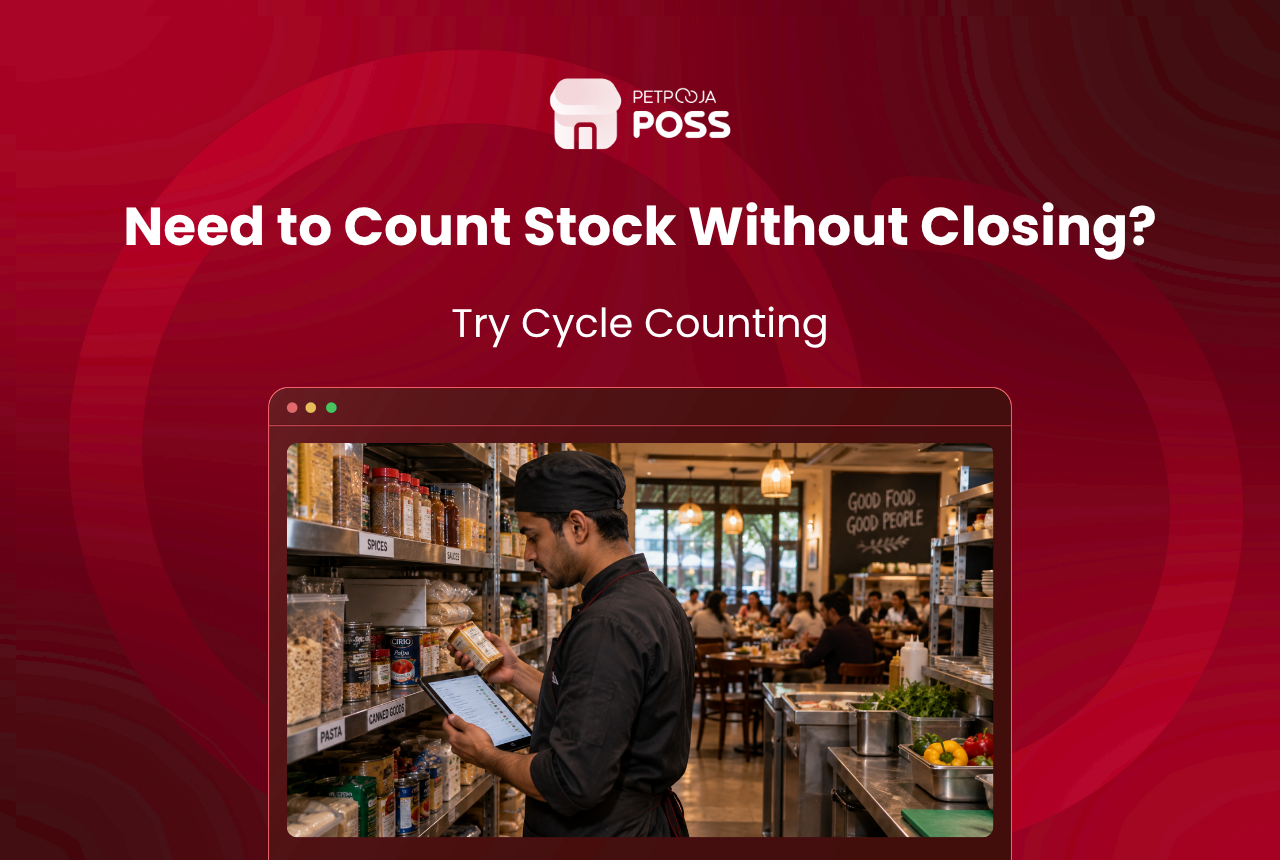
Cycle counting means checking a small slice of your stock on a rota, so the whole list gets counted over a few weeks. You never shut the shop to do it.
The alternative is the annual stock take. One long day, everything counted at once, and eleven months of gaps nobody spotted.
This post covers what to count and how often, what a gap actually means, and how to run it without a scanner.
Key Takeaways
- A gap is not proof of theft. Rule out billing shortcuts and unit mix-ups first, because both are cheaper to fix.
- Count your fastest and highest-value items weekly. The slow tail can wait for the annual count.
- Write down what the system said before you count, or the count will quietly agree with it.
What Is Cycle Counting?
Cycle counting spreads the work across a rota, so you count part of your stock often rather than all of it at once. The parts add up to the whole over a month. This section covers how that differs from a stock take.
An annual stock take closes the shop, counts everything, and gives you one accurate day a year. In India it usually lands in March, before the year-end filing, and the numbers start drifting the week after.
Cycle counting trades that for a smaller, steadier check. You never get a single perfect snapshot, but you never go eleven months blind either.
The point is not the count. It is the gap. A count that matches tells you nothing new. A count that does not is the whole reason to do it.
What Should You Cycle Count First?
Start with your fastest-moving and most expensive lines, because that is where a gap costs the most. Here is a schedule that works for most small businesses.
| Group | What it is | Count it |
|---|---|---|
| Fast and expensive | Your top sellers and your costliest lines | Weekly |
| Steady middle | Regular sellers, moderate value | Monthly |
| Slow tail | Rarely sold, low value | At the annual count |
Splitting stock this way is the ABC idea, and our guide to inventory mistakes retail stores make works through the percentages behind those buckets.
Count the same items on the same day. A Monday morning rota before deliveries land beats a count squeezed in whenever somebody is free. Stock is at its lowest and nothing is half put away.
Four weeks of that and every item on the list has been counted at least once, without the shop shutting for a day.
Petpooja is India’s biggest and most price effective restaurant POS, behind the success of 1,00,000+ outlets. It has run restaurant billing in India for over a decade, and processes 60 lakh bills a day at 0% error.
How Do You Run a Cycle Count Without a Scanner?
Most guides assume a barcode scanner and a warehouse. Most Indian shops and kitchens have neither, and the count still works. Here is the manual version.
You need a printed list of the items due this week, with a blank column for the count and a second blank for the gap. Often that is the third tab of the same sheet you order from. Nothing else.
- One person counts, another enters. The person who enters should not be the one who counted, so an error has two chances to be caught.
- Count in the order the shelf is laid out, not the order the report prints in. Walking the shelf twice is where the mistakes come from.
- Do it before service, so nothing moves mid-count.
- Record the gap, not just the count. A count with no comparison is a number nobody will look at again.
Restaurant owners using Petpooja tell us the paper version survives longer than the app version in a busy kitchen. The part people drop first is writing down the gap.
What Does It Mean When the Cycle Count Does Not Match?
A gap has four common causes, and theft is the last of them to reach for. This is the part most guides skip, and it is the only part that saves you money.
None of this is survey data. It is what people tell us when the numbers refuse to line up and they are working out where to look first.
Work through them in this order, because the first three are free to fix and the fourth is not.
- A billing shortcut. Somebody sold an item under a different code, or rang up a similar-priced line because it was faster. The stock left, the record did not.
- A unit mix-up. Bought in kilos, sold in grams, counted in packets. A sweet shop in Vastrapur buying khoya in 5-kilo blocks and selling it by the piece (an example) will show a gap every week until that conversion is fixed. It is the easiest of the four to miss, because nothing about the shelf looks wrong.
- An unrecorded movement. Wastage, a staff meal, a sample, a transfer to another outlet. All real, none of it billed.
- Shrinkage. What is left when the first three are ruled out.
Ruling out the first three is the job. Jumping to the fourth costs you a good staff member and does not fix the record. Our post on restaurant food waste covers the third cause, which is the one most often left unrecorded.
Write the System Figure Down First
Open the stock report before you count, and write the number on the sheet.
Count first and check after, and the count tends to agree with the system. Not because anyone is dishonest, but because a number in front of you is hard to unsee.
Acting on a Gap Once You Find One
A gap you record and never act on is worse than no count, because it teaches the team the exercise is pointless. This section covers the two things to do with it.
Correct the stock record on the day. The physical count is the truth. Adjust the system to match it, and note why.
Then look for the pattern. One gap on one item is noise. The same item short every week is a process fault, and that is the thing worth an hour of somebody’s time.
Gaps also move your food cost without anybody changing a price, because stock that left unrecorded is still stock you paid for.
When to Cycle Count More Often, and When to Ease Off
The weekly rota is a baseline you adjust, not a fixed rule. Two things move it: something new in the shop, or a long run of clean counts.
Go more often when something changes. A new supplier, a new staff member on the counter, or a festival week all justify a second count in the same week.
Ease off when the same group has matched for two months running. That is a signal the process works, not a reason to stop entirely.
The annual stock take does not go away. It still catches the slow tail that never appears on a weekly rota. Our inventory audit checklist covers what that fuller count should record.
Conclusion
Cycle counting replaces one long shutdown with a short check you barely notice. Fast and expensive items weekly, the middle group monthly, the slow tail once a year.
When a count does not match, work through billing shortcuts, unit mix-ups and unrecorded movements before you reach for theft. Every one of those you can fix yourself.
Start this Monday with your ten costliest items and a printed sheet. The stock inventory template gives you the columns, and your restaurant POS gives you the figure to check against.
Frequently Asked Questions
An overage is not good news either. It usually means a delivery was received twice, a return was never recorded, or a sale was rung up against the wrong item. Chase it the same way you chase a shortage. Our restaurant inventory management guide covers the receiving side.
There is no published standard, and any figure quoted as one is somebody’s internal target. Judge it against value instead. A 2% gap on rice costs you less than a 2% gap on saffron. Set a tolerance per item rather than one for the whole shop.
Not the person who orders the stock, and ideally not the same person every week. Rotating it catches habits, and separating counting from ordering removes the awkwardness of somebody checking their own work.
Yes, and that is the point of it. Count a small enough group and it fits into the quiet half hour before service. What you cannot do is count an item that is being sold at the same moment, so pick the quiet hour.
Count each outlet on its own rota, then compare the gaps between them. A fault at one site shows up as an outlier rather than disappearing into an average. Stock moving between outlets is the complication, and our multi-outlet stock guide covers transfers.
Expect the first count to find a gap, and expect it to feel like bad news. The useful signal comes around week four, when you can see whether the same items go short repeatedly or the gaps move around.