
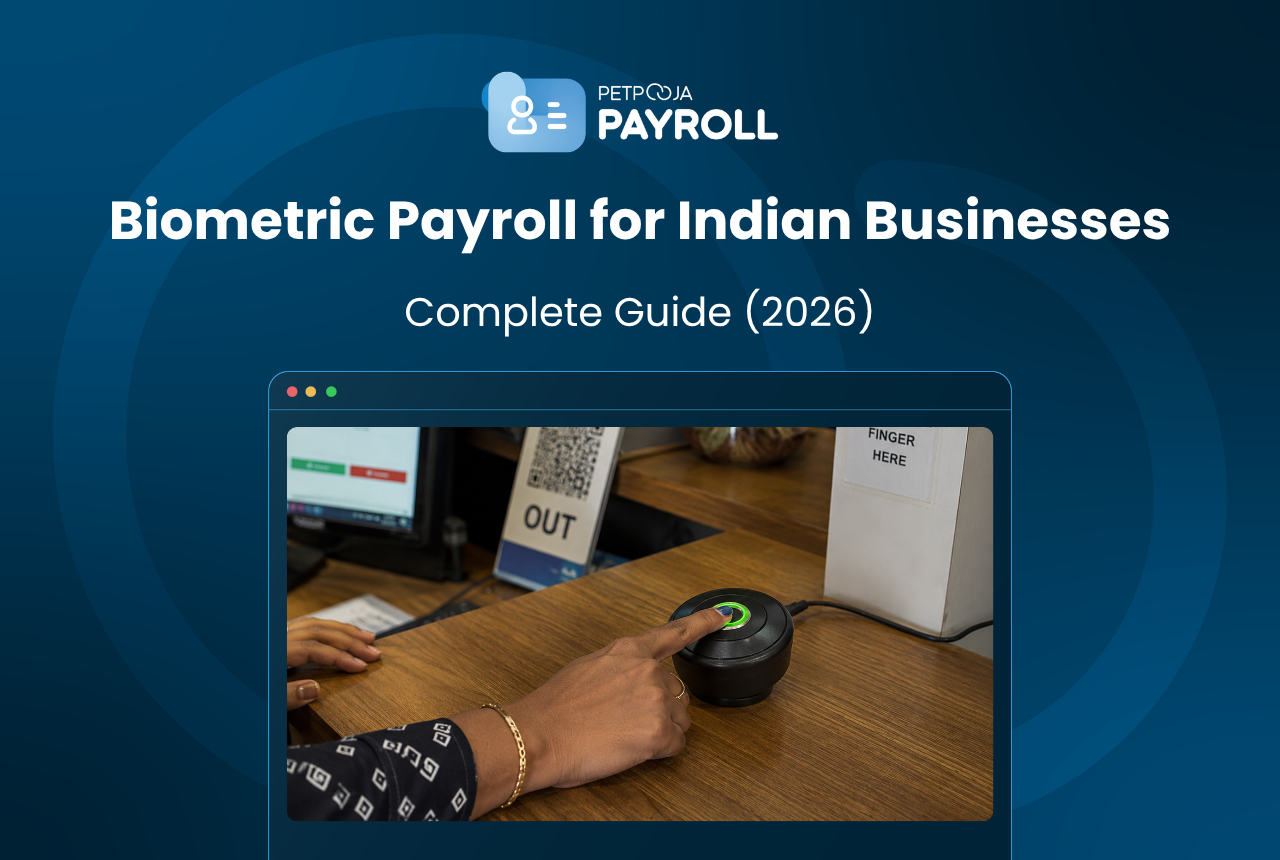
A biometric payroll system records attendance through fingerprint or face recognition, then feeds that data directly into salary calculations, PF deductions, and ESIC contributions. When this system charges a flat annual fee instead of a per-employee rate, your payroll cost stays the same whether you have 15 employees or 150.
That is the short answer. The rest of this blog covers why per-user pricing becomes a problem as you grow, what a biometric payroll system should include, and which types of businesses benefit the most from flat-fee models.
Key Takeaways
- A biometric payroll system bundles attendance hardware with salary processing software, removing manual data entry
- Per-user pricing (₹50-₹300/head/month) penalises growing businesses; flat-fee pricing keeps costs fixed regardless of headcount
- Manufacturing, multi-branch retail, construction, and healthcare businesses gain the most from flat-fee models
- Section 62 of the Factories Act requires a register of adult workers; state rules add muster roll and attendance record requirements
- Look for bundled hardware, auto PF/ESIC/TDS calculation, multi-shift support, and a device warranty before choosing a vendor
Why Does Per-User Pricing Hurt Growing Businesses?
Most payroll software in India charges ₹50 to ₹300 per employee per month on top of a base fee. For a manufacturing unit growing from 18 to 48 workers, this model nearly triples the annual software cost without adding any new features. Flat-fee payroll systems charge one fixed annual amount regardless of headcount.
At 10 employees, this feels manageable. At 40, the maths changes fast.
Consider this example: a packaging unit in Pimpri-Chinchwad starts with 18 workers. The HR manager picks a payroll tool at ₹200 per head per month. Monthly cost: ₹3,600. Over the next year, the unit hires 30 more workers for a second production line. The same tool now costs ₹9,600 a month. The software did not add a single new feature, but the bill nearly tripled.
This pattern repeats across growing Indian businesses. A diagnostic lab chain in Pune that expands from two to five branches. A textile manufacturer in Surat that doubles floor staff before Diwali. A logistics firm in Bhiwandi that onboards 25 delivery riders in a single quarter. In each case, the payroll software bill scales with headcount even though the work the software does remains identical.
The chart above uses ₹200 per employee per month as an example. Some vendors charge more. The flat-fee bar stays constant regardless of how many people you add.
What Does a Biometric Payroll System Actually Include?
A biometric payroll system combines two components: a biometric device (fingerprint or face recognition) that records timestamped attendance, and payroll software that converts those records into salary calculations with PF, ESIC, and TDS deductions. Bundled systems from a single vendor remove the need for CSV exports or manual reconciliation between attendance and payroll data.
The term gets used loosely. Some vendors sell a biometric device and call it a biometric payroll system. That is only half the picture. The two parts must work together:
Part 1: Biometric attendance hardware. This is a physical device placed at your office or factory entrance. It can be a fingerprint scanner or a face recognition terminal. When an employee scans in, the device records the exact timestamp and sends it to the cloud.
Part 2: Payroll software that reads biometric data. The software takes attendance records, maps them against shift schedules, calculates working days and overtime, and generates salary with statutory deductions (PF, ESIC, TDS, professional tax). No spreadsheet in between.
When these two parts are bundled from the same vendor, the data flow is direct. There is no CSV export-import, no manual reconciliation, and no room for mismatch between the attendance the device recorded and the attendance the payroll used.
How Does Biometric Attendance Feed Into Payroll?
Biometric attendance feeds into payroll through a five-step sequence: the employee scans at the device, data syncs to the cloud, software maps punches to shift rules, late marks and overtime get flagged, and payroll runs on actual worked days with PF at 12% of basic as per EPFO contribution rates. Here is that sequence broken down:
- Employee scans face or fingerprint at the device during shift start and shift end
- Device syncs data to cloud within minutes (some systems sync in real time)
- Software maps punches to shift rules you have configured (for example, a 9-hour general shift or a rotating three-shift pattern common in factories)
- Late marks, half days, and overtime get flagged based on the rules you set
- At month end, payroll runs on actual worked days with PF at 12% of basic, ESIC at the applicable bracket, and TDS as per the employee’s declared investment proofs
No manual entry at step 5. The salary slip reflects what the device recorded. At Petpooja, we have seen this single integration cut payroll processing time by more than half for businesses that were previously tracking attendance on paper or through a separate app. If you are evaluating options, our list of payroll software red flags covers the warning signs to watch for during vendor demos.
The Factories Act Compliance Angle
Under Section 62 of the Factories Act, 1948, every Indian factory must maintain a register of adult workers with name, work type, and shift allocation. State rules like Maharashtra’s Section 122 add daily muster rolls preserved for three years. Biometric systems generate these records from each attendance punch, making compliance a byproduct of the system rather than a separate task.
This gives manufacturing businesses an additional reason to invest in biometric payroll. The central Act covers the worker register, and state factory rules layer on daily attendance and overtime documentation.
A biometric system generates this data on its own. Every punch creates a timestamped, tamper-proof record. If a labour inspector in Manesar or Chakan asks for attendance records from November 2025, you pull a report in two minutes instead of flipping through register pages. The compliance checklist under the Factories Act runs long, but attendance documentation is one area where a biometric system closes the gap without extra effort.
For businesses that fall under the Shops and Establishments Act instead (retail stores, offices, clinics), similar muster-roll requirements apply under state-specific rules. The biometric device handles both.
Which Businesses Benefit Most From Flat-Fee Biometric Payroll?
Manufacturing units, multi-branch retailers, construction firms, and healthcare businesses benefit most from flat-fee biometric payroll because their headcount fluctuates seasonally or grows with each new project, branch, or shift. India’s MSME sector accounts for 35.4% of the country’s manufacturing output, as per a July 2025 statement by the Union MSME Ministry, and many of these units run two or three shifts with variable staffing.
Here is how each benefits:
Manufacturing and factories. A steel fabrication unit in Bhosari with 45 workers on a morning shift and 30 on a night shift needs the software to handle 75 employees. Under per-user pricing, that is ₹15,000 a month just for the variable component. Under a flat annual fee, adding the night shift does not change the bill.
Multi-branch retail and service businesses. A garment retailer in Ahmedabad operating four showrooms plus a warehouse might have 60 employees across five locations. Per-user pricing penalises the distributed headcount. Flat-fee pricing treats all branches as one account.
Construction and project-based firms. Workforce size swings by project. A Hyderabad-based interior fit-out company might have 20 permanent staff and 35 contract workers during a hotel project. When the project ends, contract workers leave. Under per-user models, you either overpay during lean months or spend time adjusting licences every quarter.
Healthcare with rotating staff. A diagnostic lab or nursing home in Nagpur running round-the-clock shifts needs biometric attendance that tracks night-shift differentials and overtime. Flat-fee pricing means the system cost does not climb when you add locum doctors or contract nurses during flu season.
What Should You Check Before Choosing a Biometric Payroll System?
When evaluating a biometric payroll system, verify six things: whether the device is bundled or sold separately, whether PF/ESIC/TDS is auto-calculated, whether pricing stays flat above 50 or 100 employees, whether it handles multiple shifts and locations, whether the device carries a warranty, and whether employees get a mobile app for self-service.
Not every vendor that advertises “biometric payroll” delivers a proper end-to-end system. The table below breaks down each checkpoint:
| Check | Why it matters |
|---|---|
| Is the biometric device included or sold separately? | Bundled hardware means one vendor to call for support, not two |
| Does the payroll auto-calculate PF, ESIC, and TDS? | Manual statutory calculation defeats the purpose of automation. Read the ESIC registration guide for current rates |
| Is pricing truly flat or does it become per-user above a threshold? | Some vendors advertise flat pricing but add per-user charges above 50 or 100 employees |
| Can it handle multiple shifts and locations? | Factories and multi-branch businesses need shift mapping, not just in/out timestamps |
| Does the device come with a warranty? | Face recognition terminals break; a lifetime warranty saves replacement costs |
| Is there a mobile app for employees? | An employee self-service portal lets staff view salary slips and apply for leave without calling HR |
At Petpooja, we bundle the face recognition device (with lifetime warranty) and the payroll software together at a flat annual rate with no per-employee charges. The device syncs attendance to the cloud, and the software handles salary, PF, ESIC, TDS, and professional tax from that data. Over 30,000 businesses use this setup today, including manufacturing units, hospitals, retail chains, and logistics firms.
If you want to see how the full system works, visit the Petpooja Payroll product page.
Conclusion
A biometric payroll system removes the two biggest friction points in Indian SME payroll: inaccurate attendance and rising software costs. When the system charges a flat fee, you stop paying a penalty for growth. When the biometric device feeds data directly into payroll, you stop reconciling spreadsheets manually.
For manufacturing units, the added benefit is built-in Factories Act compliance, for multi-branch businesses, it is centralised attendance across locations. For any growing business, it is the ability to hire 10 more people next month without recalculating your software budget.
Frequently Asked Questions
It is a setup where a biometric device (fingerprint or face recognition) records employee attendance and sends that data directly to payroll software. The software then calculates salaries, PF, ESIC, and TDS based on actual worked days, with no manual data entry in between.
Per-user pricing charges a fixed amount for each employee on your payroll every month, typically ₹50 to ₹300 per head. Flat-fee pricing charges one annual amount regardless of how many employees you add. For a business growing from 25 to 80 staff, the difference over a year can run into lakhs. You can use our payroll ROI calculator to estimate savings for your headcount.
Yes. Most face recognition devices work round the clock. The payroll software maps each punch to the correct shift based on rules you configure. For example, if your factory runs a 6 AM to 2 PM shift and a 2 PM to 10 PM shift, the software assigns each employee’s punch to the right shift window. Read more about how payroll software works for manufacturing units.
Most cloud-connected devices store punches locally and sync them once the internet connection resumes. For factories in industrial areas like Manesar, Vithalwadi, or Ranjangaon where connectivity can be patchy, look for devices with at least 48 hours of local storage capacity.
No. With face recognition, the employee just stands in front of the device for two to three seconds. There is nothing to carry, nothing to forget, and no way for one employee to clock in on behalf of another. Our guide on geo-tagged attendance explains how mobile-based attendance adds another verification layer for field staff.








