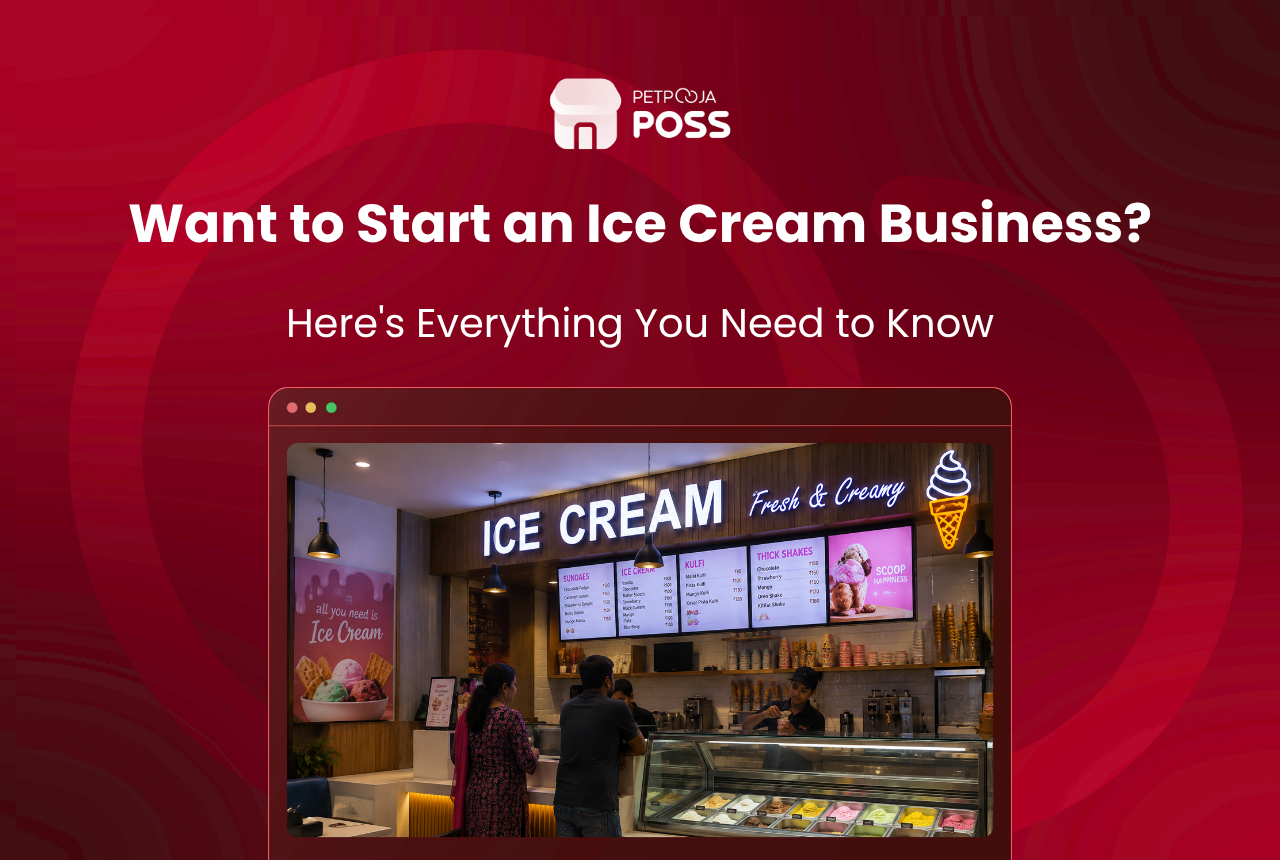
Starting your own ice cream business comes down to six decisions. Choose a format, cost the setup and the monthly running, work out what the shop can realistically sell, prove the break-even point, clear the licences, and set up a way to track the numbers from day one.
Most first-time owners come unstuck on the third and fifth of those. They budget carefully for the deep freezer and the signage, then forget that the electricity bill in May looks nothing like the one in December.
This is a working guide rather than a business studies exercise. Each step below tells you what to decide, which number to source, and where that figure usually comes from.
Key Takeaways
- Pick your format first. Cart, softy counter, parlour and franchise have different cost bases, so costing the shop before choosing the model wastes effort
- Split your investment sheet into one-time spend and monthly spend. Lenders and partners read them separately
- Break-even is a formula, not a guess: fixed costs divided by contribution per unit
- A first Mudra loan tops out at ₹10 lakh, so a bigger fit-out needs your own capital in the plan
- From 1 April 2026 a new shop turning over up to ₹1.5 crore needs only basic FSSAI registration, not a State Licence
- Impulse purchases drive 60.6% of Indian ice cream sales, which should shape your product mix
What It Takes To Start an Ice Cream Business
Before you spend anything, answer these six questions on paper. If you cannot answer one of them yet, you are not ready to sign a lease.
| Section of Your Plan | The Question It Answers | Where the Number Comes From |
|---|---|---|
| Model and concept | What format am I opening, and for whom? | Your own decision, tested against local footfall |
| Investment sheet | What do I spend once, before opening? | Vendor quotes, rent agreement, deposit |
| Operating costs | What leaves my account every month? | Rent, salaries, power, stock, licence renewals |
| Revenue projection | What can this shop realistically sell? | Footfall count, average ticket, opening hours |
| Break-even | When do I stop losing money? | Fixed costs and contribution per unit |
| Compliance timeline | What must be in place before I open? | FSSAI, GST, trade licence, shop registration |
The market context belongs on your first page, because anyone reading the plan will ask whether the category is growing. India’s ice cream market stood at ₹243.50 billion in 2025, or roughly ₹24,350 crore. IMARC Group forecasts ₹639.41 billion by 2034, a compound growth rate of 11.29% across 2026 to 2034 (IMARC Group).
How To Start Your Own Ice Cream Business in 6 Steps
The six steps below run in the order you should actually do them, because each one feeds the next. Your format sets your costs, your costs set your break-even, and your break-even tells you whether the site is worth signing for.
Step 1: Choose Your Ice Cream Business Model First
The format decision drives every other number in the plan, so settle it first. A softy counter and a 14-flavour dine-in parlour are different businesses that happen to sell the same category.
| Model | Typical Setting | What Drives the Cost | Main Risk |
|---|---|---|---|
| Cart or kiosk | College gates, markets, parks | Cart, storage freezer, permits | Weather and municipal moves |
| Softy counter | High streets, food courts | Softy machine, mix supply | Machine downtime |
| Hard-scoop parlour | Neighbourhood high streets, malls | Rent, display freezer, interiors | Rent against seasonal sales |
| Franchise outlet | Malls, arterial roads | Brand fee, fit-out to spec | Lower control, royalty outflow |
Each route has a different margin profile, which our breakdown of kulfi, gelato and softy models sets out in more detail. If you are weighing the branded route, the shortlist of ice cream franchises in India is a reasonable starting point for fee comparisons.
State your chosen model in one sentence at the top of the plan. Something like “a 180 sq ft hard-scoop parlour in Kothrud, Pune, targeting family evening footfall” tells a reader more than three paragraphs of category description.
Step 2: Build the Investment Sheet
With the format settled, the money section comes next. Split it into two tables, because they get read differently. One-time spend tells a lender how much capital you need. Monthly spend tells them whether you survive month four.
What the Setup Costs
Our own costing of a mid-range Tier 2 city parlour put the setup at ₹7.23 lakh to ₹16.35 lakh. That covers deposit, interiors, display and chest freezers, billing hardware and FSSAI registration.
Read it as a reference band, not a budget. A cart sits well below it and a fitted premium outlet sits above, so the full parlour setup costs are worth reading before you fix your own number.
Build your one-time sheet on these lines and fill the last column with real quotes:
| Setup Line Item | What It Covers | Your Quoted Cost |
|---|---|---|
| Security deposit | Usually 3 to 6 months of rent | |
| Interiors and signage | Counter, seating, branding, lighting | |
| Display and storage freezers | Scooping cabinet plus chest freezer | |
| Billing hardware and POS | Terminal, printer, software licence | |
| Opening stock | First fill of mix, cones, cups, toppings | |
| Licences and registration | FSSAI, trade licence, GST |
Where the Money Comes From
Say where the money comes from, because that is the first thing a lender turns to. Collateral-free borrowing under the Pradhan Mantri Mudra Yojana runs in tiers: Shishu up to ₹50,000, Kishore up to ₹5 lakh, and Tarun up to ₹10 lakh.
A Tarun Plus tier reaches ₹20 lakh, but it is aimed at borrowers who have already repaid a Tarun loan. So a ₹16 lakh fit-out will not be covered by a first Mudra loan. Either the format scales down or the gap comes from your own capital, and your plan should say which.
What You Pay Every Month
The monthly sheet is where plans usually go thin. Rent and salaries are obvious. Power for a freezer running through a Nagpur summer is not, and neither are the renewals that fall due once a year.
Our list of hidden running costs covers the ones owners tell us caught them out. For a first pass on the one-time total, the startup cost calculator gives you a working figure to refine with vendor quotes.
Step 3: Write the Revenue Math, Not a Revenue Wish
Costs are the easy half, because vendors quote them for you. Revenue is where plans lose credibility. Do not write a target. Build the number from three inputs you can actually observe.
Monthly revenue = units sold per day × average ticket value × trading days
Count footfall yourself before you sign the lease. Stand outside the site on a Wednesday and a Sunday, count people passing between 5 pm and 10 pm, then apply a conversion rate you can defend.
A plan that says “we assume 4% of evening footfall converts” is far stronger than one opening with a round monthly figure. The first shows your working. The second asks the reader to trust you.
Your product mix belongs here too, because it changes the average ticket. Impulse buying dominates the Indian market, so a menu built only around take-home litre packs is fighting the grain.
Cones and sticks together account for a little over half of format-wise sales, per the same IMARC data. That is a stocking decision as much as a menu decision, and it belongs in your plan in writing.
Add a seasonality line as well. Sales between April and June carry the year in most Indian cities, and December is thin outside the south. A plan that shows twelve identical months tells an experienced reader that nobody checked.
Step 4: Calculate Break-Even With the Formula
Revenue tells you what comes in. Break-even tells you when it stops being a loss. Use this formula and show your working:
Break-even units per month = monthly fixed costs ÷ (selling price per unit − variable cost per unit)
Fixed costs are the ones you pay whatever you sell: rent, salaries, and the base power bill. Variable cost is what one scoop uses up in mix, cone, cup, spoon and napkin. If you are unsure how to work that out, the food cost definition sets out the calculation.
Worked example (illustrative figures only, not a forecast):
| Break-Even Input | Example Figure |
|---|---|
| Monthly fixed costs | ₹1,47,000 |
| Selling price per scoop | ₹95 |
| Variable cost per scoop | ₹34 |
| Contribution per scoop | ₹61 |
| Break-even scoops per month | 2,410 |
| Break-even scoops per day (26 days) | 93 |
These numbers are an example to show the method, not a forecast for your shop. Substitute your own quoted rent, supplier rate and menu price. A parlour in Vastrapur and one on a Salt Lake side street will not share a single line of that table.
Run your own inputs through the restaurant break-even calculator and put the output in your plan. If the daily break-even number is higher than the footfall you counted in Step 3, the model does not work and it is cheaper to learn that now.
Step 5: Get Your Licences Under the 2026 FSSAI Rules
This part changed recently, and most guides still carry the old figures. FSSAI raised its turnover thresholds through an order dated 13 March 2026, effective 1 April 2026. Basic Registration now covers turnover up to ₹1.5 crore, against ₹12 lakh earlier. State Licence applies from ₹1.5 crore to ₹50 crore (Chambers and Partners).
For almost every new single-outlet ice cream shop, that means basic registration rather than a State Licence. You apply through the FoSCoS portal, and you should still budget renewal time into your calendar.
Your compliance timeline should list, with a target date against each:
- FSSAI registration or licence, matched to your projected turnover
- GST registration, once you cross the threshold for your state
- Shop and Establishment Act registration with the local authority
- Municipal trade licence, and fire clearance where the premises requires it
On tax, ice cream sold as a packaged or takeaway product moved from 18% GST to 5% on 22 September 2025 (ClearTax).
If your outlet has seating, your billing may instead be treated as restaurant service, which is taxed on a different basis. Confirm your classification with your accountant before you set menu prices. Getting it wrong changes every figure in Step 4.
The FSSAI compliance checklist is a reasonable annexure to attach to the plan itself.
Step 6: Track the Numbers Once You Open
The licences get you open. This last step is what keeps you open.
A plan that stops at the projection is half a plan. Decide now how you will know, in month three, whether reality is matching the sheet you built in Step 3.
Manual billing will not tell you. A notebook records that money came in, not which flavour moved, what your wastage ran at, or whether Tuesday evenings are worth staying open for.
Across parlour clients we notice the same pattern. The owners who catch a margin problem early are tracking scoop-level sales and stock from opening week, not reconciling at year end. Petpooja works with ice cream and dessert businesses in this category, including the Ahmedabad brand Hocco.
Write into your plan which numbers you will review weekly. Daily sales by flavour, wastage against stock issued, and contribution per item are the three that matter most in the first year. A dedicated ice cream shop POS produces all three without anyone maintaining a spreadsheet.
Write down one more thing before you open: a short honest list of what could go wrong. Cheap locations, untracked stock and running out of cash by month four account for a large share of closures, as our analysis of why small parlours fail sets out.
Naming your own risks early is what stops them turning into surprises.
Conclusion
Starting your own ice cream business is mostly arithmetic done in the right order. Choose the format, cost it in two tables, build revenue from observed footfall rather than ambition, and prove the break-even with a formula anyone can check.
The 2026 FSSAI threshold change works in your favour if you are opening a single outlet. Make sure your paperwork follows the current rules, not a checklist written three years ago.
When you are ready to move from planning to opening, Petpooja’s restaurant POS handles billing, stock and reporting. That keeps the numbers in your plan measurable once the shutter goes up.
Frequently Asked Questions
Work through six steps: pick your format, build a one-time investment sheet, list your monthly operating costs, project revenue from counted footfall, calculate your break-even, and complete your FSSAI, GST and trade licence registrations before you open.
Most new single outlets need only basic FSSAI Registration. Since 1 April 2026 the registration tier covers annual turnover up to ₹1.5 crore, so a State Licence applies only above that. Apply through the FoSCoS portal mentioned earlier.
Ice cream as a packaged or takeaway good is taxed at 5% following the change on 22 September 2025. Outlets serving on premises may fall under restaurant service rules instead, so check your specific classification with a tax adviser.
Whatever your quotes add up to, not a benchmark figure. The range across formats is wide, from a cart to a fitted parlour, which is why the setup cost breakdown linked above is more useful than a single headline number.
It depends entirely on your fixed costs and contribution per scoop, which is why the formula in Step 4 matters more than any average. Calculate your monthly break-even units, compare them against realistic daily sales, and you will have a defensible timeline for your own site.
Yes. If you want the opening sequence on a single page, without the worksheets and formulas, read our shorter 2026 ice cream business guide.