


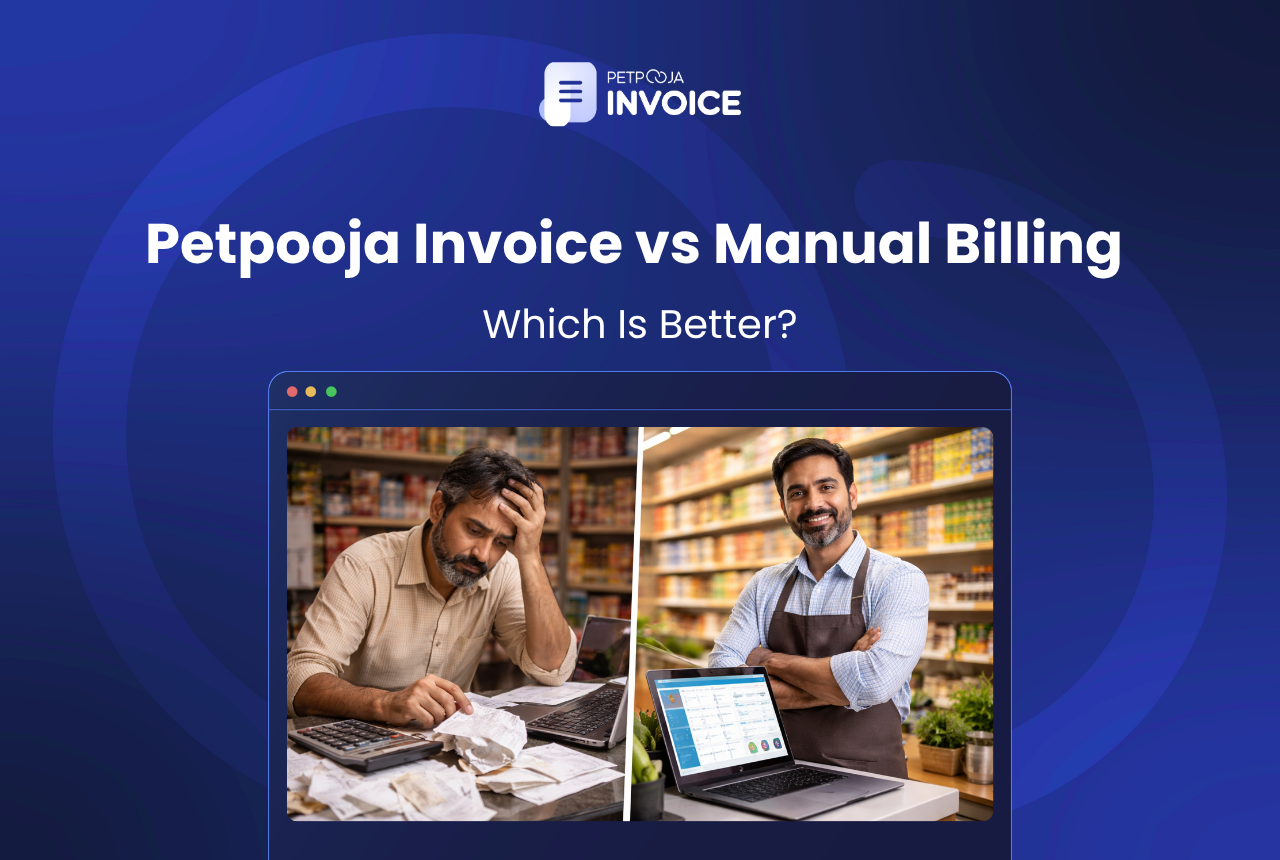
Picture this. It’s 9 PM, and you’re sitting behind the counter of your garment store in Surat. You’ve got a notepad with the day’s sales, a WhatsApp thread full of credit reminders, and an Excel sheet that hasn’t been updated since Tuesday. Sound familiar?
Here’s the honest take: if your store handles more than 20-30 transactions a day, manual billing is costing you real money. Petpooja Invoice wins this comparison on speed, GST accuracy, and inventory control. According to Superworks (2024), 41% of Indian companies face billing or payroll errors every year. Most of those errors come from manual processes that software could handle in seconds.
So let’s break down exactly where manual billing falls short, and what switching to billing software actually looks like for an Indian retail store.
Key Takeaways
- Manual billing costs retail stores roughly 3.75 hours daily in repetitive tasks like invoicing, stock updates, and Tally entry.
- 41% of Indian companies face billing errors each year, primarily from manual data handling (Superworks, 2024).
- Petpooja Invoice starts at ₹8,500 + GST per year with built-in GST invoicing, E-invoices, and E-way bills.
- Stores doing 20+ daily transactions benefit most from switching to billing software.
- Automatic Tally sync eliminates double data entry, one of the biggest pain points for Indian retail owners.
What Does Manual Billing Actually Cost You?
India’s retail market is valued at US$ 952 billion (IBEF, 2024). Yet most of the country’s estimated 13 million kirana and retail stores still rely on handwritten bills and register books (Invest India). The gap between market size and billing maturity is staggering.
Manual billing doesn’t just feel slow. It actively drains your business in five ways that most store owners don’t even track.
1. Time wasted on repetitive tasks
A single handwritten invoice takes 3-5 minutes. With billing software, the same invoice takes about 30 seconds. Multiply that across 50 daily bills, and you’re losing over two hours just on invoicing. That’s time you could spend with customers or managing suppliers.
2. GST calculation errors
Calculating CGST, SGST, and IGST by hand is asking for trouble. Different products carry different tax rates, 5%, 12%, 18%, or 28%. One wrong entry, and you’re either overcharging the customer or underpaying the government. Both lead to problems. For context, the Government of India has been tightening GST compliance requirements steadily since 2017.
3. Inventory blind spots
You sold 14 units of a product today. But did your stock register get updated during the afternoon rush? Probably not. Manual inventory tracking creates a permanent gap between what your register says and what’s actually on your shelves.
4. Zero sales insights
Which product is your best seller this month? Which items haven’t moved in 60 days? With manual billing, answering these questions means hours of digging through registers. Most store owners simply don’t bother, and that’s a missed opportunity.
5. Double data entry into Tally
This one frustrates almost every retail owner we’ve spoken to. You write the bill by hand. Then you enter the same data into Tally or Excel at night. It’s the same information, entered twice. Every extra entry is another chance for errors.
Nearly four hours a day. That’s half your working morning gone on tasks that software handles automatically. Is that really the best use of your time?
How Does Petpooja Invoice Replace All of That?
Petpooja Invoice is a GST billing and inventory management solution built specifically for Indian retail businesses. It’s already used by 8,000+ stores and is part of the wider Petpooja ecosystem that powers over 1,00,000 businesses across India. With 14+ years in the market, Petpooja is one of the most established names in Indian SME software.
Trusted customers include AhAs, Ginger & Nuts, Computron, Mangalam, and Swaroopa Reddy. Pricing starts at ₹8,500 + GST per year.
Here’s what the software actually covers.
GST Billing with E-Invoices and E-Way Bills
GST compliance isn’t an add-on here. It’s built into the core product. You select products, and the system applies the correct GST rates automatically. Need to generate an E-invoice or E-way bill? It happens right from the billing screen. No separate portal, no extra steps.
Centralised Inventory That Updates Automatically
Every sale deducts stock in real time. So when a customer in your Ahmedabad store buys five units, the inventory count updates instantly. No manual register entry needed. You always know what’s in stock and what needs reordering.
Barcode Scanning for Faster Checkout
Scan, bill, done. Barcode scanning cuts billing time to a few seconds per item. For stores with hundreds of SKUs, like electronics shops or supermarkets, this feature alone saves hours each week. It also eliminates pricing mistakes that come from manual lookups.
CRM and Loyalty Programmes
Want to know who your repeat customers are? Petpooja Invoice tracks purchase history and lets you run loyalty programmes. A garment store in Jaipur, for example, could offer returning customers a discount after their fifth purchase. This keeps buyers coming back without you needing a separate CRM tool.
WhatsApp Integration for Invoices and Reports
Send invoices directly to customers on WhatsApp. No printing, no paper waste. You can also receive daily sales reports on WhatsApp, so you don’t even need to open the software to check how your day went. Convenient for store owners always on the move.
AI Productivity Suite
The AI features help you spot trends, flag slow-moving inventory, and generate quick business summaries. It’s not some flashy gimmick. It’s practical intelligence that helps you make better buying and pricing decisions without staring at spreadsheets.
Tally Integration
This is the feature that retail owners in India care about most. Petpooja Invoice syncs directly with Tally, so your sales, purchases, and inventory data flow automatically. No double entry. No end-of-day data punching. Your accountant will thank you.
Cloud Access and Mobile App
Check your store’s sales from anywhere. Whether you’re at home, travelling, or managing a second outlet across town, the cloud dashboard and mobile app keep you connected. You don’t need to be physically present at the shop to know what’s happening.
Multi-Counter Billing
Running a busy supermarket with two or three billing counters? Petpooja Invoice supports multi-counter setups. All counters feed into the same centralised system, so inventory stays accurate and reports stay unified. No conflicting data between counters.
Business Intelligence Reports
You get detailed reports on sales trends, product performance, stock movement, and profit margins. These aren’t just numbers on a screen. They’re the insights that help you decide what to stock more of, what to discount, and what to stop ordering altogether.
Petpooja Invoice vs Manual Billing: Side-by-Side Comparison
Here’s how the two approaches stack up across the features that matter most to Indian retail stores.
| Feature | Manual Billing | Petpooja Invoice |
|---|---|---|
| GST invoicing | Calculate tax rates manually for each bill | Auto-applies correct CGST/SGST/IGST rates |
| E-invoice and E-way bill | Generate separately on government portal | Built-in, generated from the billing screen |
| Inventory updates | Update stock register by hand after sales | Real-time automatic deduction on every sale |
| Barcode billing | Not possible | Scan and bill in seconds |
| Payment tracking | Cash register and manual notes | Automatic tracking of cash, UPI, card payments |
| Expense recording | Separate notebook or Excel sheet | Logged within the same system |
| Tally integration | Enter all data manually into Tally | Direct sync, no double entry |
| Sales reports | Flip through registers, calculate by hand | Instant reports with charts and filters |
| Multi-outlet support | Separate registers per store, no unified view | Centralised dashboard across all outlets |
| WhatsApp integration | Not available | Send invoices and receive reports on WhatsApp |
The pattern is clear. Every task that takes minutes (or hours) with manual billing takes seconds with software. And every data gap that exists with pen-and-paper disappears when the system tracks everything automatically.
When Should You Make the Switch?


The India POS terminals market is growing rapidly, with increasing adoption among small retailers (Mordor Intelligence, 2024). However, not every store needs to switch today. Here’s a simple decision framework.
Manual billing might still work if:
- You process fewer than 10 bills per day
- You sell only 1-2 product categories
- You don’t need GST invoices
- You’re a solo operator with no staff
You should switch to Petpooja Invoice if:
- You handle 20+ transactions daily
- You need GST-compliant invoices with correct tax breakdowns
- You run multiple counters or outlets
- You want inventory that updates without manual effort
- You’re tired of entering the same data into Tally every night
- You want sales insights without digging through registers
The catch: most Indian retail stores that start with manual billing don’t switch until a problem forces them to. A GST audit, a big stock mismatch, or a costly billing error. Don’t wait for the crisis. If you’re already feeling the strain, that’s your signal.
For a more detailed look at how to evaluate billing software, check out this complete guide to picking the best billing software. While it’s written for restaurants, the evaluation criteria apply to retail stores too.
We’ve seen that stores making the switch typically notice the difference within the first week. Faster billing, fewer errors, and a much calmer end-of-day routine.
Should Your Store Switch to Petpooja Invoice?
Manual billing had its place. For decades, Indian retail stores ran perfectly well on pen, paper, and carbon-copy invoice books. But the requirements have changed. GST compliance is stricter. Customers expect digital receipts. Inventory management can’t rely on end-of-day guesswork anymore.
If your store does more than 20 transactions a day, Petpooja Invoice is the practical upgrade. It handles GST billing, E-invoicing, inventory, Tally sync, CRM, and multi-counter operations, all from one platform at ₹8,500 + GST per year.
Ready to make the switch? Contact the Petpooja Invoice team at +91- 92279 80766 or email getinvoice@petpooja.com to explore features and request a demo.
Frequently Asked Questions
Petpooja Invoice starts at ₹8,500 + GST per year. That works out to roughly ₹700 per month. For comparison, the time you save on manual billing alone, nearly 3.75 hours a day, makes the cost negligible. You can reach the sales team at +91-63571 92024 for a custom quote based on your store’s needs.
Yes, and it’s simpler than you’d think. The onboarding team helps you import your existing product catalogue, customer data, and opening stock balances. You don’t lose your historical data. Most stores complete the migration within a few days, depending on the catalogue size.
Petpooja Invoice is cloud-based, so it works best with an internet connection. However, basic billing functions can continue during brief connectivity gaps. Your data syncs automatically once you’re back online. For stores in areas with unstable internet, a simple mobile data backup is usually enough.
Technically, yes. Small businesses below the GST registration threshold can still issue manual bills. But once you’re GST-registered, you need to maintain proper tax invoices with correct formats and calculations. Doing that by hand consistently, without errors, is where most stores struggle. Software removes that risk entirely.
Most stores are up and running within 1-2 days. The setup includes adding your product catalogue, configuring tax rates, and connecting your barcode scanner. Petpooja’s support team handles the heavy lifting, and they offer 24×7 multilingual assistance if anything comes up.
Absolutely. Multi-outlet support is one of the core strengths. You get a centralised dashboard that shows sales, inventory, and reports across all your stores. Whether you run two outlets in Pune or five across Maharashtra, everything stays connected through one system. For understanding how POS systems simplify multi-location management, this guide is worth a read.


