


The shift towards digital payroll systems has accelerated among SMEs in India over the past few years. As businesses move away from paper-based registers & spreadsheet-driven salary calculations, the demand for structured payroll software has grown significantly. Modern attendance and payroll software now plays a central role in ensuring transparency, compliance, and workforce accountability.
Among the many payroll software companies in India, businesses often search for the best payroll software for small businesses in India that balances cost, compliance, and attendance accuracy, especially when comparing fixed subscriptions with per-employee pricing models. Whether implemented as a structured salary management system or as part of a broader HRMS for small businesses, payroll software must align with operational realities. Petpooja Payroll and PagarBook are two such solutions frequently considered by growing SMEs.
What Are the Key Differences Between Petpooja Payroll and PagarBook?
While both platforms serve as payroll software solutions for SMEs, their approach to attendance control, pricing and system functionality varies. A closer look at these differences clarifies which solution may be better suited to your business needs.
Petpooja Payroll
Key Features
- Centralised attendance‑linked payroll processing across multi‑outlet teams
- Consolidated attendance capture from web + app + biometric sources
- Auto PF, ESI & statutory calculations with compliance reporting
- Cross‑location payroll synthesis for distributed workforces
- Advanced rule enforcement (overtime, shift swaps, multi‑punching)


Best For
Shift‑based and multi‑location SMEs where:
- payroll reconciliation requires central consolidation,
- attendance data comes from different outlets or work sites,
- supervisors need a unified payroll view across teams.
This makes Petpooja Payroll well‑suited for businesses operating:
- retail or franchise chains,
- field staff or service delivery teams,
- distributed outlets where attendance handling is fragmented.
Limitations
- Not as lightweight or minimal as mobile‑first payroll apps
- Limited deep HR suite like onboarding or performance management
- May include more configuration for multi‑location payroll admins
P.S.: For a more detailed look at how payroll requirements differ in restaurant environments, you may refer to the restaurant payroll software comparison in India.
Pagarbook
Simple, mobile-first payroll built for small teams.
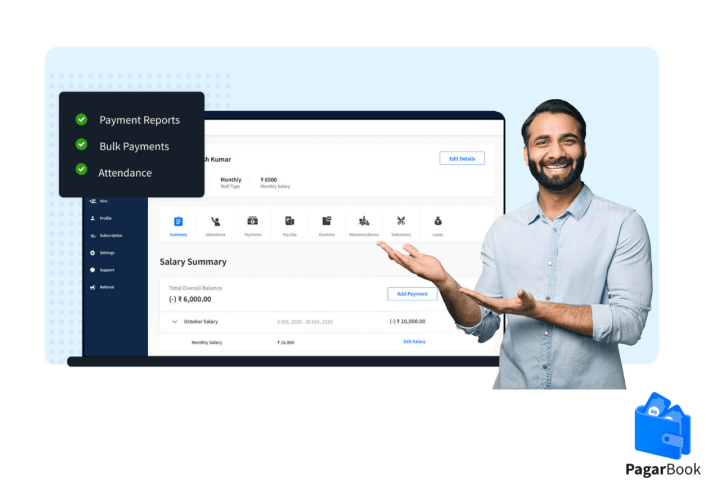
PagarBook focuses on ease of use and quick setup. It is designed for small businesses that need straightforward attendance tracking and salary calculation without complex configurations.
It keeps payroll lightweight and accessible.
Key strengths:
- Very easy onboarding and setup
- Mobile-based attendance tracking
- Basic payroll and deduction management
- Suitable for non-technical users
Limitations:
- Limited advanced payroll structuring
- Basic reporting depth
- Not ideal for complex compliance scenarios
- May require manual oversight as teams grow
Best for: Micro and small SMEs seeking simplicity over structure.
Pricing Comparison: Fixed Subscription vs Per-Employee Model
Pricing structure plays a crucial role when selecting payroll management software. While both Petpooja Payroll and PagarBook operate within the payroll software space, their cost models differ significantly, affecting how the payroll software price in India scales as your team grows.
For businesses using payroll as a core salary management system, pricing predictability becomes especially important when workforce size fluctuates.
| Criteria | Pagarbook | Petpooja Payroll |
| Pricing Model | Per employee (annual) | Fixed annual subscription |
| Base Price | ₹699/employee/year | ₹8,000/year + GST (unlimited employees) |
| Billing Frequency | Annual | Annual |
| 10 Employees (Total Cost) | ₹6,990 | ₹8000 + GST |
| 50 Employees (Total Cost) | ₹34,950 | ₹8000 + GST |
| 100 Employees (Total Cost) | ₹69,900 | ₹8000 + GST |
| Cost Behaviour as Team Grows | Increases linearly | Stays fixed |
| Multi-Location Support | Basic | Built for multi-outlet businesses |
| Compliance Handling (PF/ESI/Statutory) | Limited automation | Structured compliance support |
| Impact of Adding Employees Mid-Year | Additional per employee charge | No cost change |
How Does Payroll Cost Behave as Your Business Grows?
Pricing alone does not determine the right payroll software. What matters more is how that pricing behaves as your team expands. Global research shows that small businesses are increasingly adopting scalable payroll systems as they grow.
For SMEs planning to hire seasonal staff, expand to new outlets, or increase workforce size over time, per-employee pricing models can lead to incremental cost increases each year. While manageable for smaller teams, this structure may require recurring budget adjustments as the organisation grows.
In contrast, a fixed annual subscription model offers cost predictability. Once subscribed, adding employees does not change the overall payroll software price in India for that year. For SMEs treating payroll as a long-term salary management system rather than a short-term tool, this predictability can reduce budgeting pressure.
The right choice depends on your growth plans:
- Stable team size with minimal expansion → Per-employee pricing may remain manageable.
- Growing workforce or multi-location expansion → Fixed pricing offers long-term cost clarity.
5 Practical Points to Evaluate Before Choosing Payroll Software
1. Attendance Dependency
- If your salaries depend heavily on:
- salaries depend heavily on:
- Shifts
- Overtime
- Late penalties
- Multiple punch-ins
- Then attendance-linked payroll becomes critical. If attendance rules are simple, lightweight payroll may work.
2. Workforce Growth Plan
- Are you planning to:
- Hire seasonal staff?
- Expand to new locations?
- Increase workforce size in the next 12-18 months?
- If yes, evaluate how pricing behaves as headcount increases.
3. Compliance Exposure
- Businesses under PF/ESI scrutiny or regular audits may require:
- Automated statutory calculations
- Structured reporting
- Compliance-ready documentation
- Simpler setups may not require advanced automation.
4. Operational Complexity
- Ask yourself:
- Is payroll handled centrally?
- Do managers manually share attendance?
- Are corrections frequent at month-end?
- The more manual coordination involved, the more structured the system needs to be.
5. Budget Predictability
- Does your business prefer:
- Variable cost per employee? Or
- Fixed yearly budgeting?
- This often determines long-term comfort.
Frequently Asked Questions
SMEs should evaluate team size, shift complexity, compliance needs and whether attendance directly impacts salary calculations before selecting payroll management software.
Most modern payroll software companies in India provide automated PF and ESI calculations, though the level of compliance automation may vary by platform.
Mobile-first payroll apps may suit very small teams with simple attendance structures, whereas structured payroll systems become important as workforce size, shift complexity, or compliance exposure increases.
Fixed pricing offers cost predictability, while per-employee pricing may be suitable for very small teams. The better model depends on expected workforce growth.
Cloud payroll software typically includes encrypted data storage and controlled access, making it suitable for handling sensitive employee payroll management system data.


