


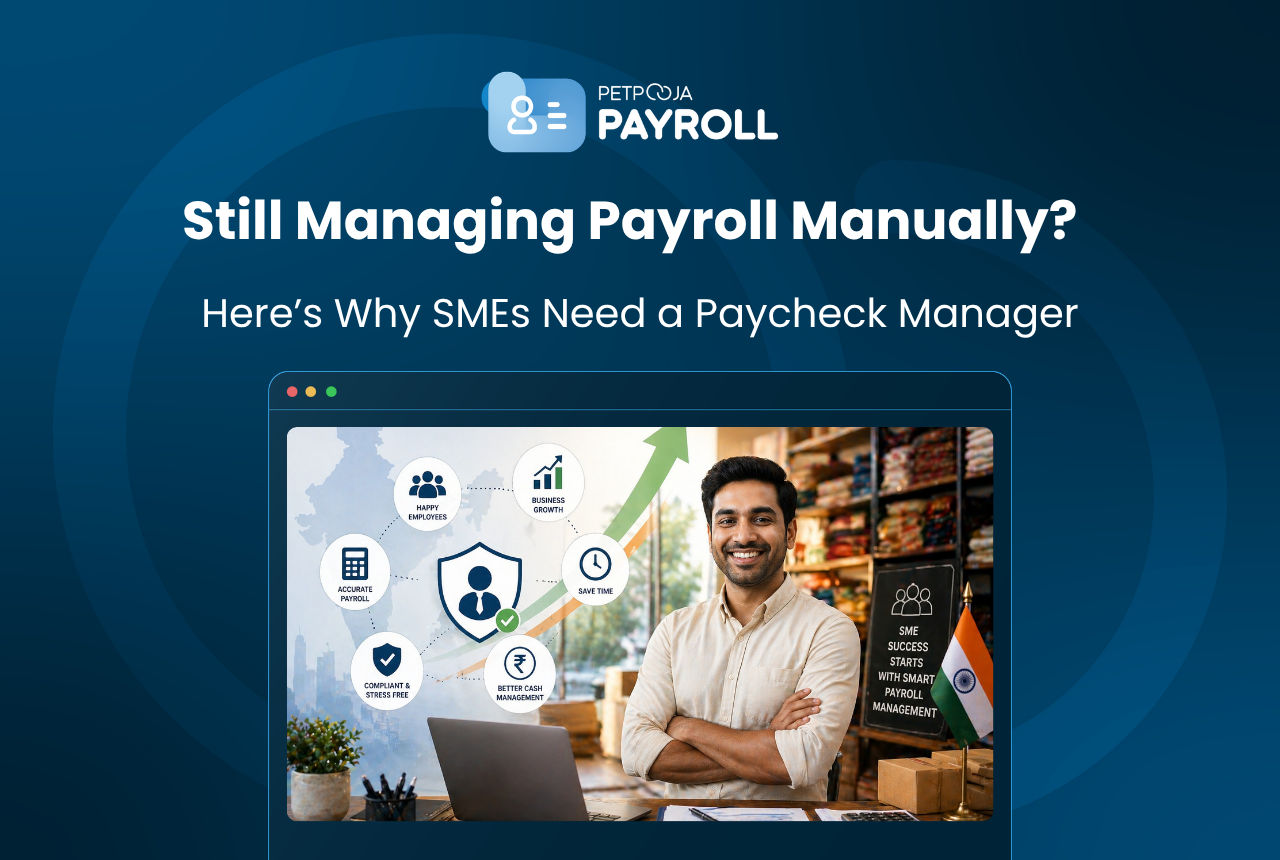
Every Indian SME with 20+ employees needs a paycheck manager. Manual payroll eats 3-5 working days per month, breeds compliance errors that attract penalties up to ₹3 lakh, and generates payslip complaints that push good employees out the door. Software handles the entire cycle in under two hours at a fraction of the cost.
Consider what happens without one. For example, a packaging unit in Bhiwandi with 45 workers running payroll on Excel might not catch a PF miscalculation on overtime pay for 14 months, until an EPFO inspection triggers a damages notice of ₹4,18,000. Or a diagnostic chain in Vizag where three lab technicians resign in the same week because their February payslips showed ₹1,800 less than expected, and nobody could explain why until the accountant spent two days retracing the formulas.
Paycheck management software exists to take that risk off the table. It automates salary calculation, statutory compliance, attendance sync, payslip generation, and return filing, and it costs less than what most SMEs spend on printer cartridges in a year.
TL;DR: Manual payroll breaks at 20+ employees. Errors compound into compliance penalties (up to ₹3 lakh for ESIC alone), employee complaints, and wasted admin days. Software fixes all four problems at a flat annual fee.
Key Takeaways
- 49% of Indian companies reported payroll errors in the past year, with PF miscalculation being the most common trigger (Business Standard, 2026)
- Manual payroll consumes 3-5 working days per month for teams of 30-80 employees
- The 2025 Labour Codes increased non-compliance penalties by 10-100x compared to old laws
- Payslip errors are the #1 reason for salary-day complaints in SMEs with manual processes
- Software like Petpooja Payroll charges a flat annual fee (no per-employee pricing) and handles the entire cycle in under two hours
What Does Manual Payroll Actually Cost Your Business?
The cost of manual payroll isn’t just the accountant’s salary. It’s the three to five working days that person spends locked into the payroll cycle every single month, the errors that slip through because Excel doesn’t flag a PF threshold crossing, and the penalty notices that arrive six months after the mistake was made. According to HROne’s analysis of Indian payroll operations, the average cost per payroll error in India is approximately ₹50,000 when you factor in back-payments, interest, and the admin hours spent correcting it.
Consider a mid-sized scenario. A furniture manufacturer in Rajkot with 55 employees: 40 on the shop floor (daily wages plus overtime), 10 in the office (fixed monthly salary), and 5 on contract. The owner’s brother-in-law handles payroll in Excel. Each month he:
- Collects attendance from a register kept by the floor supervisor
- Manually calculates overtime at 2x for hours beyond the 48-hour weekly cap
- Applies PF on basic for permanent staff, skips it for contract workers (hoping they stay below the threshold)
- Calculates ESIC for employees under ₹21,000 gross, but only rechecks thresholds in April
- Creates individual payslips in a Word template, changing names and numbers one by one
- Types NEFT details into the bank portal for each employee
That is four days of work. Every month. Twelve times a year. And one miscalculation in July doesn’t get caught until the PF inspector visits in January.
Problem 1: Compliance Errors That Turn Into Penalties
The 2025 Labour Codes didn’t just rename old regulations. They increased penalty amounts by 10 to 100 times compared to the previous framework and introduced mandatory digital record-keeping for all establishments with 10 or more employees (Mondaq, 2026).
What this means for an SME doing payroll manually:
| Compliance Area | Common Manual Error | Potential Penalty |
|---|---|---|
| PF (EPFO) | Wrong wage base for PF calculation | 12% interest p.a. + 5-25% damages on arrears |
| ESIC | Missing the ₹21,000 threshold crossing | Up to ₹3 lakh + back payments + imprisonment |
| TDS | Wrong regime applied (old vs new) | Interest at 1-1.5%/month on shortfall |
| Professional Tax | Using wrong state slab after employee transfer | State-specific penalty + interest |
| Minimum Wages | Not updating state minimum wage revision | Back-pay for entire underpaid period |
A real pattern we’ve seen across 30,000+ Petpooja Payroll clients, including L&T, Zepto, ISKCON, and Mapro: SMEs don’t get penalised for one big violation. They get penalised for dozens of small miscalculations that pile up over 12-18 months until an inspection triggers a consolidated demand notice. By then, interest and damages often exceed the original shortfall.
For a detailed breakdown of the most common mistakes, read our 9 payroll mistakes Indian SMEs make.
Why Does the Payroll Cycle Stall Every 28th?
Every SME owner knows the feeling. It’s the 28th. Salaries must hit bank accounts by the 1st. The accountant is still reconciling attendance for the second week of the month because the supervisor’s register had three entries scratched out and rewritten.
Manual attendance collection is where the payroll cycle stalls most often. When payroll and attendance run on separate systems, HR teams spend hours reconciling mismatched data before salary processing can begin (Asanify, 2026).
The register says an employee was present on the 14th. The employee says he was on approved leave. The supervisor doesn’t remember. Someone checks WhatsApp messages from that week to find a leave approval. Thirty minutes spent on one employee’s one day.
Now multiply that by 55 employees across 22 working days.
A hospital in Warangal with 70 staff (nurses, ward boys, reception, lab technicians, housekeeping) used to finish payroll on the 3rd of the following month because attendance reconciliation alone took two full days. Nurses work rotating shifts. Ward boys swap duties informally. Reception staff cover for each other during festivals. None of this shows up neatly in a paper register.
Software with biometric or mobile attendance eliminates this problem. Punches record with timestamps. Shift assignments map to the roster. Leave applications flow through the app with approval trails.
By the 28th, attendance data is already sitting in the payroll dashboard, reconciled and ready. Our guide on how attendance discipline improves payroll accuracy covers this connection in detail.
How Do Payslip Errors Damage Employee Trust?
Salary-day complaints are more damaging than most business owners realise. In most Indian SMEs running manual payroll, employees receive a payslip with a final number and no breakdown of how it was calculated. When a machine operator at a textile unit in Erode sees ₹1,200 less on his payslip than last month and nobody can explain it on the spot, trust erodes.
The explanation might be legitimate (a new PF slab kicked in, or one day was marked absent instead of half-day), but if it takes three days to trace the Excel formula and provide a clear answer, the damage is done.
In manual payroll setups, the error-to-explanation cycle works like this:
- Employee notices a discrepancy on their payslip
- Employee raises it with their supervisor (who doesn’t handle payroll)
- Supervisor forwards it to the accountant or HR (who is already working on next month’s attendance)
- Accountant traces back through the Excel sheet, cross-referencing attendance, leave records, and deduction formulas
- Explanation reaches the employee 2-5 days later
With paycheck management software, the employee opens the app and sees exactly how their salary was calculated: present days, leave days, overtime hours, each deduction line item with the rate applied. No WhatsApp messages to the supervisor. No three-day wait for an answer.
What Changes When You Add Paycheck Management Software?
The three problems above share one root cause: manual data entry and manual calculations at every stage of the payroll cycle. Software removes both, and reclaims the 3-5 working days your team currently spends on the cycle every month. Across 30,000+ businesses on Petpooja Payroll, we’ve watched teams go from dreading the last week of the month to finishing the entire run in a single sitting.
The owner of a quick-commerce dark store in Aundh, Pune, with 22 delivery riders and 8 warehouse staff used to spend two days every month verifying payroll. Those days now go toward route optimisation and vendor negotiations.
At 30+ employees, manual payroll becomes a full-time function costing ₹3-4.2 lakh/year in salary alone. Payroll software does the same work for a flat annual fee that’s a tiny fraction of that cost. Our guide on manufacturing payroll automation shows how factories reclaim those days.
Here is what the monthly cycle looks like on Petpooja Payroll for a retail chain in Guwahati with 45 employees across three stores:
- Week 1-3: Attendance records itself via biometric devices. Leave applications come through the employee app. Nothing for the admin to do
- 28th: Click Process. Net pay for all 45 employees calculates in under four minutes. PF, ESIC, professional tax (Assam slabs), and TDS deductions apply from pre-configured rules
- 29th: Review the output, verify pro-rata for late joiners, check threshold flags. Finalise
- 30th: Payslips go out via WhatsApp. NEFT bank file downloads in HDFC’s format. ECR file generates in one click. Salaries credit by the 1st
Total time: about 90 minutes. One manager, one dashboard.
Who Needs This the Most?
Not every business is suffering equally from manual payroll. The pain is sharpest in three types of SMEs:
Businesses with mixed workforce types. A construction company in Mehsana with salaried engineers, daily-wage labourers, and piece-rate workers runs three different payroll logics. Excel formulas that work for salaried staff break when applied to daily-wage calculations with overtime and ESI eligibility checks.
Multi-location operations. A bakery chain with outlets in Raipur, Nagpur, and Indore needs attendance from three locations, state-wise professional tax for Chhattisgarh, Maharashtra, and Madhya Pradesh, and one consolidated payroll run. On spreadsheets, that’s three attendance files, three PT slab lookups, and a merge nightmare on the 28th.
Growing teams crossing compliance thresholds. When a startup in HSR Layout, Bangalore, grows from 9 to 12 employees, they cross the PF threshold. At 20, ESIC kicks in. At 50, gratuity applies. Each threshold introduces a new statutory obligation that manual payroll either misses or handles late. The 2025 Labour Codes tightened the penalties for crossing these thresholds without registering (Patron Accounting, 2026).
If you’re exploring your first payroll tool, our guide on the best payroll software for small businesses in India compares options by pricing, features, and compliance depth.
Conclusion
Manual payroll is a monthly liability disguised as a routine task. It eats 3-5 working days, breeds compliance errors that compound into five-figure penalty notices, generates payslip complaints that erode employee trust, and ties up a person (or the owner’s own time) on work that software handles in 90 minutes.
Petpooja Payroll charges a flat annual fee with no per-employee pricing, includes biometric hardware, and handles PF, ESIC, TDS, and professional tax from a single dashboard. For Indian SMEs with 10 to 200 employees, there is no business case for continuing to do payroll by hand.
Frequently Asked Questions
Manual payroll relies on Excel formulas and human memory for compliance calculations. PF rates, ESIC thresholds, state-wise professional tax slabs, and TDS regime rules all have specific conditions that change periodically. A single miscalculation compounding over 12 months can result in penalty notices exceeding ₹4-5 lakh, including interest and damages from EPFO and ESIC.
For teams of 30-80 employees, manual payroll typically consumes 3-5 working days per month. This includes attendance reconciliation (1-2 days), salary calculation and verification (1 day), payslip preparation (half day), and bank file creation plus statutory filing (half day). Payroll software reduces this entire cycle to under two hours.
A paycheck manager is software that automates the monthly salary cycle: attendance tracking, salary calculation, PF/ESIC/TDS deductions, payslip generation, bank file creation, and statutory return filing. Indian SMEs need it because the 2025 Labour Codes introduced mandatory digital record-keeping and increased penalties for non-compliance by 10-100x.
Pricing models vary widely. Petpooja Payroll uses a flat annual fee with no per-employee charges and includes biometric hardware. Other platforms charge per employee per month, which adds up fast as your team grows. For SMEs with 10-100 employees, flat-rate tools offer the best value. Compare options in our best paycheck management software comparison.
Yes. Most payroll tools support multi-location setups with state-specific professional tax, minimum wage, and Labour Welfare Fund configurations. Petpooja Payroll handles attendance from biometric devices at each location, applies the correct state slabs, and generates a consolidated payroll for all branches from a single dashboard.


