Indian SMEs with multiple branches often discover the same hidden problem: as soon as you add more locations, payroll quietly becomes one of the most time‑consuming, error‑prone tasks in the business. Different outlets follow different processes, data lives in scattered Excel sheets and one delayed attendance file can hold up salaries for everyone. Centralised payroll is how growing businesses bring order to this chaos…improving efficiency, compliance and transparency across all locations.
Here we explain the payroll challenges multi‑outlet Indian SMEs face, what centralised payroll actually means, the features you should look for, how to implement it step by step and which tools are helping Indian businesses make the switch.
What is centralised payroll?
Centralised payroll is a model where a single system and process handle payroll for all branches and outlets of a company, instead of each location running its own local payroll.
In a decentralised or branch‑level setup:
- Each outlet calculates salaries independently.
- Attendance, leaves, and overtime are handled locally.
- Head office has to consolidate later, or only sees summary numbers.
In a centralised setup:
- Attendance from all outlets flows into one system.
- Payroll is processed once for the entire organisation, with outlet‑wise breakdowns.
- Rules for salary, deductions, and compliance are defined centrally and applied consistently.
Key differences:
- Control: Centralised payroll gives head office or HR full control over rules and approvals.
- Visibility: Management can see payroll cost, headcount, and trends per location.
- Standardisation: All outlets follow the same policies, formats, and schedules.
Features That Actually Make a Difference
When you start looking at centralised payroll systems, don’t get lost in jargon. Focus on tools that make real life easier:
- Biometric or app‑based attendance syncing from all locations.
- Automatic compliance with PF, ESI, and state‑specific labour laws.
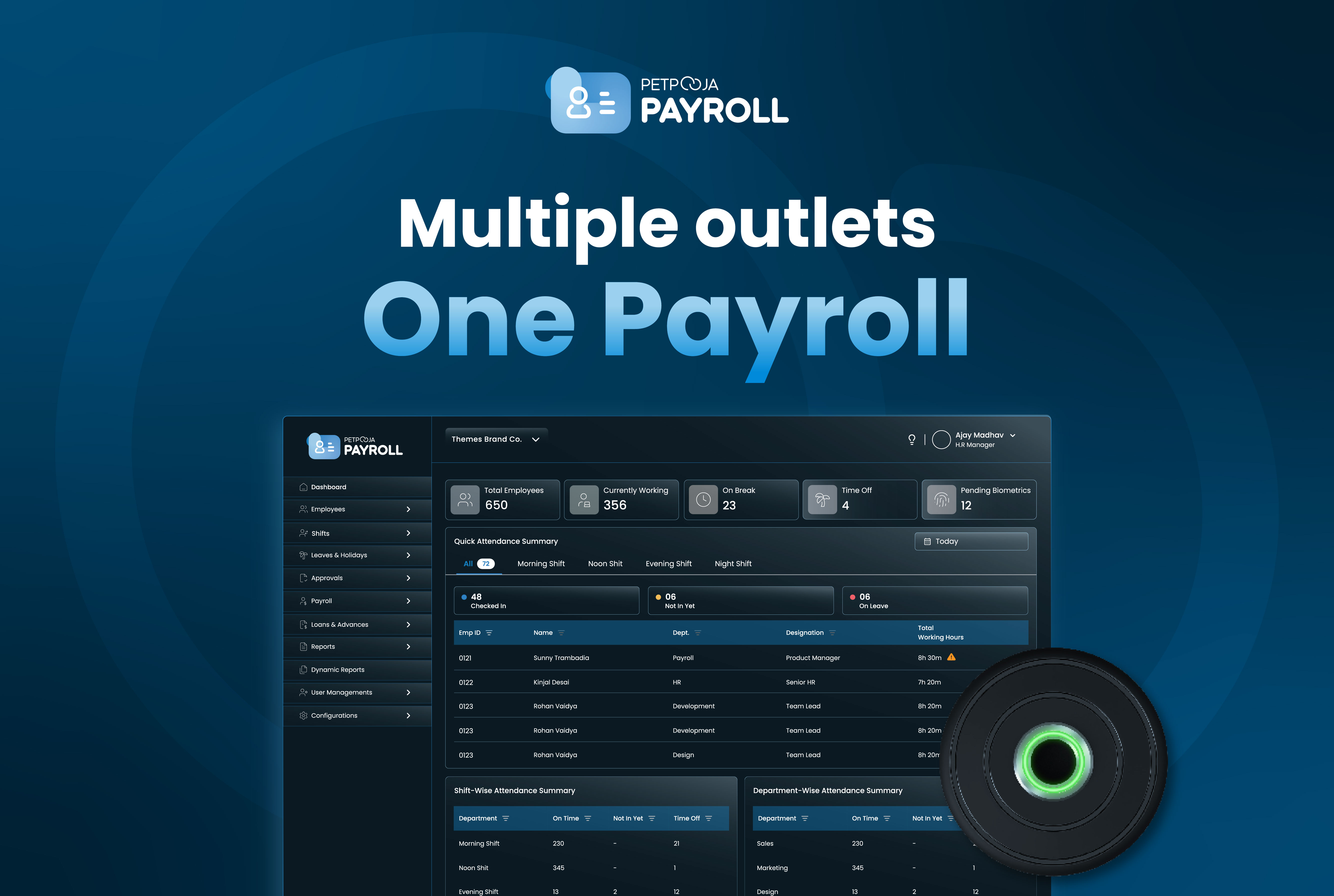
- Real‑time dashboard showing payroll status for every outlet.
- Employee self‑service portal for payslips and leave requests.
The goal isn’t just digital transformation … it’s simplicity.
How It Works in Real Life
Picture this: you’re opening a new outlet in Nashik and instead of weeks of setup headaches, it’s live in minutes. Modern centralised systems make multi-outlet management feel straightforward … no IT drama, just results. Here’s how it changes the daily grind:
- Add New Outlets in Minutes … Connect a biometric device, onboard staff and that branch syncs attendance automatically. No waiting for specialists.
- Give Managers Smart Access – Branch leads see only their data; head office gets the full view. Privacy stays intact, control stays right.
- Move Employees Seamlessly – Shifting someone from Pune? Their profile, leave balance, and tax calc update in one click.
- Stay Compliant Effortlessly – State law changes? The system adapts instantly across branches. Audit-ready filings in clicks.
- Run Payroll in Hours – Morning syncs attendance, flags gaps, and processes everything company-wide from days of chasing to a quick afternoon wrap-up.
I remember talking to an Ahmedabad restaurant owner who made the switch. “It was like someone turned off the fire alarm that had been blaring in my head every month,” he laughed.
The Real Outcomes for SMEs
- 90% less admin time each month.
- One-click payroll for all locations.
- Staff transfers are managed in seconds ….leave balances, advances, history all move automatically.
- No rogue spreadsheets, no “Did Branch 2 file PF this month?” uncertainty.
- Predictable costs, no matter how fast you grow.
A Step‑by‑Step Shift to Centralised Payroll
- Map your current process. Note where delays or confusion usually happen.
- Choose one system for attendance and payroll not one per outlet.
- Standardise your data formats so every location reports the same way.
- Test the system with one branch first, then scale to others.
- Train your managers. The best system still needs people who know how to use it confidently.
It’s a shift, yes. But it’s a one‑time change that pays back every single month.
How Petpooja Payroll Solves the Biggest Pain in Multi‑Outlet Payroll
Most payroll software charge per employee at every outlet, which seems fine until your headcount explodes ….then your costs spiral.
With Petpooja Payroll, you pay once per outlet and add as many employees as you like without ever seeing your price jump.
Why Is This Different?
- Fixed Per-Outlet Pricing: Your 10th branch costs just like the first….software, hardware, setup all included.
- Unlimited Employees: Hire 15 more people at any branch? No extra charges. Payroll fee stays the same.
- Hardware Included: Biometric attendance devices come bundled….no hidden costs or device surprises later.
- Low, Predictable Recurring Fees: After year one, you pay just a nominal annual renewal (not 10x your headcount).
- No “ Per-Head SaaS Shock ”: Other companies may offer a low starting price, but then charge ₹30 to ₹60 per worker each month.
For 10 stores with 25 workers, that’s ₹3,000–₹6,000 every month. That adds up to ₹36,000 -₹72,000 every single year. If you hire more people, your costs double.
Let’s Compare Real Costs (10 outlets):
| Model | Year 1 Cost | Year 2+ Annual Cost | 10 Branches, 25 Staff | 10 Branches, 80 Staff |
| Petpooja Payroll | ₹7,000/branch (incl. hardware)Total: ₹70,000 | ₹2,500/branchTotal: ₹25,000 | Unlimited (still ₹25K) | Unlimited (still ₹25K) |
| Per-Employee SaaS | ₹0 in hardware | ₹30/employee/month × 250 = ₹7,500/moYear: ₹90,000 | ₹90,000/yr | × 800 = ₹2,88,000/yr |
| Big Brand HRMS | ₹50-60/employee/mo incl. support | ₹50/emp/mo × 800 = ₹40,000/mo₹4,80,000/yr | ₹1,50,000/yr | ₹4,80,000/yr |
The Indian SMEs Already Doing It Right
Plenty of businesses are already making this transition. Multi‑city restaurants, small manufacturing units, retail chains …. all have found that centralising payroll gives them surprising freedom.
One Ahmedabad food chain shared how, after integrating a centralised system, salary preparation time dropped from 3 days to just a few hours. “It used to take half our energy,” the owner said, “now it’s just another Tuesday task.”
Conclusion
Behind every payslip is a story. A tuition fee waiting to be paid. A family dinner planned for the 1st of the month. When salaries arrive late, it isn’t just a clerical issue … it’s personal. That’s why getting payroll right matters so much. It’s not just efficiency; it’s respect.
And for SMEs that are growing, centralised payroll isn’t about software … it’s about finally feeling in control again. Ready to simplify yours? Start mapping that process today.
Frequently Asked Questions
No. Most systems, like Petpooja Payroll, allow smooth onboarding with bulk staff uploads and run in parallel with old systems for the first month ….so you’re always in control.
A good centralized platform automatically applies each location’s local compliance (PT, ESI, PF), so you never miss a statutory update ….no matter where you operate.
One-click transfer …. employee records, leave, and history move with them. No duplicate admin entries or risk of lost data.
Yes! You can provide branch-level logins so managers only see and manage their outlet, while your admin team has a birds-eye view.
Most growing Indian SMEs save between ₹2–6 lakhs per year in admin/time costs and missed penalties with the added bonus of zero “per-head” fee surprises as you hire more staff.